The Consumer Analyst Skills That Matter in the AI Age
A CMO or VP of consumer research should judge analysts by how well they frame decisions, challenge evidence, and govern the handoff from exploration to action. The question is not whether a model can produce an answer, but what an analyst must review before that answer can influence pricing, positioning, or a launch.
Without that gate, a plausible summary can become a business decision before anyone checks it against real behavior. The cost surfaces after the launch or spend is committed, when the analyst loses credibility with the stakeholders who acted on the finding.
The value of the role is moving toward judgment
The analyst role is not disappearing. The U.S. Bureau of Labor Statistics projects 7% employment growth for market research analysts from 2024 to 2034, with roughly 87,200 average annual openings (BLS Occupational Outlook Handbook).
What is changing is where the role creates value. Models can draft questions, summarize transcripts, and produce an initial reading of a stimulus. The analyst is accountable for deciding whether the question matches the business choice, whether the evidence supports the conclusion, and whether the result is safe to act on.
Five skills that protect the decision
How do you frame the business choice?
Start with the action under consideration, not the prompt: the price, message, feature, or launch decision. Then state what evidence would change that decision and how costly a false signal would be.
2. Separate exploration from validation
A generated hypothesis or a simulated experiment can help a team explore, but neither is automatic proof of consumer behavior. Analysts must label the evidence stage clearly so stakeholders do not mistake a directional result for a validated one.
How do you design a causal comparison?
Descriptive reactions are not enough when the buyer needs to choose an action. A useful study varies the action under consideration, holds the rest of the setup steady, and asks what changed. This keeps the analysis tied to the decision instead of producing a collection of plausible observations.
What should you review before a finding reaches a stakeholder?
Before a finding reaches a stakeholder, review the audience definition, question wording, assumptions, source grounding, and alternative explanations. State what the work covered, what it did not cover, and what evidence is still needed.
5. Govern the handoff to action
Define who can approve a directional finding, when real-human validation is required, and how caveats appear in the final recommendation. Expensive or public decisions deserve a stricter gate because the damage from an unchecked signal is harder to reverse.
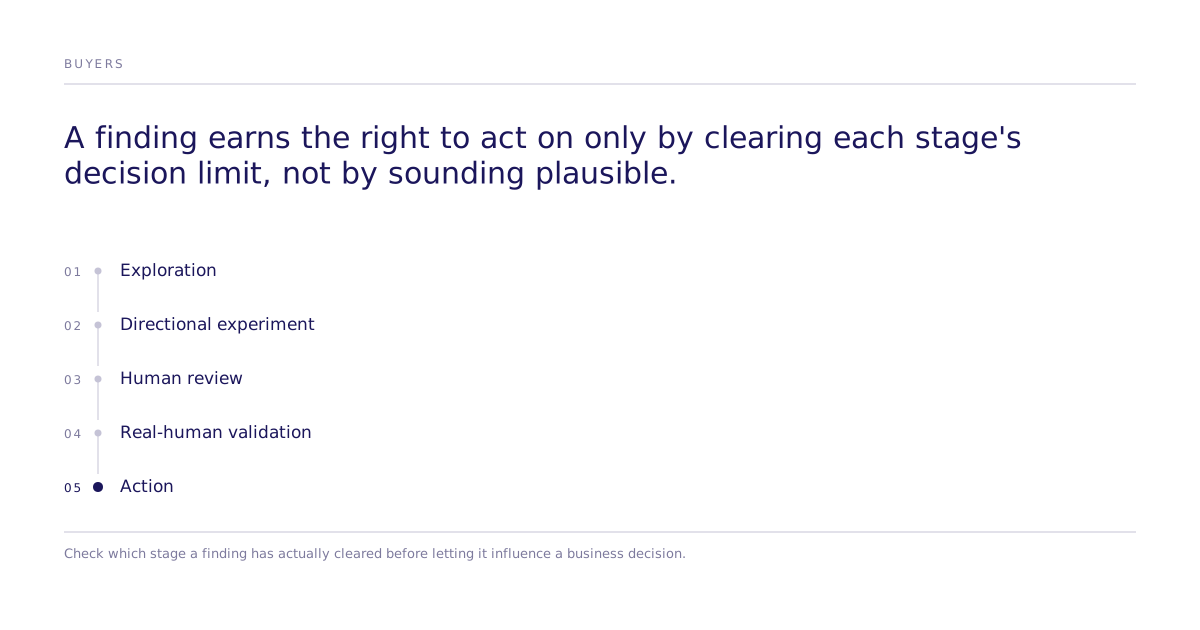
Make every stage carry a clear permission
The distinction between stages is easier to govern when each one has an explicit purpose and decision limit.
| Evidence stage | Appropriate use | Decision limit | Accountable reviewer |
|---|---|---|---|
| Exploration | Generate hypotheses and alternative explanations | Cannot support a market action on its own | Analyst |
| Directional experiment | Compare a defined action under controlled conditions | Establishes direction, not observed market performance | Analyst |
| Human review | Challenge the audience, setup, assumptions, and interpretation | Cannot repair missing evidence through judgment alone | Analyst and decision owner |
| Real-human validation | Test the same causal question with recruited participants when the stakes require it | Does not remove uncertainty about market performance | Analyst and decision owner |
This is an evidence policy, not a ranking of tools. It gives the analyst a consistent way to explain why one finding can guide the next test while another is ready to inform action.
Operationalize exploration and validation as separate stages
Subconscious is one way to operationalize the separation between a directional causal experiment and real-human validation. A team can carry the same causal question from a simulated experiment into testing with real participants. The analyst still decides whether the setup fits the business question, whether the result is credible, and whether more evidence is needed before action (how the study process works).
Causal experimentation does not eliminate the need for real-human validation on expensive or public decisions, and real-human testing does not turn a result into automatic proof of market performance.
A planning exercise for the next decision
Use the following as a one-week planning example, not as a delivery promise:
- Pick a real project tied to a live decision.
- Write the business decision in one sentence.
- Define the audience and the cost of being wrong.
- Keep generated hypotheses and a directional simulated study in the exploratory stage.
- Review the output by hand and mark what is supported, uncertain, or unsafe to repeat externally.
- Present the finding with a stated caveat and a named validation step.
Repeat that once a week for a month. The output should be a working evidence policy: a clear rule for what can guide exploration, what requires analyst review, and what must be checked with real people before the business acts.