Testing a Founder Story Before It Reaches Investors
A founder story is usually written once, in twenty minutes, and never touched again. It is also the first thing an investor reads after the deck, the first thing a journalist skims before a story, and the first thing a strong hire reads before deciding whether to leave a stable job. Publishing it untested means finding out which line cost you the meeting only after the meeting never happens.
Why does a founder story carry so much weight?
When there's no revenue, no customers, and no track record yet, the founder story has to carry the weight a product would otherwise carry. It has to do several jobs at once: establish credibility, establish motivation, establish insight, and sound like a person rather than a press release. Most drafts fail at least one of these jobs, and readers pick up on the failure in seconds. The conclusion they draw is blunt: wrong founder for this idea, or wrong idea altogether.
The founder is rarely the person who can catch this: having repeated the story internally so many times, their ear for it is gone. Research on early-stage investor evaluation points to first impressions as a persistent driver of how pitches get judged, which is why a story needs an outside read before it goes live, not after.
Five readers, five different filters
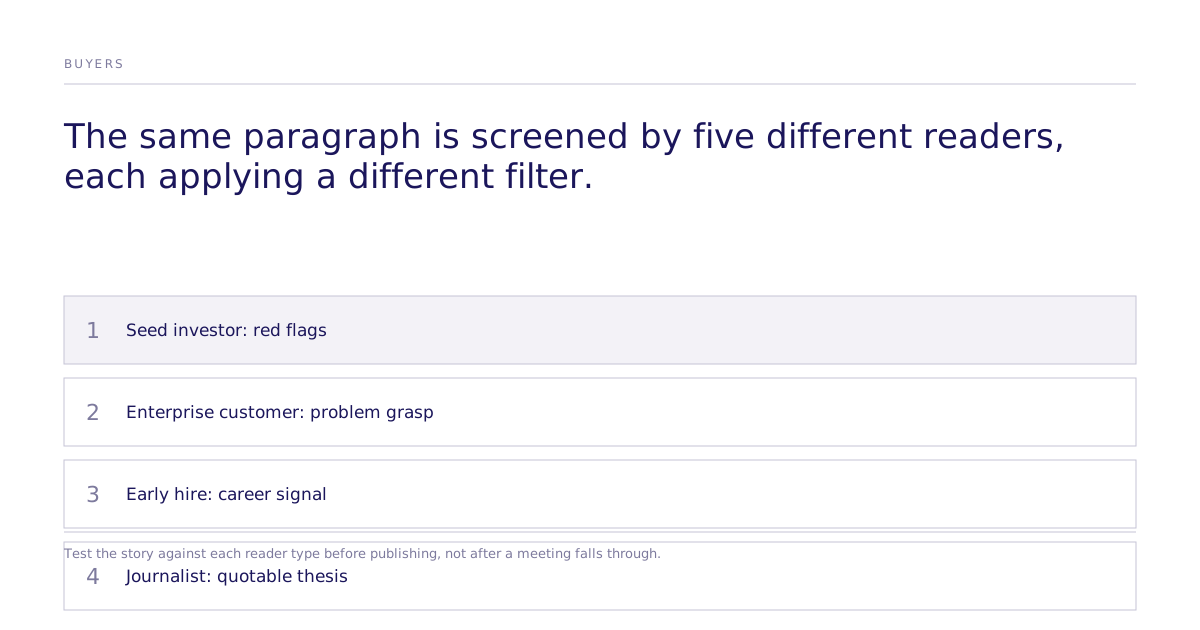
An About page or founder story is read by at least five distinct audiences, each applying a different filter:
| Reader | What they're screening for |
|---|---|
| Seed investor | Absence of red flags: right background, real stakes, the sense this founder survives the hard years |
| Design partner or first enterprise customer | Whether the founder understands their actual problem, not their pedigree |
| Early hire | Whether this is a place to build a career, and whether the copy sounds like every other startup |
| Journalist or analyst | A quotable line that can serve as the thesis of a story |
| Peer founder or operator | Whether it's compelling enough to share, the main channel for organic spread in the early months |
A strong story survives scrutiny from all five. A weak one usually survives only the last, most forgiving reader.
What does a pre-publish test actually measure?
The buyer decision here is narrow: which version of the narrative goes live, before it reaches an investor, a candidate, or a reporter. Guessing wrong doesn't produce an error message: it produces an investor who passes, a candidate who declines, or a journalist who skips the story, with no record of which line caused it.
A controlled comparison answers this before publication instead of after. It sets up two or more candidate narratives or opening paragraphs, defines respondent profiles matched to the intended reader (investor-type, operator-type, candidate-type) and measures which version moves stated interest or intent, with a result that can be rerun rather than a single subjective read from a friend.
Subconscious runs this kind of comparison against a person-level audience graph covering 800 million real people, and can extend a study from a simulated read to real human participants without changing the underlying question being tested.
Questions worth asking before a rewrite
The value of a pre-publish test is less in the verdict and more in what it forces you to ask. Four questions repeatedly separate a story that lands from one that doesn't:
- First reaction. What is the one-sentence takeaway, and does it converge across readers or scatter into five different interpretations?
- The missing piece. What question does a reader want to ask the founder that the page doesn't answer? The most common gap is "why you": the problem and the solution are established, but not why this founder is the one to solve it.
- Tone. Does the founder read as competent, arrogant, humble, or out of their depth? Tone is the hardest thing to self-evaluate and often the deciding factor in whether a reader keeps going.
- The weak line. Is there one sentence that would make a reader lose interest, a claim that feels unearned or a detail that rings false? Cutting that single line often improves the page more than any amount of additive editing.
Testing two or three opening paragraphs against each other, rather than shipping the first draft, tends to surface a different winner than the one the founder started with, usually because founders open with backstory when the reader wants the insight first.
What patterns repeat across founder stories?
A few failure modes show up often enough to check for directly: backstories that run long when readers want insight over biography; "we" language that reads as inflated when the company is still one person; category labels chosen for safety that end up making the company sound interchangeable with competitors; a team section that looks thin and undercuts credibility rather than building it; and a closing call to action that is usually the weakest paragraph on the page.
What this does not replace
A controlled narrative comparison does not write or edit the story; it tells you which version is working and where it isn't. It also does not substitute for an actual investor meeting, interview, or press conversation; it reduces the chance that a preventable line costs you the meeting before you get there.
Where to start
If an About page or founder story is already live, the same test applies before the next revision: define the reader archetypes actually reading the page, run the comparison against the current draft and one or two alternatives, and ship the version that converges best. See how a study like this runs or book time to scope one against a specific investor, hire, or press narrative you're about to publish.