AI Panel Research vs. Surveys: Use Each for the Right Question
Surveys measure responses from people in a defined sample. Simulated panels explore how modeled audiences may respond to a controlled choice or open-ended prompt.
When should you use a survey?
Use a survey when the decision requires quantitative breadth, a known answer space, and evidence from real respondents. It can estimate preference, awareness, or stated intent when the sample and instrument support the inference.
Surveys measure the questions selected for the instrument; open responses or an adaptive design can explore further detail. Low response rates can threaten sample coverage. For one benchmark, Survicate's 2025 report on 4,332 in-product surveys from 460 of its customers found a median B2B response rate of 8.18%, against 12.85% for B2C. The report defines response rate as responses divided by views, across mobile, widget and Intercom surveys, so it describes in-product survey starts. It does not describe recruited-panel completion rates or all B2B research (Survicate, 2025 Survey Response Rate Benchmarks).
When should you use a simulated panel?
Consider a simulated panel when relevant calibration supports an exploratory comparison or helps prepare a human study. Inspect audience coverage and the cost of screening errors. Retain a baseline and uncertain alternatives; a modeled shortlist can discard a useful option.
A randomized simulated experiment can produce a standard error and a significance test within the modeled response process. Statistical significance in a simulation does not by itself validate human behavior, because the interval describes the simulated respondents and not your customers. An open-ended persona session needs a defined estimand and analysis before any uncertainty calculation has a clear meaning. Fidelity depends on elicitation, calibration, audience definition, and the task. A simulation cannot replace observed behavior or primary research required by an external stakeholder.
A three-step hybrid
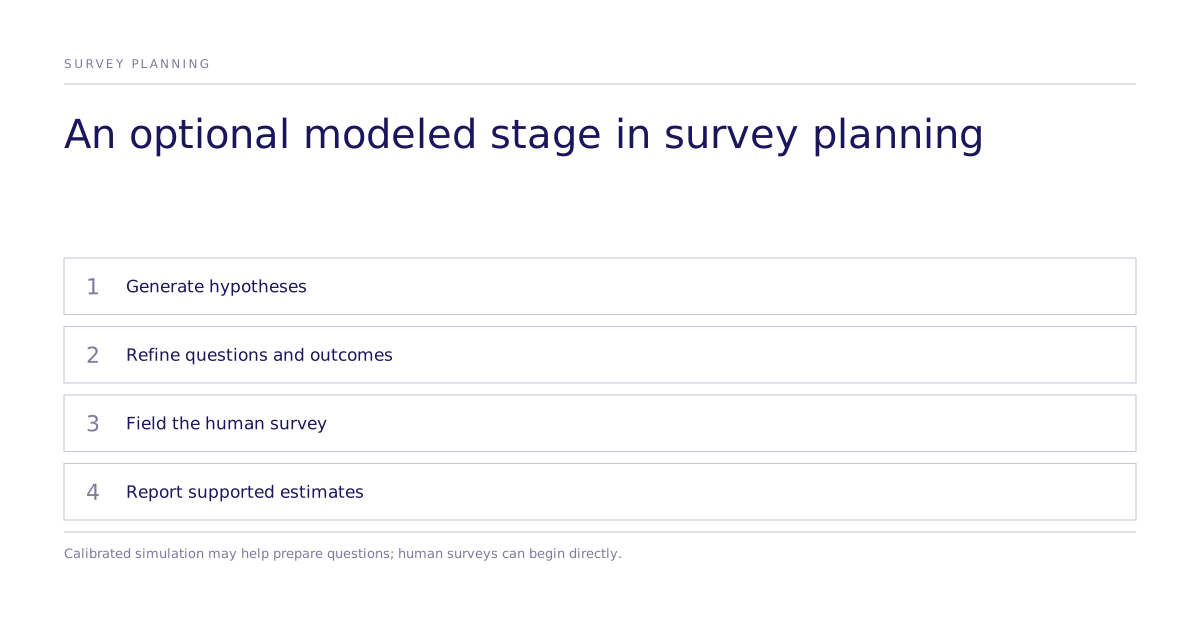
First, consider an optional modeled comparison to prepare hypotheses when calibration and coverage support it. Human research can begin directly when it answers the required question.
Second, use the findings to refine the survey. Remove ambiguous options, add missing answers, and define the behavior the survey should measure.
Third, field the survey with real respondents and quantify only what the sample and method support.
What determines cost and time?
| Method | Requirements to include in a scoped estimate |
|---|---|
| Simulated panel | Configuration, relevant calibration, task execution, review, and independent checks |
| DIY survey | Instrument design, recruitment, data collection, cleaning, and analysis |
| Full-service research agency | Agreed audience, sampling, fieldwork, analysis, and deliverables |
| Online panel survey | Eligibility, incidence, recruitment, instrument length, quality checks, and reporting |
Obtain current quotes for the actual audience, design, and deliverables. The following workflow is hypothetical, including its schedule. A team with two weeks before a pricing review runs a simulated comparison of three price points in the first days, uses the result to cut a 40-question survey to the questions that separate those price points, and fields the shorter survey with real respondents in the second week. The simulation saved survey space. The survey, not the simulation, supplies the number the review relies on.
Review the aggregate fidelity evidence and study approach before deciding whether a modeled stage adds useful evidence to the survey plan. Use real respondents and behavioral data when the decision requires human proof. To plan the hand-off for your own survey, book a decision review.