Audience Mapping or Causal Testing: Choose the Right Instrument
The instrument should match the decision. Audience mapping describes groups and their observable digital behavior. Open-ended dialogue develops possible explanations and creative directions. A controlled causal experiment compares defined actions to estimate which one changes buyer choice. Confusing those jobs can put budget behind a segment description or plausible conversation that never tested the proposed action.
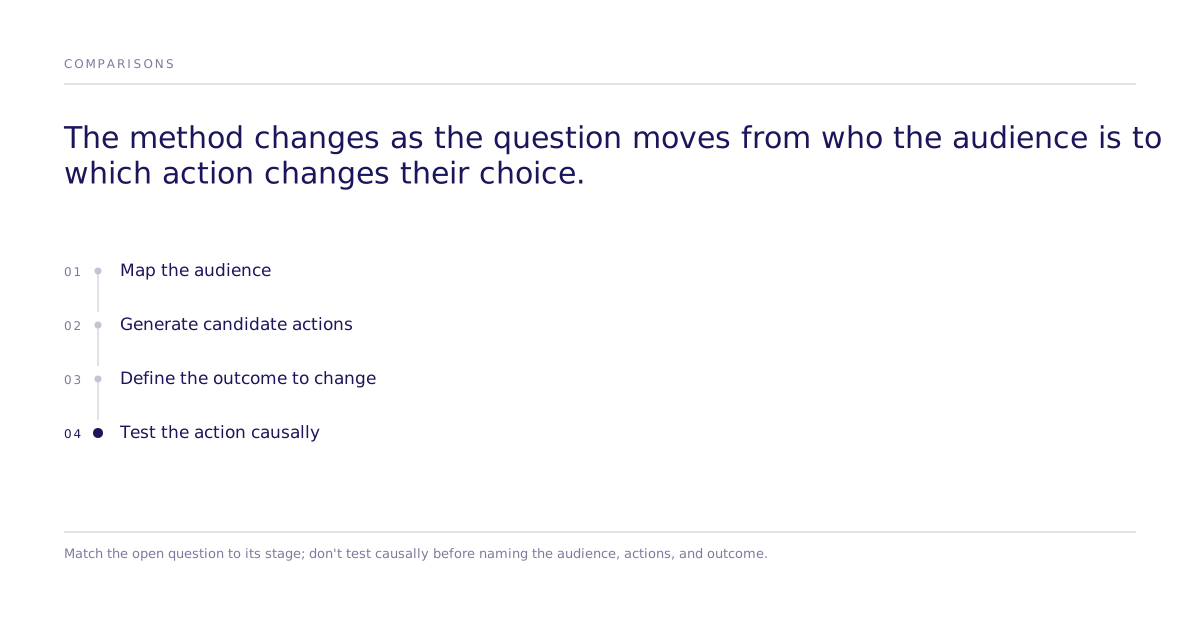
Match the method to the question
Audience mapping fits the starting question: who is present, how do groups differ, and where can a campaign reach them? A current product page in this category describes segments built from social conversations or marketer-chosen traits (audience-mapping product description).
Open-ended dialogue fits an earlier creative question: what objections, interpretations, or message directions should the team consider? It expands the option set but cannot establish that a generated response represents a market or that a proposed message will change behavior.
A controlled causal experiment fits the action question: which message, price, or positioning alternative changes choice for the defined audience? Subconscious compares specified alternatives in a decision-specific experiment, estimates differences between actions, and reports uncertainty only when the study design supports it.
| Buyer question | Audience mapping | Open-ended dialogue | Controlled causal experiment |
|---|---|---|---|
| What it establishes | Who a group is and how it behaves across observed digital channels | Which reactions or objections may be worth considering | Which defined action changes a decision-specific outcome |
| Best input | Audience traits, conversations, affinities, and observed activity | A customer definition, topic, and exploratory prompts | A target audience, alternatives to compare, and a measurable choice |
| Useful output | Segment maps for campaign planning, media selection, and influencer targeting | Candidate messages, objections, and hypotheses | A directional comparison between actions, with uncertainty where supported |
| What it does not prove | That a message, offer, or price will change choice | That generated dialogue predicts market behavior | Live social behavior or automatic market performance |
When should you switch to causal testing?
Move to causal experimentation once the team can name:
- the audience whose choice matters;
- the messages, prices, or positions under consideration;
- the choice or behavior the campaign is meant to change; and
- the decision the team will make from the result.
Without those elements, a causal study has no clean intervention or outcome. With them, the team can test whether one action changes that group's choice.
A campaign decision in practice
Suppose an audience map identifies a promising buyer group and the creative team develops three positioning directions. The map defines whom to study; the creative work supplies the alternatives. The unresolved decision is which position to fund.
A useful experiment holds the audience and outcome definition constant while varying the positioning action, addressing the budget decision directly rather than inferring effectiveness from affinity, engagement, or eloquence.
Subconscious can run controlled studies against a person-level audience graph covering 800 million real people. That figure describes audience reach, not the size of a recruitable participant pool. When the stakes require human evidence, Subconscious can test or validate the same study with real human participants without changing the causal question.
What can the experiment still not establish?
A controlled study is only as useful as its audience definition, alternatives, outcome, and design; weak inputs produce a precise answer to the wrong question.
Naming what a method does not cover is what lets a buyer size the remaining gap before committing budget. Subconscious does not replace the observation of social conversations or digital audience mapping needed for campaign and influencer targeting. It does not replace direct qualitative work during problem discovery or idea development.
The boundary of a method belongs next to its claim so a buyer can weigh both before deciding. Real-human validation narrows uncertainty for the same causal question. It does not turn the study into an observed usability session, guarantee post-launch performance, or remove the need to monitor the market after the decision ships.
Bring a defined choice, not a broad audience question
Start with audience mapping to find and describe the group. Use direct qualitative exploration to generate candidate actions. Once the audience, alternatives, and outcome are defined, review the research method and the study workflow. Teams with a decision ready to compare can bring it to a demo.