Comparing four methods of conjoint for pricing research
A pricing lead picking between CBC, ACBC, MBC, and volumetric conjoint is choosing a survey format, not a guarantee of accuracy. All four ask respondents to trade off features and price in a hypothetical scenario, and none of them checks whether that trade-off matches what people do when real money is on the line. The decision that actually determines pricing accuracy happens after the questionnaire is built: whether the resulting price sensitivity gets validated against a real behavioral outcome.
- CBC (Choice-Based Conjoint): standard discrete choice tasks with price as one attribute among several. Fastest to field, easiest to analyze, and the default starting point for most pricing studies.
- ACBC (Adaptive CBC): adds a build-your-own screening stage before an adaptive choice tournament, run through Sawtooth's Lighthouse Studio. Surveys typically take two to three times longer than standard CBC (Sawtooth Software).
- MBC (Menu-Based Conjoint): respondents assemble their own bundle or subscription tier item by item, the right fit for configurable offers with add-ons (Sawtooth Software).
- Volumetric conjoint: asks how many units a respondent would buy, not just which option they'd pick, which matters when demand volume drives the pricing decision more than choice share.
- All four are stated-preference formats. The format you choose changes what respondents see; it does not, by itself, tell you whether the trade-off they report predicts what they'd actually pay.
What do CBC, ACBC, MBC, and volumetric conjoint actually measure?
Each method estimates the same underlying thing, a respondent's relative preference for price versus other attributes, through a different questionnaire structure.
| Method | What it does | Respondent burden | Best for |
|---|---|---|---|
| CBC | Fixed discrete choice tasks, price as one attribute among several | Low; 10-15 tasks capture most of the available signal ([Sawtooth Software](http://legacy.sawtoothsoftware.com/help/lighthouse-studio/manual/acbchowwelldoesitwork.html)) | Best for: quick pricing screens with a small, fixed attribute list. |
| ACBC | Build-your-own screening stage feeding an adaptive choice tournament | High; survey runs 2-3x longer than CBC ([Sawtooth Software](https://sawtoothsoftware.com/conjoint-analysis/acbc)) | Best for: large attribute lists and studies needing more precise part-worths. |
| MBC | Respondent configures a bundle or subscription tier item by item | Moderate, scales with menu size | Best for: subscriptions, add-ons, and other configurable offers. |
| Volumetric | Respondent states quantity, not just choice | Moderate | Best for: categories where unit volume, not just selection, sets the revenue outcome. |
Which conjoint method should a pricing team pick?
Pick based on the product structure and attribute count, not on an expectation that one method is more accurate than the others. A short, fixed feature set with a single price point points to CBC. A long attribute list, or a pricing study where precision on part-worths matters more than fielding speed, points to ACBC, with the tradeoff that it costs two to three times the interview length (Sawtooth Software). A subscription or configurable bundle points to MBC. A category where customers buy varying quantities, not a single unit, points to volumetric. None of these choices changes whether the resulting price sensitivity holds up against real behavior.
Why do CBC and ACBC produce almost the same answer?
Because they're estimating the same utility function with different collection mechanics, not different models of how people decide. Sawtooth's own comparisons find "very strong similarities" between CBC and ACBC part-worth utilities, with ACBC utilities showing somewhat more precision and price carrying slightly more relative importance than in standard CBC (Sawtooth Software). The same source notes that CBC hit rates gain little beyond 10-15 choice tasks, meaning the extra length ACBC adds mostly buys precision, not a different conclusion. If two methods that differ this much in respondent burden still converge on the same price sensitivity, the choice among them is a design question, not an accuracy lever.
Does agreement between methods mean the price estimate is accurate?
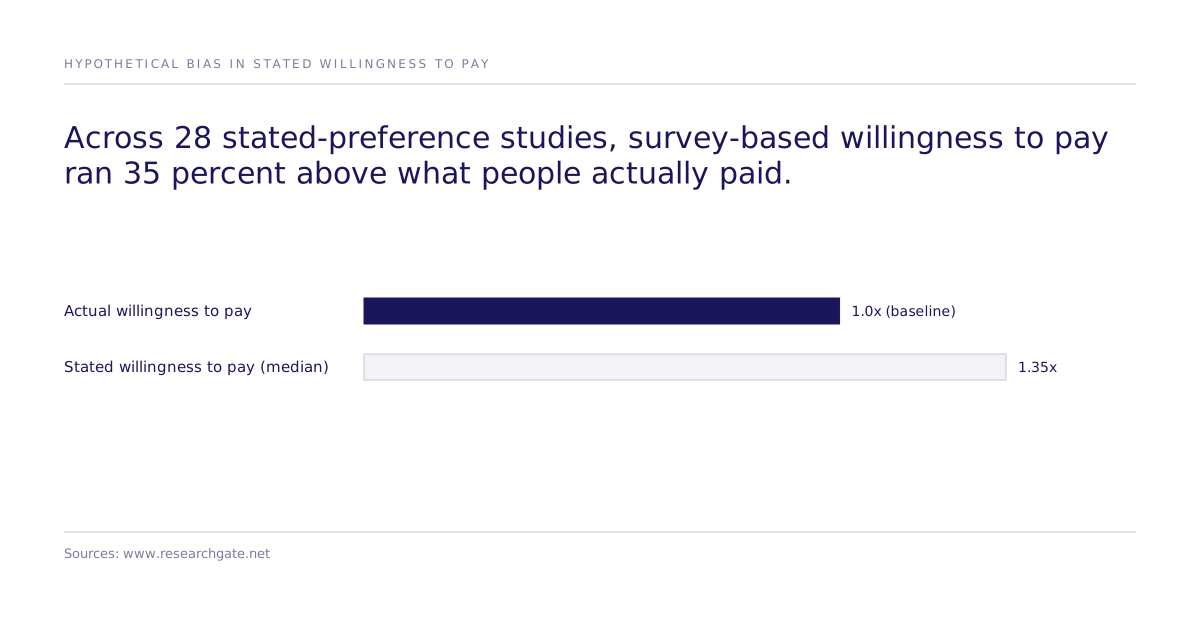
Publishing where two methods agree, and where that agreement stops, is what lets a buyer check the estimate rather than take it on faith. No. Agreement between CBC and ACBC only shows that the methods are consistent with each other; it says nothing about whether either one matches real purchase behavior. A meta-analysis of 28 stated-preference valuation studies found a median hypothetical-to-actual willingness-to-pay ratio of 1.35, meaning people overstate what they'd actually pay by roughly a third in a hypothetical survey setting, before any conjoint-specific design choice enters the picture (ResearchGate). This bias runs in one direction, stated willingness to pay comes in high, and it applies regardless of which of the four conjoint architectures collected the data.
How is trade-off accuracy actually validated?
By checking the estimated price sensitivity against a real behavioral outcome, not by choosing among CBC, ACBC, MBC, or volumetric formats. McFadden discrete choice, Mixed Logit, and ICLV are estimators that turn choice data into part-worths and willingness-to-pay figures; they are not causal methods on their own. Causal identification comes from randomizing the price and feature manipulations respondents see, then analyzing the resulting choices with these models. A flat multinomial logit, the base case under standard CBC, imposes the independence-of-irrelevant-alternatives assumption, which can distort preference-share and substitution estimates; Mixed Logit relaxes that assumption at the cost of a more complex model.
Subconscious runs randomized experiments on a simulation of the market and checks the result against a human baseline. Our best configuration reaches 87% of the measured human ceiling on one study: 0.832 rank correlation against the published human result, where two independent samples of real humans reach 0.959. Across all 43 studies that pass design filters the mean is 0.73, a validation-set result on the studies in the public leaderboard. It is a validation result, not a guarantee for a new market. See the causal fidelity paper. That number also comes with a limit worth stating plainly: some of the human studies used for validation are published, and published studies can sit in a language model's training data; the replication protocol behind the leaderboard is built to address that risk, but it doesn't make the risk disappear. Stating where a result stops applying is what turns it into something a buyer can act on. A confidence interval from a simulated experiment covers the effect within the simulated population it was run on; it does not bound the real market unconditionally. For a longer treatment of what replication testing does and doesn't prove, see the methods and validation hub.
What are the limits of this approach?
A number without its limits is marketing; naming the failure mode is what makes it a working tool instead. None of this replaces the questionnaire-design decision covered above; it sits on top of it. Choosing CBC over ACBC because the study needs a shorter field time is still a legitimate call. What changes is what happens next: instead of treating the resulting price sensitivity as a finished answer, it becomes a hypothesis to check against a held-out human study or a behavioral outcome, with the hypothetical-bias direction named and the confidence interval scoped to the population it was estimated on. A method that produces a precise, internally consistent estimate that has never been checked against real behavior is not more accurate for being precise.
Before locking a launch price off any conjoint output, pull the top two price points from the study and re-test them as a randomized experiment against a human holdout rather than trusting the questionnaire result on its own; the comparisons hub has more on how to structure that check. If it's useful to walk through your specific study design, the Subconscious team is available for that conversation.