How to Evaluate Market-Simulation Evidence Before Committing Research Budget
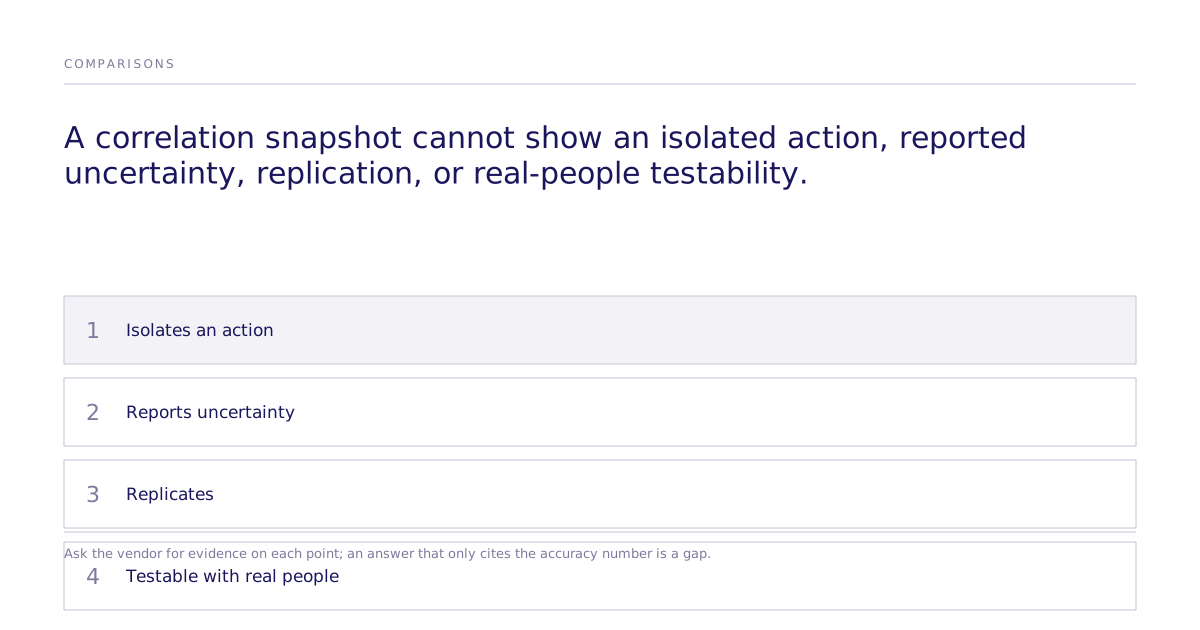
Evaluate a market-simulation vendor by the evidence behind the decision, not the largest accuracy figure in its pitch. The decisive questions are whether the study isolates an action, reports uncertainty, replicates, and can be tested with real people without changing the causal question. A single correlation snapshot cannot answer those questions.
The cost of choosing poorly is not limited to the contract. A team can commit research budget, act on an unverified number, and discover after launch that the simulated result did not hold against customer behavior.
The budget decision is about evidence
Public case material shows that market simulation is being applied in wealth and asset management (EY). That is not, by itself, evidence that a result replicated or that a proposed action caused the measured outcome.
The useful comparison is not a category label or sales model. It is the type of proof a vendor can put behind the decision.
Compare the proof each method can provide
| Evidence offered | What it can support | What it cannot establish |
|---|---|---|
| One correlation snapshot | An association observed in one study | The causal effect of an action, replication, or performance in the next market decision |
| Replicated randomized experiment with confidence intervals | The estimated effect of a defined action and the uncertainty around that estimate | Automatic performance across every market, buyer group, or launch |
| Real-human validation matched to the same causal question | Whether simulated and participant results answer the same decision question | A usability observation, clinical outcome, or guarantee of market performance |
A method's limits belong next to its claims, so a buyer can check them before committing budget. A correlation shows what moved together. It cannot tell a buyer whether changing a price, message, offer, or product feature caused the outcome. Random assignment and confidence intervals address that question; replication asks whether the result survives another test under a stated method.
Questions that expose weak proof
Ask for answers that can be reviewed before procurement:
- What exact action and outcome did the study test?
- Was assignment randomized, and what comparison condition was used?
- How was uncertainty reported?
- Was the result replicated, and under what population and market conditions?
- Can the same causal question be tested with real people?
- Which decisions fall outside the method's stated limits?
If a deck repeats an inherited benchmark without the method behind it, label that number as a historical or planning example. Do not treat it as a current performance claim.
How does Subconscious test the action?
Subconscious research uses randomized experiment design and confidence intervals to estimate whether a specific action changes an outcome. When a decision warrants an additional check, a team can move from a simulated experiment to real-human validation without changing the causal question.
It does not turn the study into an observed usability session, and it does not guarantee market performance. The Subconscious method is best suited to choices that can be expressed as a defined action, comparison, and measurable outcome.
Subconscious can use a person-level audience graph representing 800 million people for targeting and simulation. A number without its limits functions as marketing, so the limit is stated plainly here. That reach is not a recruitable participant pool, and it must not be presented as a fielded sample size. Published benchmark results provide another artifact a buyer can inspect, but they do not remove the need to match the method to the decision.
How do you set the procurement gate before reviewing proposals?
Require a pre-specified causal question, the experiment design, confidence intervals, replication evidence, written failure conditions, and a real-human validation plan when the stakes justify one. Apply the same standard to every vendor.
Naming what a study cannot establish is what lets a buyer check the claim against the evidence. This evidence cannot support a price or delivery-speed comparison. It also cannot convert an unpublished method or a promotional number into proof. If a supplier cannot provide the required artifacts, include the risk of an unverified result in the budget decision.
Teams with a live market choice can discuss an appropriate study design.