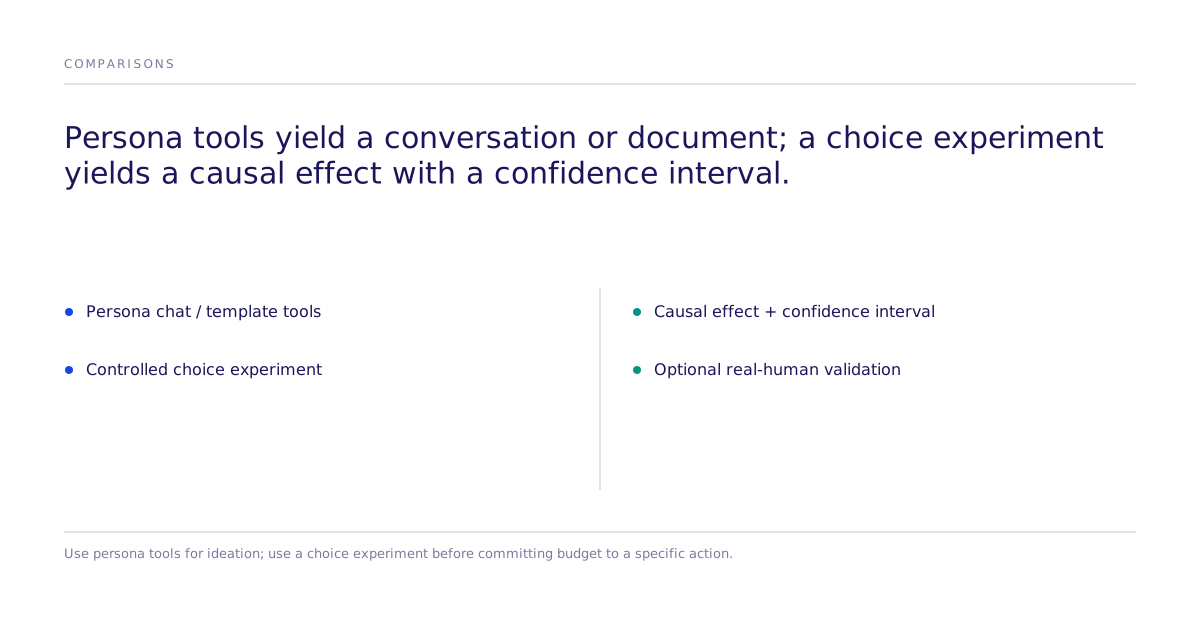
Persona Simulation Tools vs. Causal Choice Experiments: A Buyer's Comparison
The persona simulation and synthetic-research market splits into four categories: conversational persona platforms, data-grounded persona generators, template builders, and specialized simulators. None of the four answer the question that actually drives a launch, pricing, or positioning decision: which specific action changes what a customer chooses.
Four categories, one gap
Conversational persona platforms let a team query a synthetic persona like a chat partner, asking it to react to a message, a feature, or a pitch. Data-grounded generators build a persona from analytics, CRM records, or interview transcripts, trading conversational flexibility for a documented data source behind each trait. Template builders produce a static one-page persona document for a deck or a kickoff meeting, with no simulation layer at all. Specialized simulators cover narrower jobs, such as scripted engineering tests against a synthetic user or documentation testing.
All four produce a description of a customer, not a controlled comparison between real decisions.
What is the real decision underneath the category?
The real choice is between a tool that generates persona conversations or documents, and a platform that runs a controlled experiment to determine which specific action changes customer choice. A team that buys a persona-chat or template tool for a question that needs a causal, replicable answer ends up shipping a positioning, pricing, or launch decision with no evidence it changes real behavior. A persona will agree with almost anything asked of it in conversation; agreement is not evidence of a choice.
How does a controlled choice experiment answer it?
Subconscious runs randomized, controlled discrete choice experiments against the specific action a team is deciding between: a price point, a headline, a feature bundle, a launch sequence. The discrete choice experiment itself is decades-old applied economics, not a new invention: it is the reference method built on McFadden's Nobel-recognized framework for modeling how people choose among a fixed set of alternatives. That lineage, not a benchmark percentage, is the rigor bar a comparison should use. Subconscious's own application of the method is documented on the replication leaderboard.
Where the two approaches actually differ
| Persona chat / template tools | Controlled choice experiment | |
|---|---|---|
| Primary output | A conversation, document, or profile | A causal effect on a specific choice, with a confidence interval |
| Best job | Early ideation, stakeholder alignment, deck-ready personas | Deciding between two or more concrete actions before committing budget |
| What it cannot tell you | Whether one action outperforms another for a defined segment | Open-ended reactions outside the tested alternatives |
| Repeatability | Depends on the prompt and persona configuration used | A repeatable design against the same choice set |
Use the row that matches the question. A team that needs a shareable persona document for a kickoff still needs a template builder. A team that needs to know whether Price A or Price B changes signup rate needs the experiment.
What does the causal approach not replace?
Subconscious does not replace open-ended persona conversations for early ideation, and it does not replace direct human interviews for exploratory discovery. Those are different jobs: understanding a customer's language and context, rather than comparing fixed alternatives. Audience-graph reach used for targeting and recruitment is also not the same thing as a recruitable research panel.
From simulated experiment to real-human validation
When a decision is large enough to warrant it, Subconscious can test or validate the same study with real human participants, without changing the causal question being asked. That matters most for high-stakes launch, pricing, or positioning calls.
Choosing the right tool for the decision in front of you
Start from the decision, not the tool category. A team that needs a document or a conversation partner should buy a persona or template product. A team that needs an answer that holds up under scrutiny needs a controlled choice experiment. See how Subconscious runs a study or book a walkthrough to scope which one applies.