Sales Coaching or Pre-Launch Causal Research: Match the Tool to the Decision
The right tool depends on the decision. Sales-roleplay platforms help sellers rehearse and improve a conversation. Pre-launch causal research tests whether a product, price, or message changes a market outcome. One cannot stand in for the other.
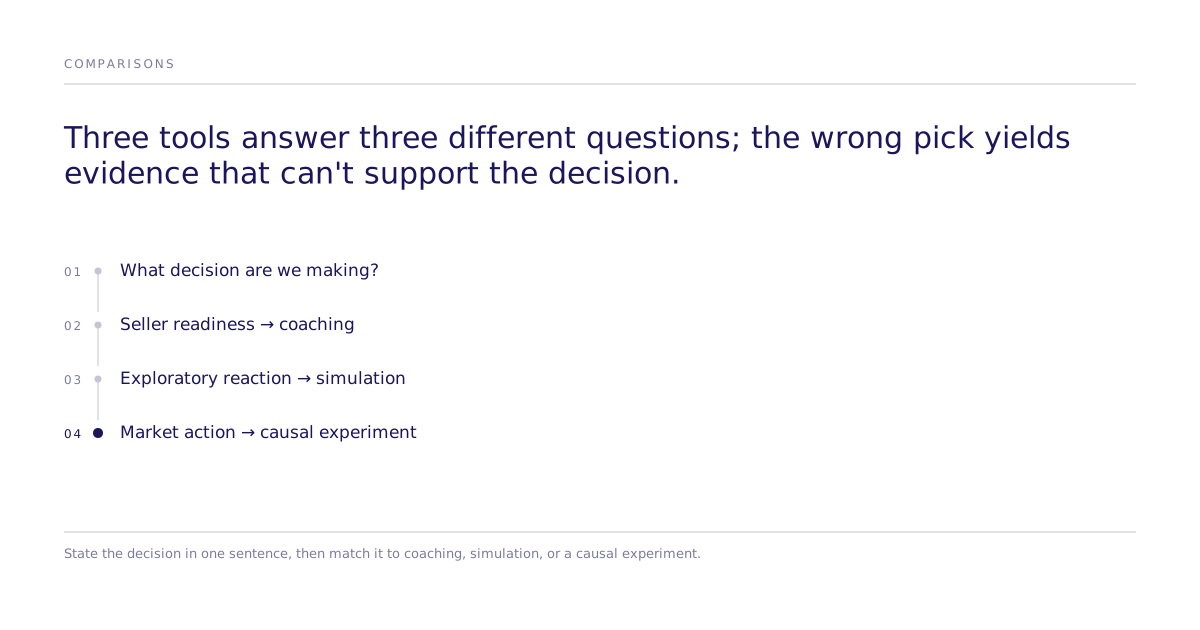
What operational decision should you start with?
For a sales-enablement leader, the decision may be whether a rep is ready for a difficult buyer conversation. For a CMO or CRO, it may be whether to launch a product, change a price, or commit budget to a message. A third need is exploratory: learning how a segment describes a problem before the team has framed an action to test.
| Buyer question | Method that fits | Evidence produced | What it cannot establish |
|---|---|---|---|
| Is this seller ready for a type of conversation? | Sales roleplay and coaching | Practice feedback about seller behavior | How the market will respond to a product, price, or message |
| How does this segment describe or react to an idea? | Descriptive market simulation | Stated reactions and an aggregated readout | Whether a specific action caused an outcome to change |
| Which action changes an outcome for this segment? | Subconscious causal behavioral study | An estimated causal effect from a randomized experiment | Seller readiness or live call performance |
Coaching evidence does not answer a launch question
One product in the sales-enablement category positions itself as a sales roleplay and coaching platform (product page). That is a valid job. Practice and coaching evidence can reveal how a seller handles a simulated conversation.
A published limit tells a buyer exactly where the evidence stops. It does not reveal whether buyers in a defined market will respond to a planned product, price, or message. The problem is not the quality of the roleplay. The problem is a mismatch between the evidence and the decision.
The reverse mismatch is just as important: a market experiment is not a coaching system.
Why does an action decision need experimental evidence?
Descriptive simulation helps a team explore language, reactions, and early direction, but a correlational readout cannot show that an action caused a change in behavior. If the buyer must choose which action to fund, the research design has to match that causal question.
Subconscious runs randomized experiments on a simulation of a defined market. It estimates which action moves an outcome for a specified segment. Discrete-choice-style modeling can structure the trade-offs among products, prices, or messages.
Validation has a boundary worth stating on the record. A team can validate the simulated study with real human participants without changing the causal question. It does not automatically prove market performance.
Read more about the research behind causal behavioral simulation.
Put the method boundaries in the buying brief
A sound procurement brief should state what each method will not do:
- A buying brief earns trust by naming what a method will not do. Subconscious does not provide per-rep call scoring, live coaching, or onboarding practice connected to a live sales pipeline. Those are distinct sales-enablement workflows.
- Descriptive simulation is useful for exploration, but its stated reactions are not causal evidence about an action.
- Real-human validation preserves the causal question without turning a study into automatic proof of market performance.
- Confidence intervals and segment heterogeneity should be reported only when the specific study design supports them.
Turn the category search into a study question
Before comparing interfaces, write down the decision in one sentence:
- Are we trying to change seller behavior or choose a market action?
- If it is a market action, do we need exploratory language or a causal estimate?
- What action, outcome, and buyer segment must the evidence cover?
- What validation would make the result credible enough for this decision?
If the answer is seller behavior, evaluate a roleplay and coaching platform. If the answer is a product, pricing, messaging, or go-to-market action, review how Subconscious designs the study or bring the decision to a demo.