Vendor Directory or Causal Experiment? Choose Based on the Decision
A research-ops or growth marketing lead should choose between vendor discovery and direct causal testing based on what remains unresolved. Use a directory or industry report when the team needs to understand the supplier landscape. Use a causal experiment when the team already has a product, pricing, or messaging action to test. A poor choice either adds procurement work that does not answer the decision or produces evidence that is too weak for the stakes.
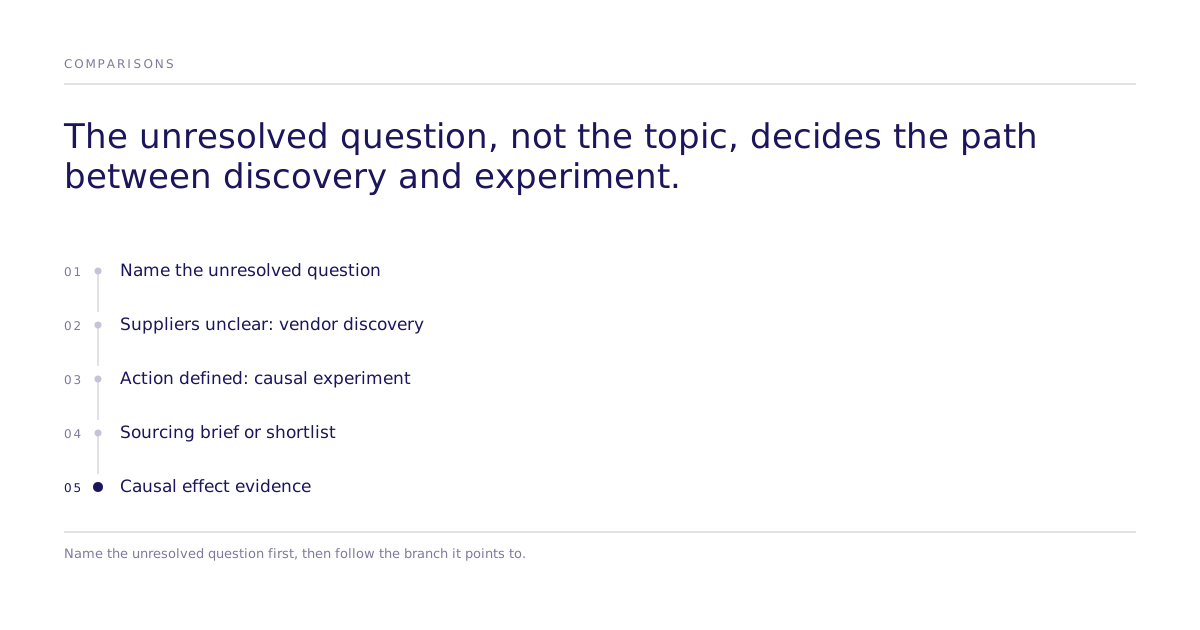
Choose the path based on the unresolved question
Vendor discovery answers, “Who can help us conduct this work?” Direct causal testing answers, “Which action changes the outcome we care about?”
If the team cannot define the method, supplier category, or procurement criteria, sourcing comes first. If the action and outcome are already clear, the team can frame a controlled experiment without treating the question as a vendor search.
When is the market landscape the missing evidence?
Industry directories and trend reports help a buyer map research methods, supplier categories, and market practice before writing an RFP. An annual research-industry trends program is one public example of market-level evidence for that sourcing decision.
That path fits an unfamiliar initiative, a formal supplier evaluation, or an internal case that depends on industry benchmarks. A sourcing brief that skips this line reads like proof it never claimed to be. Its output is procurement context. It does not itself establish whether a proposed price, message, product feature, or launch action will change buyer behavior.
When is the action ready to test?
Subconscious is a causal behavioral platform for controlled experiments on simulated populations. This path fits a team that can state the decision as a testable contrast, such as which price changes choice, which message changes consideration, or which offer changes preference.
A simulated effect published without this line looks like a finished market result. Simulation is not automatic proof of market performance. Subconscious can test or validate studies with real human participants without changing the causal question. The team should set that evidence threshold before relying on the result for a high-stakes claim, price point, or launch decision.
Compare what each route is designed to answer
| Decision factor | Vendor discovery or industry report | Direct causal experiment |
|---|---|---|
| Primary question | Which supplier or method should we procure? | Which action changes the target outcome? |
| Useful when | The supplier landscape or research approach is unclear | The action, alternatives, audience, and outcome can be specified |
| Typical evidence | Market categories, vendor information, and industry benchmarks | Causal effects from a controlled experiment |
| Buyer output | A sourcing brief, shortlist, or RFP criteria | Evidence for a product, pricing, messaging, or launch choice |
| Important boundary | Does not test the business action by itself | Does not map the vendor market or replace required fieldwork |
The routes serve different stages of the buying process.
Set the evidence threshold before procurement
Write down the decision, action, outcome, and consequence of a false conclusion. Then choose the path:
- If the missing evidence concerns who can conduct the work, research the supplier market.
- If the missing evidence concerns what buyers will choose under defined alternatives, frame a causal experiment.
- If a simulated result would not meet the decision's proof standard, plan real-human validation on the same causal question.
This sequence keeps the method attached to the decision.
Turn the decision into a study
See how a causal study moves from question to validation, or discuss the decision you need to test.