Bring your own respondents
A pricing lead deciding how to staff next quarter's conjoint study faces a real fork: buy sample from a marketplace panel like Cint, Dynata, Prolific, or CloudResearch, or route the survey to the company's own CRM list, customer panel, or app users. Using your own respondents solves who answers a survey, not what the answer is worth: a verified customer list still produces stated preference data, filtered by who chose to respond, unless the study underneath it is built as a randomized experiment. The decision that actually protects a launch bet is the experimental design, not the respondent source.
- Bringing your own respondents (BYOP) means routing a survey or conjoint study to a company's own CRM list, customer panel, or app users instead of a third-party marketplace panel.
- A number without its limits is a marketing claim. BYOP buys data hygiene: known identities, lower bot risk, higher engagement. It does not buy causal validity.
- Panel fraud is real and getting worse: NORC puts nonprobability sample fraud at 15 to 30 percent industry-wide, spiking to 45 percent on some platforms and 90 percent in social-media-recruited samples (NORC).
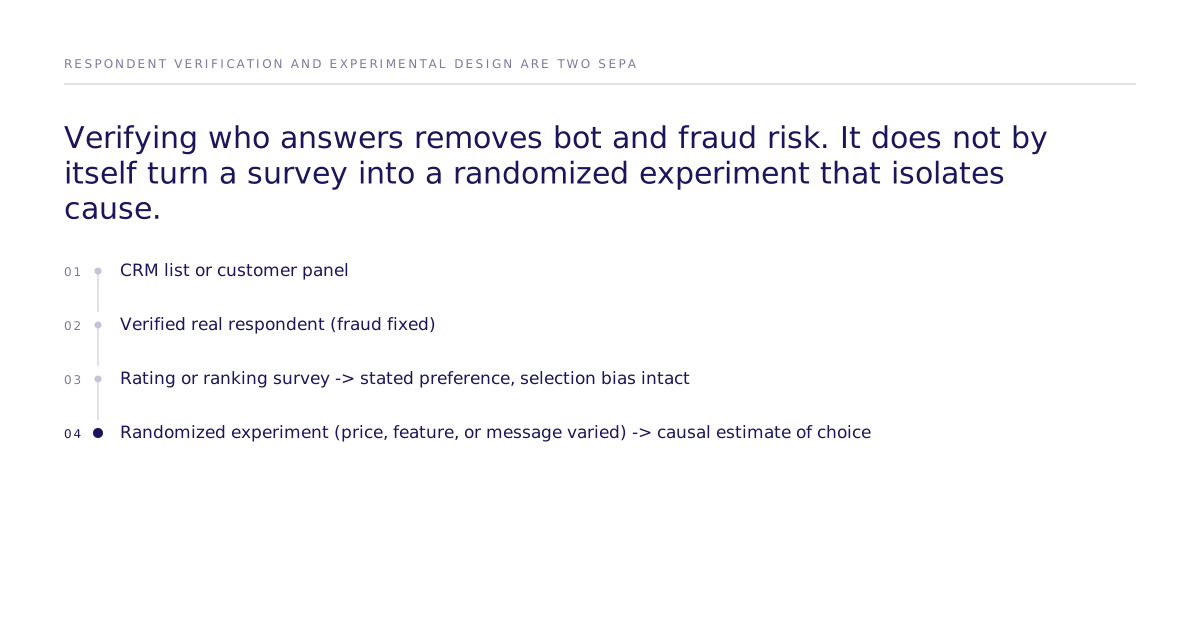
- A verified respondent list run through a rating-scale or ranking survey still returns stated preference filtered by selection bias, not a causal estimate of what a price or feature change will do.
- The actual fix is a randomized experimental design analyzed with discrete choice models, independent of where the respondents came from.
What "bring your own respondents" actually means
BYOP means a company supplies its own respondent pool, CRM contacts, an existing customer panel, or app users, instead of paying a marketplace for sample. Platforms like Qualtrics now treat this as a first-class option next to marketplace panel, not a workaround. A parallel market of "branded panel" vendors (Rival, Reach3) and AI-moderated qualitative tools has made owning a respondent base cheap enough to default to, not a workaround. That's why BYOP has moved from a niche choice to a live procurement decision for buyers who used to just default to a marketplace panel.
Why buyers are choosing BYOP over marketplace panels now
The shift is trust-driven, not cost-driven. GRIT's 2025 Insights Practice Report flags rising data-quality concerns, attributed to synthetic respondents and Gen Z survey fatigue, now among the industry's top five priorities (GRIT via NewtonX). CloudResearch estimates 30 to 40 percent of online survey responses are fraudulent or unusable, and finds that most current fraud is still coordinated human click-farm activity, not AI bots (CloudResearch). NORC separately estimates roughly 40 percent of nonprobability survey interviews in 2025 were fraudulent (NORC). These are nonprobability-sample estimates with contested measurement methodology, not a single agreed industry rate, so read them as directional. A known CRM list sidesteps that specific problem because the buyer already knows who is on it.
Does bringing your own respondents solve the panel fraud problem?
Yes, largely, for fraud specifically. A CRM list of verified customers removes the click-farm and bot risk that drives NORC's 15 to 90 percent fraud range, because identity is already known rather than self-reported to a marketplace. That is a genuine, measurable improvement in data hygiene. But fraud and validity are different failure modes, and fixing one says nothing about the other.
What bringing your own respondents doesn't fix
Naming a failure mode is what lets a buyer check it before they rely on it. Removing bots from your list guarantees you're talking to real people. It does not guarantee that what you're measuring predicts a real decision. A self-selected, engaged BYOP list run through a rating scale or ranked-preference survey still returns stated preference: what respondents say they'd do, filtered by who chose to answer at all. That's correlation with a selection bias baked in, not a causal estimate of what a price change, feature cut, or message swap will actually do to choice. A CRM-sourced conjoint that asks customers to state a willingness to pay runs into the same standard problem regardless of respondent source: stated willingness to pay runs high relative to real purchase behavior, unless the choice itself is incentive-aligned.
BYOP, marketplace panel, or randomized experiment: how the three compare
| Approach | Fixes | Doesn't fix |
|---|---|---|
| Marketplace panel (Cint, Dynata, Prolific, CloudResearch) | Scale, speed, category breadth | Bot and fraud risk: 15 to 30 percent industry-wide, up to 45 percent on some platforms, up to 90 percent in social-media-recruited samples (NORC). Best for: broad population reach when your own list is too small or unrepresentative. |
| BYOP self-report survey (CRM, customer panel, app users) | Identity verification, engagement, brand context | Selection bias, stated-preference gap, no causal estimate. Best for: a fast directional read among engaged customers when no launch decision rests on the result. |
| Randomized experiment on your respondents, analyzed with discrete choice models | Isolates cause from confound regardless of respondent source | Still needs enough real respondents, or a validated simulation, to hold a comparison group. Best for: a buyer who has to bet a launch, price change, or message swap on the result. |
Where does CRM data fit inside a causal research design?
CRM respondents are most valuable as a human baseline, not as the whole study. McFadden discrete choice, Mixed Logit, and ICLV are estimators, not causal methods on their own; the causal identification comes from randomizing what respondents are exposed to inside the experiment, not from where the respondents were recruited. A randomized experiment run partly on synthetic populations and validated against your own CRM respondents as a holdout gets you both: known, real customers and a design that isolates the effect of the change you're testing. Subconscious's own validation protocol reaches 87% of the measured human ceiling on one study: 0.832 rank correlation against the published human result, where two independent samples of real humans reach 0.959. Across all 43 studies that pass design filters the mean is 0.73, per the causal fidelity paper. The misses sit on the public leaderboard right next to the hits. That is a validation result, not a guarantee for a brand-new market. It also doesn't eliminate the risk that a published human study sat inside a model's training data, a risk the replication protocol is built to test against, not one the number pretends away. Results by domain are public on the leaderboard, and a confidence interval reported from a simulated experiment covers the effect within the population simulated, not the real market unconditionally.
What should a buyer check before betting a launch on BYOP data?
Ask whether the study varies something, not just asks about it. If the survey shows every respondent the same product, price, or message and asks them to rate or rank it, the design cannot separate cause from the respondent's prior opinion, no matter how clean the list is. If it randomizes what different respondents see, whether run on your CRM, on synthetic populations, or a blend, that's the design that produces a defensible causal estimate. For deeper background on how simulated and human-run studies are evaluated against each other, see the methods and validation hub, and for how BYOP-style approaches stack up against panel and simulation alternatives more broadly, see comparisons.
Before the next study goes out, pull up the current survey instrument and check one thing: does any question vary a price, feature, or message across randomized groups, or does every respondent see the same stimulus and get asked to rate it? If it's the latter, the respondent source, however clean, will not turn the result into an answer you can bet a launch on. If you want a second opinion on a specific study design, talk to us.