Continuous Discovery Finds Opportunities. Causal Tests Decide What to Build.
A recurring discovery conversation reveals where a product team should look next. It cannot show which intervention the market would choose or how large that preference is. Before committing engineering or launch resources, the buyer must decide whether the finding is an opportunity to explore or a defined choice ready for causal testing.
Continuous discovery is commonly framed as regular customer contact that informs product decisions while work is in progress. This overview describes the practice as weekly touchpoints centered on desired outcomes, opportunities, and solutions. The useful principle is sustained contact with customer problems.
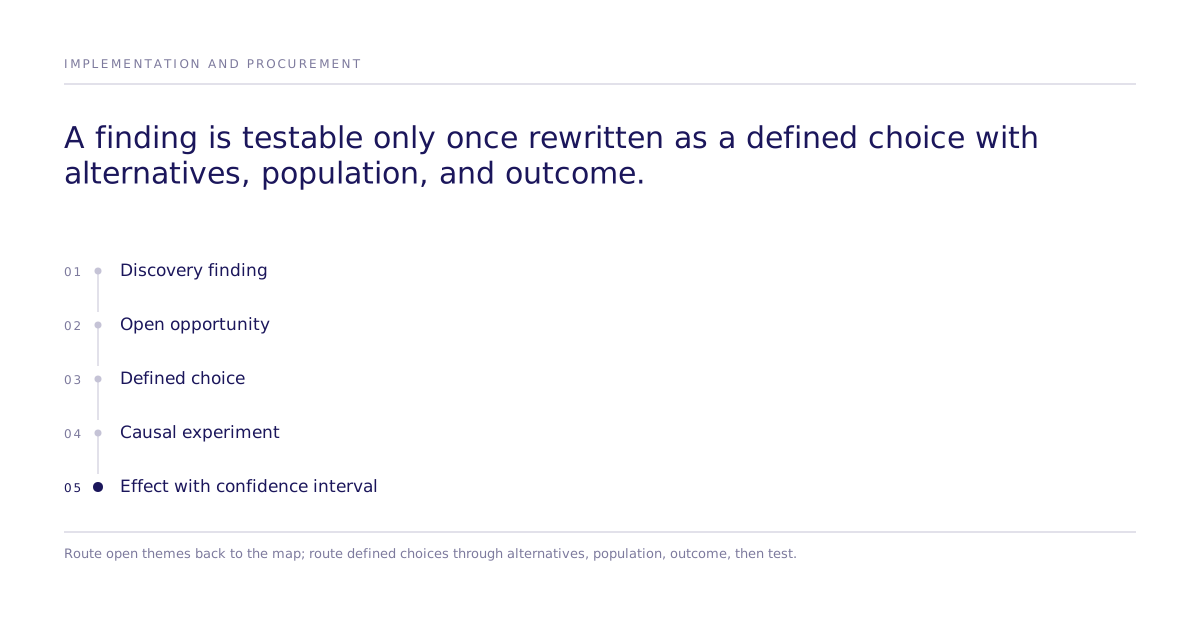
The decision boundary is more important than the cadence
Open-ended discovery generates candidate explanations. A conversation might surface a workaround, an onboarding confusion, a segment-specific expectation, or an assumption the team has not examined. Those findings help map the opportunity space and decide what deserves a sharper question.
A historical planning example used three reusable synthetic groups: 8 to 10 core profiles, 6 to 8 expansion profiles, and 6 to 8 churned or at-risk profiles, not a current Subconscious configuration, audience requirement, or vendor benchmark. The grouping helps a team look for competing hypotheses; it does not measure which alternative a defined population would choose.
The boundary appears when a finding begins to justify an action. "Customers struggle with exports" is an opportunity signal. "We should build guided export presets instead of improving the existing manual flow" is a choice between interventions. The second statement needs evidence designed around that comparison.
Two methods answer two different buyer questions
| Decision dimension | Open-ended discovery conversation | Controlled causal experiment |
|---|---|---|
| Buyer question | What problems, workarounds, or assumptions should we examine? | Which defined alternative changes choice, and by how much? |
| Inputs | Broad prompts and candidate audience perspectives | Specific alternatives, a defined population, and a stated outcome |
| Evidence returned | Themes and hypotheses for further work | A measured causal effect with a confidence interval |
| Appropriate action | Update the opportunity map or sharpen the question | Prioritize, revise, or reject a proposed intervention |
| Main misuse | Treating an explored theme as validated demand | Testing before the alternatives or population are defined |
Confusing these methods creates a procurement problem and a research problem. A team can buy a continuous stream of plausible observations and still lack evidence for the build decision it faces. The question is not whether discovery produced signal, but whether the evidence matches the action the team is about to fund.
Preserve the habit, then hand off the decision
One historical planning format allocated 45 minutes across four blocks:
- Minutes 1-5: state one opportunity or assumption.
- Minutes 5-25: explore it with the core perspective.
- Minutes 25-35: check it against a second segment.
- Minutes 35-45: record what changed and what remains uncertain.
This agenda is a historical planning example, not a Subconscious service format or delivery promise. Its output is a candidate question, which the team should rewrite in experimental form:
- Name the action under consideration.
- Define the alternatives, including the relevant status quo.
- Specify the population whose behavior matters.
- State the outcome that would change the product decision.
- Set the evidence threshold before seeing the result.
Subconscious research begins at this handoff. It runs a controlled discrete-choice experiment over the specified alternatives and population, returning a measured causal effect with a confidence interval. The practical advantage is decision evidence tied to the proposed action, not another set of open-ended impressions.
What can't a causal test do?
Naming what a causal test cannot do is what lets a buyer check the claim before funding the next step. A controlled experiment does not replace the qualitative habit: it does not generate an opportunity map, conduct an open-ended persona conversation, observe a usability session, or decide which customer problem deserves attention. Product and research leaders own those judgments.
A method that draws its own boundary is a method a buyer can verify. Simulation and recruited research remain distinct. Audience reach describes the scale of a simulated experiment, not a participant count. When the stakes call for recruited real-human validation, the same causal question can be tested without relabeling the work as qualitative discovery, a usability study, a clinical trial, or proof of market performance.
The limit sits next to the finding, so a buyer can check the claim against the tested population before funding a launch. The result is bounded evidence for a defined comparison. It can reduce uncertainty about which alternative causes a change in stated choice within the tested population; it cannot guarantee adoption after launch or substitute for production measurement.
How do you put a build decision into experimental form?
Before the next planning meeting, take the strongest discovery finding and write down the action it seems to support. If the team cannot name the alternatives, population, and outcome, keep exploring. If it can, the question is ready for testing.
See how Subconscious structures the engagement, from decision framing through validation. The goal is not to replace continuous discovery, but to prevent a promising signal from becoming an expensive build commitment before the causal choice has been tested.