AI Research for Financial Services: Testing Client Decisions You Can't Survey
Wealth management, insurance, and retail-banking teams have to decide which retention message, product proposition, price framing, or switching-moment intervention to fund, for clients who will not fill out a survey or join a focus group. Subconscious answers that decision by running a controlled experiment on a simulated version of the segment and measuring which alternative changes stated choice, with a causal effect and confidence interval attached.
Why this decision matters
Financial services firms hold more customer data than almost any other industry, and still struggle to explain customer behavior. Transaction data shows what happened. It does not show why. CRM data shows which products someone holds. It does not show whether they are satisfied, weighing a switch, or about to lapse.
The cost of guessing wrong is concentrated in the accounts that matter most. A high-net-worth client considering a move rarely fills out a survey before leaving, a pattern documented in research on rich non-responders. A business owner juggling personal and business finances is not going to sit through a focus group. When a retention offer, a pricing change, or a new proposition is built on an untested narrative, the firm usually finds out it was wrong only after the client has already switched or the policy has already lapsed.
What causes this outcome?
Traditional research methods are constrained by the same three things in financial services: compliance review cycles, privacy rules on customer data, and the difficulty of getting time-poor or high-value people to participate. Those constraints do not remove the underlying behavioral question; they make it harder to answer with a survey, an interview, or a panel.
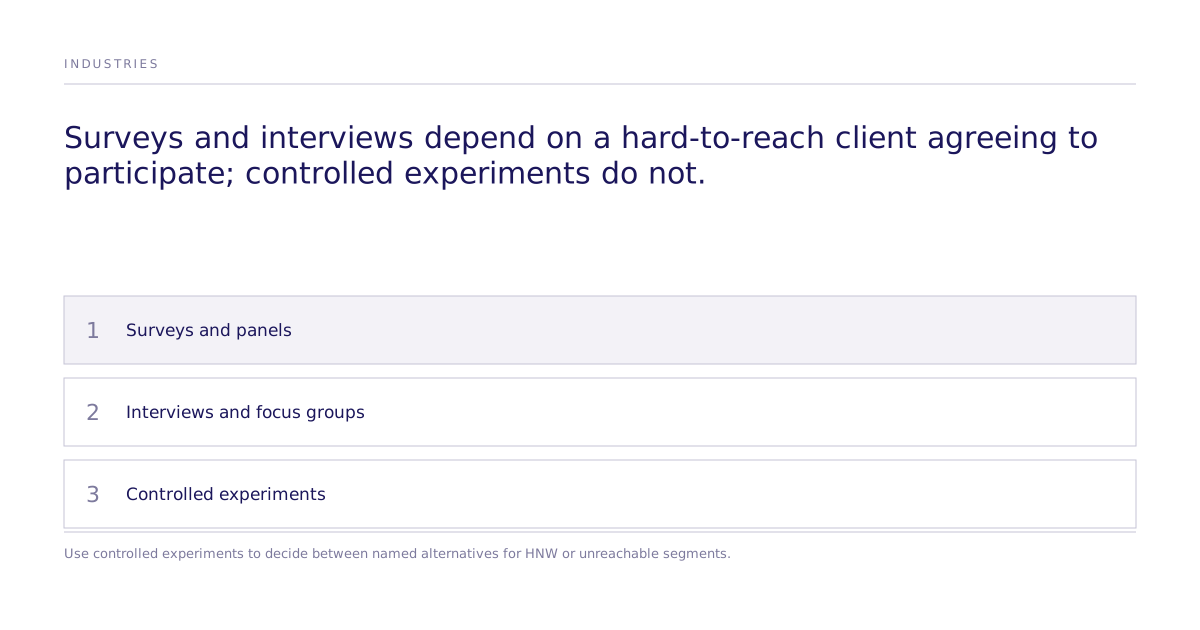
A controlled experiment sidesteps the participation problem by comparing defined alternatives, not by asking a real HNW client or a real business owner to participate. The question shifts from "what do these clients say they want" to "which of these specific product, price, or message alternatives changes their choice, and by how much."
Evidence
Some client and product moments are hard to research for reasons beyond access. A firm cannot deliberately give a customer a bad claims experience to study how it affects loyalty, and it cannot manufacture a renewal-shock moment on demand to see who leaves. These are the moments where comparing controlled alternatives in a simulation, rather than waiting for a natural experiment to happen to a real customer, is the only practical way to get evidence before a decision ships.
Examples of moments worth testing this way:
- A renewal notice arrives roughly 15% higher than the prior term. Which retention message or discount structure holds the account, and which one accelerates the switch?
- A claim takes three weeks and four phone calls to resolve. How much does that specific delay move stated loyalty compared with a faster, single-contact resolution?
- A client has done all of their daily banking and investing through separate direct-to-consumer apps and has not been inside a branch in three years. What proposition, if any, gets them to consider a traditional provider?
- A mass-affluent client is comparing a full-service advisory relationship against a lower-cost automated alternative priced at roughly half the fee. What specific value proposition justifies the premium, and for which segment does it fail to?
Each of these is a comparison between defined alternatives, not an open-ended conversation. That distinction is what makes the result usable as decision evidence rather than as a plausible story.
Options and trade-offs
| Method | What it captures | Access to hard-to-reach segments | Best used for |
|---|---|---|---|
| Surveys and quantitative panels | Stated preference at scale | Weak for HNW clients, business owners, and time-poor professionals who decline to participate | Broad directional sentiment across a large, reachable population |
| Interviews and focus groups | Qualitative depth and language | Weak; requires scheduling a real client's time, and sensitive segments rarely agree | Early-stage discovery and hypothesis generation |
| Controlled experiments on a simulated segment | Which specific alternative changes stated choice, with a measured effect and uncertainty | Strong; the segment does not need to be recruited or scheduled | Deciding between named product, price, or message alternatives before committing budget or advisor time |
None of these methods replaces the others. A controlled experiment is the right tool once the firm has narrowed to a specific set of alternatives and needs to know which one is more likely to change behavior.
Recommended decision process
- Name the decision precisely: the segment, the specific alternatives under consideration, and the stated-choice outcome that counts as success (stated preference or a comparable stated-choice measure), and the real-world behavior, such as retention or uptake, it is intended to inform.
- Define the population as narrowly as the real decision requires, such as HNW clients weighing a switch, next-generation wealth-transfer clients, or small-business owners evaluating banking relationships.
- Run a controlled comparison of the alternatives against that population and measure the causal effect on stated choice, with uncertainty reported.
- Route any claim, pricing, or compliance-sensitive language through the firm's compliance and legal review before it reaches a real client, regardless of how the alternative performed in the experiment.
- Where the decision is consequential enough to warrant it, confirm the finding with real-human testing or validation before it ships, without changing the underlying causal question.
Where does Subconscious fit?
Subconscious runs randomized experiments on a simulation of the target segment, validated against real human behavior at 87% of the measured human ceiling (0.832 over 0.959; mean 0.73 across the 43 studies passing design filters; see the causal fidelity paper), to estimate which action is likely to cause a change in a defined outcome, for a defined population, with a confidence interval. For financial-services buyers, that means comparing named retention messages, product propositions, or price framings against a precisely defined segment, rather than running an open-ended simulated conversation.
Subconscious can run controlled studies against a broad audience graph, which matters for financial-services segments that are narrow, high-value, and otherwise unreachable through recruitment. Where a firm needs to confirm a finding beyond the simulation, Subconscious can test or validate studies with real human participants.
Learn more about how Subconscious structures and validates causal experiments. Firms evaluating this for a specific segment can read how the process works end to end.
Limitations and failure conditions
Publishing where the method stops is what lets a firm check a causal claim before it reaches a client. A controlled experiment does not replace compliance and legal review before a claim, price, or message reaches a real client. It does not replace the advisor or broker relationship, and it does not substitute for direct engagement with the firm's own customer data where that data is available and appropriate to use. Regulatory constraints specific to financial services still apply in full; a simulated result is evidence for a decision, not a compliance approval.
Naming a failure mode here is what lets a buyer check it before treating simulated scale as validation. Running a study against a broad audience graph is not the same as recruiting real participants, and Subconscious keeps those two capabilities separate rather than presenting simulated scale as a substitute for recruited validation. A controlled experiment also will not tell a firm why a client is unhappy in their own words the way an interview can; it tells the firm which of the alternatives it already defined is more likely to change the outcome.
Adjacent questions
Can this replace a compliance-reviewed customer research program? No. It replaces the step where a firm would otherwise guess between alternatives, or wait for a real client interview slot that never gets filled.
Does this require pulling individual customer records? No. The population is defined by segment characteristics relevant to the decision, not by processing an individual client's account data, which is part of why it is workable for hard-to-reach or sensitive segments.
What is the fastest way to see if this fits a specific decision? Name one retention, pricing, or messaging decision for one defined segment and book a walkthrough to see the experiment design against that exact decision.