AustralianSuper leads the funnel, CommBank leads on customer support
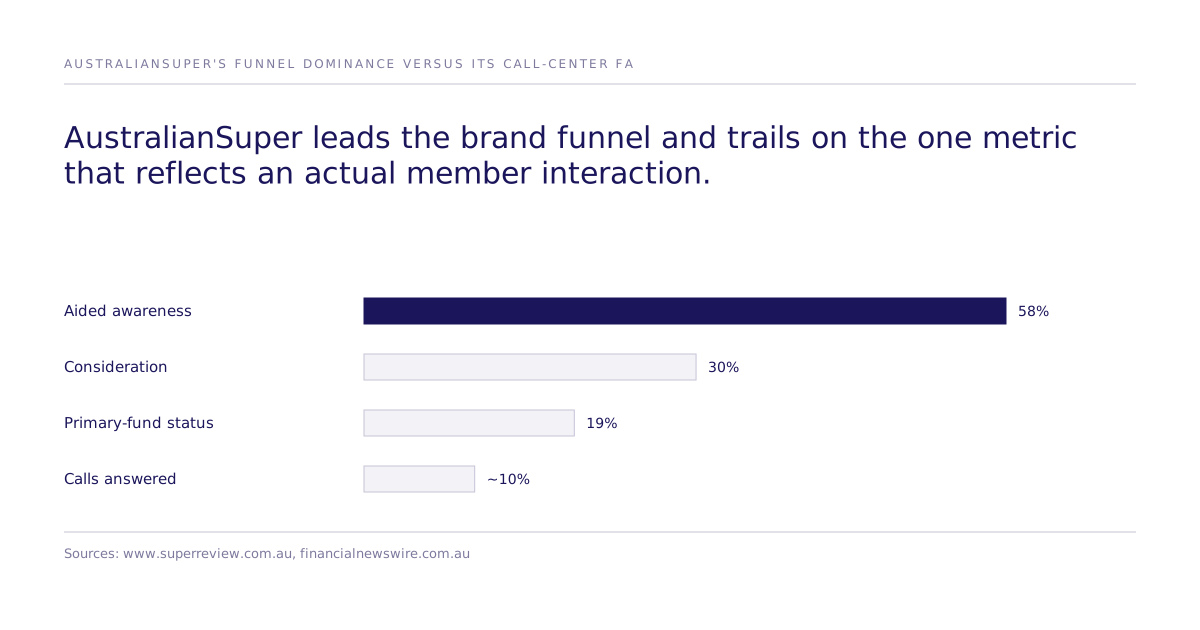
A chief marketing officer at an Australian super fund deciding where next year's budget goes, brand spend or call-center headcount, is staring at two 2026 datasets that don't agree. AustralianSuper leads every stage of the funnel by a wide margin: awareness at 58%, consideration at 30% and primary-fund status at 19%, across four brand-tracker waves from December 2025 to April 2026 (Super Review). A separate mystery-shopper study, fielded in July 2026, found AustralianSuper answered only about 10% of test calls and was the one major fund excluded from the industry's call-center rankings, while smaller funds including CommBank Super are credited with a real service-quality edge (Financial Newswire). Neither survey answers the question a CMO actually needs answered: what does a bad call do to the odds a member switches. That takes a controlled experiment, not two scoreboards read side by side.
- AustralianSuper tops every funnel stage Super Review tracked, with awareness at 58%, consideration at 30% and primary-fund status at 19% (December 2025 to April 2026).
- AustralianSuper answered roughly 10% of mystery-shopper calls in a July 2026 study and was dropped from Super Consumers Australia's call-center rankings entirely (Financial Newswire).
- CommBank Super and Australian Retirement Trust are credited with real service-quality and conversion advantages despite far lower brand awareness than AustralianSuper.
- Naming this failure mode is what lets a marketing lead check the comparison before repeating it. Stated preference and observed call-handling behavior are being reported as if they measure the same thing. They don't, and the two datasets weren't even collected in the same period.
- Neither dataset is a causal test of switching. That requires a randomized experiment analyzed with discrete choice models.
Does AustralianSuper's funnel dominance mean its members are safe from switching?
No. Funnel dominance measures what people recall and say they'd consider, not what they do when their fund fails them on a call. AustralianSuper's consideration score actually moved during the tracking window, from 24% in December to a peak of 31% in February, easing back to 30% by April (Super Review). Rest and Hostplus trail well behind at 48% aided awareness each, and on paper AustralianSuper looks unassailable at every stage from recall through primary-fund status. A funnel chart like that is a snapshot of stated preference. It tells you what a survey respondent said in a phone or online poll, not what a member does the next time they need help and can't get through. Those are different behaviors, and only one of them puts a dollar figure on retention risk.
Does CommBank Super actually outperform AustralianSuper on customer support?
A number posted without its limits is marketing copy, and this one carries its limit plainly. Only partially, and the public data can't fully quantify it. On the one metric in this story that reflects a real interaction rather than a stated opinion, whether the fund picked up the phone, Super Consumers Australia and CSBA ran 1,000 mystery-shopper calls across 20 funds in July 2026 and found an industry-average experience score of 49.9%, with no fund clearing 55% and none reaching SCA's own 80% benchmark (Super Consumers Australia). AustralianSuper did worse than that average by a wide margin: it answered only about 10% of calls attempted, meaning close to 90% went unanswered, so few that SCA excluded it from the call-center rankings rather than publish a number that would have anchored the bottom of the table (Financial Newswire). Coverage of the same dataset credits CommBank Super and Australian Retirement Trust with what Financial Newswire called "genuine competitive advantages" in service quality and conversion efficiency, despite awareness numbers far below AustralianSuper's, but neither the SCA release nor that coverage publishes a fund-by-fund score for CommBank Super, so the size of that advantage isn't public. What's confirmed is narrower and still decisive for a CMO: AustralianSuper's own answer rate was bad enough to disqualify it from comparison entirely.
One fund, two scoreboards
Holding four numbers in your head at once, on two different scales, from two different studies, is where this story gets misread. The figure below puts them on one axis.
The say-do gap: why survey answers and behavior diverge
Two different kinds of measurement are being collected on AustralianSuper right now, and coverage often treats them as if they're checking the same thing.
The brand tracker asks people what they think and feel: aided awareness, consideration, primary-fund status. It's a stated-preference instrument, run across four waves from December 2025 to April 2026, mostly independent of any specific service failure. AustralianSuper's consideration score actually rose during that window, from 24% in December to 31% in February, before settling at 30% in April (Super Review).
The mystery-shopper study measures something else entirely: what happens when someone actually tries to call. AustralianSuper answered about one in ten of the 1,000 test calls placed across the industry in July 2026 (Financial Newswire).
Those two facts get placed side by side often, stated preference holding up, call-handling near zero, as if the gap between them proves something about how resilient the brand is, or isn't. It doesn't. A brand survey and a mystery-shopper call are different instruments, run in different months, on different sample sets. Neither is built to isolate the effect of one bad call on a member's later choice. Reading a causal story into the space between two separately-collected numbers is the mistake this article is arguing against.
Where does the causal chain actually break?
Right where the funnel stops. The brand-tracker stages, awareness, consideration, primary-fund status, read like a causal sequence because they're drawn as one, arrow after arrow toward eventual retention. They aren't. Each stage is a self-reported snapshot at a point in time, not a measured step in a chain of cause and effect, and the step that would actually determine switching, a member's response to a specific service failure, sits outside the funnel with no instrument pointed at it.
| Brand tracker (Super Review) | Mystery-shopper study (SCA/CSBA) | |
|---|---|---|
| What it measures | Stated awareness, consideration, primary-fund status | Observed call-answer behavior on one attempted contact |
| Method and window | Four survey waves, December 2025 to April 2026 | 1,000 calls placed to 20 funds, July 2026 |
| What it can't tell you | Whether a member behaves differently after a bad experience | What one bad call costs a fund in future consideration or switching |
| Best for: | Reading stated brand preference, not switching risk | Diagnosing whether the phone gets answered, not why members leave |
If a member does leave AustralianSuper, the question of where they land matters for anyone modeling the market. A flat multinomial logit would assume independence of irrelevant alternatives, that a member's relative odds of choosing CommBank Super over Rest don't shift depending on which other funds are in the choice set. In a market with more than a dozen credible super funds, that assumption rarely holds, which is one reason Mixed Logit and ICLV, both of which let preferences vary across simulated members, are the more defensible estimators for a substitution question like this one.
Why DCE, Mixed Logit, and ICLV aren't causal by themselves
A benchmark number posted without its limits is just marketing copy. Discrete choice models estimate what respondents chose; they don't, on their own, tell you why. The causal identification comes from the randomized manipulation built into the experiment design, not from the estimator. A study built to answer this question would randomize a service attribute, say, call wait time or hold-abandonment probability, across a discrete choice experiment on a simulated population, then measure the causal effect of that attribute on stated switching intent and modeled primary-fund status. Mixed Logit and ICLV are the estimators suited to pulling that effect out of the choice data once the randomization has done the identifying work.
On its best configuration, the method behind these estimators reaches 87% of the measured human ceiling on one study: 0.832 rank correlation against the published human result, where two independent samples of real humans reach 0.959. Across all 43 studies that pass design filters the mean is 0.73 (the causal fidelity paper). The misses sit on the same public leaderboard as the hits, so the gap gets published instead of hidden. That's a validation-set result, not a finding about Australian super funds specifically: this market hasn't been tested yet, and because some published studies can sit inside a model's training data, the replication protocol behind that number exists specifically to check for that contamination rather than assume it away. Method performance across study types is public at the leaderboard; the underlying validation approach is documented in /blog/methods-and-validation.
What should a super fund's marketing or CX lead do this quarter?
Stop comparing the funnel number to the call-center number and start testing the link between them directly. That means designing a discrete choice experiment that includes a service-quality attribute, wait time, abandonment rate, resolution on first call, as a randomized variable, then reading the modeled effect on switching probability and primary-fund status against a holdout sample before trusting it. It also means treating AustralianSuper's funnel lead and its call-center exclusion as two separate facts until a causal test says otherwise, not as evidence that answers each other.
A concrete next step: pull the attribute list from a published discrete choice study design in your category and add a randomized service-quality attribute to it before your next brand-tracker wave runs, so the two data sources stop talking past each other. If you want a second set of eyes on that design, book time with the team.