Availability adjustment for conjoint preference shares
A pricing lead deciding whether to raise price off a conjoint simulator's forecast is really asking one question: does availability adjustment make the preference share trustworthy? A number without its limits is marketing. It does not. Availability adjustment scales simulated preference shares down for market realities the design can't see on its own, mainly which products shoppers actually know about and can actually buy, so the topline lines up with observed market shares. It fixes that one number. It does not check whether the attribute-level effects that produced it are correct. It doesn't tell you which feature actually moved choice. It doesn't tell you how much price actually mattered.
- Availability adjustment corrects the topline for unequal awareness and distribution. It does not validate the causal drivers underneath the topline.
- Sawtooth's Lighthouse Studio and Displayr apply availability adjustment inside a fixed four-step sequence: choice rule, availability, scale factor, calibration, and the order changes the answer.
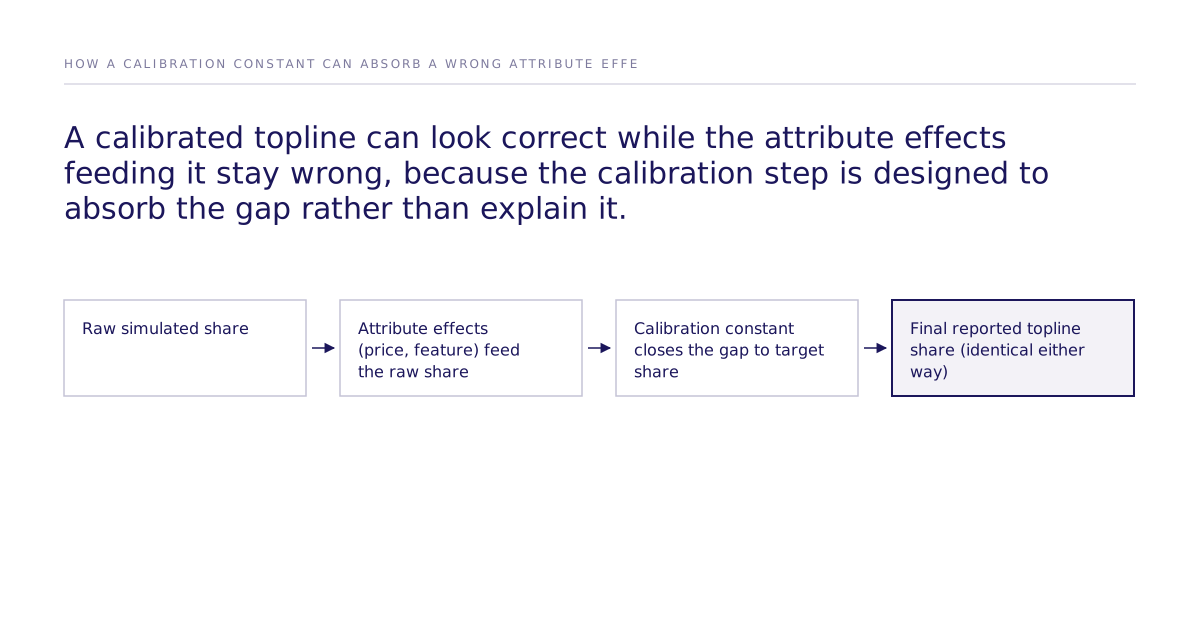
- Calibrating a simulated share to match a known market share can hide a wrong attribute effect, because the calibration step is built to absorb whatever gap exists, not to expose it.
- A flat logit share estimate assumes independence of irrelevant alternatives (IIA); that assumption, not the adjustment, is what breaks when profiles are close substitutes.
- The way to check attribute-level accuracy is replication against real human behavior, not a closer topline match.
What availability adjustment corrects, and what it assumes
Raw simulated preference share assumes every profile in a conjoint design is equally known and equally in stock, which no real market is. A new entrant with zero brand awareness gets simulated as if shoppers already know it exists on the shelf next to the incumbent. Availability adjustment corrects that by down-weighting or excluding profiles the analyst flags as unavailable or unfamiliar, so the simulated share reflects actual distribution and awareness instead of a fully-stocked hypothetical. Sawtooth's Lighthouse Studio implements this literally: its simulator can search for utility adjustments until simulated shares match a target share the analyst types into a Target Share column (Sawtooth Software, Share Adjustment). That target is set by the analyst, not derived by the model. It is a deliberate correction to one output, not a check on the mechanism that generated it.
The standard four-step stack, and why order changes the result
Sawtooth's own framework, published by Orme and Johnson (2006), codifies four sequential adjustments. First, change the choice rule. Then apply availability. Then tune a scale factor. Then calibrate the residual gap directly to known shares (Orme and Johnson, 2006).
Displayr's documentation for calibrating conjoint simulators to market share mandates the identical order: availability before scaling, scaling before calibration. Running the steps out of sequence changes the resulting shares (Displayr).
The scale factor step exists because first-choice-rule simulators reliably overstate the sharpness of real differences between products, especially for the already popular ones. Sawtooth's default exponent is 1. Analysts lower it specifically to flatten that overstated spread (Sawtooth Software, Share of Preference Options).
| Topline share calibration | Attribute-level replication | |
|---|---|---|
| What it proves | Aggregate simulated share matches a known market share | The direction and outcome of the study reproduce a real human study |
| What it misses | Whether individual attribute effects (feature lift, price elasticity) are correct | Whether the exact current-period topline percentage matches |
| Evidence source | Analyst-tuned four-step adjustment stack (choice rule, availability, scale, calibration) | 87% of the measured human ceiling (0.832 against a 0.959 human-to-human ceiling; mean 0.73 across the 43 studies passing design filters), per [the causal fidelity paper](https://fidelity.subconscious.ai/papers/causal-fidelity/causal_fidelity_paper.pdf) |
| Best for | Confirming a simulator's topline forecast looks plausible before a launch review | Sizing a pricing or roadmap decision that depends on which attribute is actually driving choice |
Does calibrating the topline validate the attribute effects underneath it?
The misses go on the record next to the hits, so a buyer can check them. No. Calibration adjusts the aggregate number to match a target; it says nothing about whether the feature-level effects that generated it are real. The calibration constant in that four-step stack is engineered specifically to absorb whatever gap exists between the raw simulated share and the target share.
Consider a simple illustration. Say the true price elasticity implies a premium option should hold 30 percent share, but a mis-specified model puts it at 45 percent. Say a second, correctly specified model puts it at 32 percent. Calibration nudges both toward the same observed 33 percent market share: the first model absorbs a 12-point correction, the second a 1-point correction, and both simulators now report 33 percent. The topline is identical. The price elasticity feeding it is not.
Availability adjustment fixes the marginal number, not the causal validity of the preference estimates underneath it. A calibrated topline is not proof that the attribute effects driving your actual decision are real.
Why representativeness in the design matters as much as the adjustment
Adjustment happens downstream of a deeper problem. Political-science methodologists Hainmueller, Hangartner, and Yamamoto (2015), writing in the Proceedings of the National Academy of Sciences, found that attribute-level effects (AMCEs) from a conjoint design matched real-world outcomes only when the profile distribution used in the design mirrored real-world attribute correlations, not the uniform-random distribution most conjoint tools default to. Naming this failure mode is what lets a buyer check the design before they lean on it. That result comes from a single political-science study; it has not been replicated across commercial market categories, so treat it as a documented risk, not a universal law. Stack it underneath a calibrated topline anyway and the failure mode compounds: a share number can match market history for reasons that have nothing to do with the mechanism your pricing or roadmap decision actually depends on. Availability adjustment cannot fix a design that never had representative attribute correlations to begin with; it operates entirely on the output side.
What is the IIA assumption, and why does it matter for preference shares?
The independence of irrelevant alternatives (IIA) assumption is what makes a flat logit's first-choice preference share possible to compute at all, and it's also what makes that share wrong when two profiles are close substitutes. A standard McFadden discrete choice model assumes a shopper's relative preference between any two options doesn't depend on what else is in the set, so adding a near-identical competitor pulls share proportionally from every existing option instead of mostly from its closest substitute. That's the same mechanism behind Sawtooth's scale factor guidance: first-choice simulators overstate sharpness for popular products precisely because the model isn't representing substitution correctly. Mixed Logit relaxes IIA by allowing preference parameters to vary across simulated respondents instead of assuming one fixed set of tradeoffs for everyone, and ICLV goes further by modeling the latent attitudes behind those tradeoffs directly. Neither availability adjustment nor scale-factor tuning relaxes the IIA assumption; they reshape the output of whichever estimator is running underneath.
What actually validates the causal estimates behind a preference share?
Before a buyer commits budget to a pricing or roadmap call, the question that matters is whether the attribute effects behind the forecast are real, not whether the topline number matches. That validation doesn't come from the estimator. Causal identification in a conjoint study comes from the randomized attribute manipulation built into the experiment design, not from the estimator applied afterward. McFadden discrete choice, Mixed Logit, and ICLV are estimators for reading that randomization: they describe how the choices are modeled, not why the result is causal. The estimator doesn't make the result trustworthy; the random assignment of attributes across profiles does. The way to check whether the resulting attribute effects are trustworthy, separate from whether the topline share happens to match, is replication against independently observed human choice behavior. Our best configuration reaches 87% of the measured human ceiling on one study: 0.832 rank correlation against the published human result, where two independent samples of real humans reach 0.959. Across all 43 studies that pass design filters the mean is 0.73, per the causal fidelity paper. It is a validation result, not a guarantee for a new market. A validation number earns trust only when its own blind spots are published alongside it. It also doesn't erase a real limitation: published human studies used for validation can sit inside a model's training data, and the replication protocol is built to address that risk rather than pretend it doesn't exist. Results are tracked openly on the leaderboard rather than reported only in a vendor's own case study, which is worth checking against whatever validation number a conjoint vendor gives you for their own tool.
A decision checklist before you size a decision on a calibrated share
Before a pricing or roadmap decision leans on a calibrated conjoint forecast, four questions separate a real causal estimate from a curve-fit:
- What is the attribute-level replication rate against real human behavior, not just the topline share match?
- Did the design's profile distribution mirror real-world attribute correlations, or was it uniform-random?
- What scale factor was applied, and does the analyst know why it was needed?
- Was the Target Share value in the calibration step set independently, or reverse-engineered from the market answer already known?
If a vendor's answer to any of these is "we calibrated the topline," that answer describes calibration, not causal validation. Pull the adjustment log from your last simulator run, check whether the calibration step is larger than the attribute effect your decision depends on, and if it is, ask for the replication evidence before you commit budget. To see how attribute-level replication is checked before a topline number ever gets calibrated, get in touch.