Best tips and tricks for drafting surveys for response quality
A research or insights leader who owns survey design is really deciding one thing: whether to trust a clean-looking dataset or to build in the randomization that makes an answer causal. The standard fixes for response quality are well known: trim survey length, cut matrix grids, randomize item order, replace attention-check traps with commitment pledges, and screen on a vetted panel. All of it cleans the respondent side of a stated-preference instrument. It reduces noise in self-reports. It does not turn a self-report into a measurement of what actually drives behavior, because none of it randomizes the thing being tested.
- Keep surveys to 7-10 minutes to reduce abandonment, and avoid matrix/grid questions, a known trigger for straightlining.
- A percentage with no source named next to it is marketing. Commitment requests (asking respondents to pledge thoughtful answers up front) cut data-quality issues by more than half compared with traditional attention-check traps, per Qualtrics' own research on its product (qualtrics.com), not independently replicated.
- Prolific and CloudResearch panels outperform MTurk, Qualtrics panels, and SONA student samples on attention checks and instruction-following, per a 2023 PLOS ONE panel comparison (journals.plos.org); panel quality shifts over time, so treat this as a baseline, not a current read.
- Fraudulent or unusable responses commonly run 15-30% on nonprobability online panels, and AI-written open text now routinely defeats completion-time and attention-check filters built for a pre-LLM world (NORC, norc.org; CloudResearch, cloudresearch.com).
- None of this substitutes for randomizing the choice itself. A respondent who passes every check is still just telling you what they say they'd do.
What actually makes survey responses clean?
Response-quality hygiene is a well-tested set of tactics, and it works on the problem it's built for: separating attentive humans from bots, speeders, and satisficers. Length matters. The standard advice caps most instruments at 7-10 minutes to reduce abandonment on longer surveys. Matrix and grid questions get cut or broken up because they invite straightlining, where a respondent picks the same column down an entire block without reading each item. Item order gets randomized to control for position effects. And the detection fight has moved past gotcha attention checks: Qualtrics' 2024-25 research found that asking respondents to commit to thoughtful answers up front cut data-quality issues by more than half compared with a control group using traditional attention-check traps (qualtrics.com). A number without the name of who ran the study attached is marketing copy. That's Qualtrics-run research evaluating its own product, not an independent replication, so read the magnitude as directional.
Panel choice compounds all of it. A peer-reviewed comparison across MTurk, Prolific, CloudResearch, Qualtrics panels, and SONA student samples, published in PLOS ONE in 2023, found Prolific and CloudResearch respondents pass attention checks, follow instructions, and produce meaningful open-text answers at meaningfully higher rates than the alternatives (journals.plos.org). Naming a study's expiration date is what lets a buyer decide when to re-check it. Panel quality shifts over time, and that comparison predates the AI-generated response problem covered next, so treat it as a baseline on panel selection rather than a current read on bot detection. If the question is "how do I stop garbage responses from entering my dataset," this is the current best practice, and it's worth doing regardless of what comes next.
Is attention-check vetting still working?
Not as well as it used to, and the gap is widening. Attention checks and completion-time filters were built for a pre-LLM world, where bad responses looked like gibberish or random clicking. CloudResearch argues that AI-generated survey responses now read as coherent, contextually appropriate, and human, which means the old filters miss exactly the thing they were designed to catch (cloudresearch.com). NORC's literature review puts fraudulent or unusable responses in nonprobability online panels at roughly 15-30%, depending on panel composition and incentive structure (norc.org). The center of the fight has shifted from "catch the speeder" to "catch the bot that reads like a person," and that fight is not settled.
But even a fully solved version of that fight, every bot caught, every satisficer filtered, every respondent vetted and committed, only gets you a clean set of stated opinions. It says nothing about whether those opinions predict behavior.
Why doesn't a clean dataset answer why people choose?
Because hygiene operates on the respondent, and causal identification requires a manipulation in the design itself. A respondent who passes every attention check, every commitment pledge, and every speed filter is still answering a question with no randomized condition attached to it: no control group, no varied price or message or feature set assigned at random, no way to separate what someone says moved them from what actually would. That's the say-do gap, and no amount of respondent screening closes it, because the screening never touches the part of the design that would let you isolate a driver of behavior from a stated preference.
What does a randomized discrete-choice experiment add?
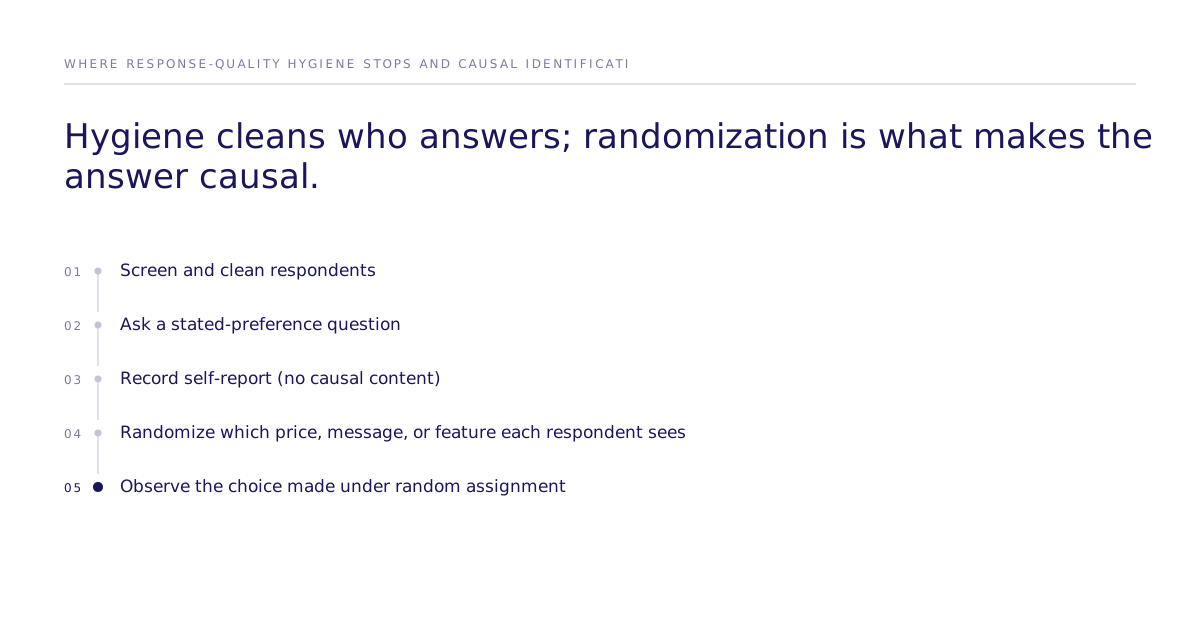
It adds the manipulation itself. Discrete choice experiments (DCE), Mixed Logit, and ICLV are estimators, statistical models for analyzing choice data, not causal methods on their own. The causal identification comes from randomly assigning which price, message, or attribute bundle each respondent sees before they choose, the same logic as an A/B test applied to preference structure. A standard multinomial logit also carries the IIA assumption (independence of irrelevant alternatives), which can distort substitution patterns when alternatives aren't truly independent; Mixed Logit relaxes that assumption, and ICLV adds a layer for latent constructs like trust or risk aversion that a single choice question can't observe directly. None of the three methods manufactures causality by itself. What makes an effect causal is that the treatment was randomized before the outcome was observed.
| Response-quality hygiene | Randomized discrete-choice design | |
|---|---|---|
| Fixes | Bots, satisficers, straightlining, inattentive respondents | Confounded stated preference, absence of a control condition |
| Evidence it works | Commitment requests cut quality issues >50% vs. attention checks, per vendor research not independently replicated ([Qualtrics](https://www.qualtrics.com/articles/strategy-research/attention-checks-and-data-quality/)); Prolific/CloudResearch outperform MTurk/SONA ([PLOS ONE, 2023](https://journals.plos.org/plosone/article?id=10.1371%2Fjournal.pone.0279720)) | Randomized attribute assignment plus discrete choice modeling (McFadden DCE, Mixed Logit, ICLV) isolates which action moved the choice |
| What it can't fix on its own | Say-do gap; a clean respondent still only reports stated intent | Requires clean, attentive respondents upstream to be worth running |
| Best for: | Any team running stated-preference research on any panel, as a baseline | A buyer who needs to know which specific action drives a real decision, not just what respondents say they prefer |
How is causal accuracy actually verified?
By checking whether a simulated study reproduces the direction and outcome of a real human study, and reporting how often that holds. Our best configuration reaches 87% of the measured human ceiling on one study: 0.832 rank correlation against the published human result, where two independent samples of real humans reach 0.959. Across all 43 studies that pass design filters the mean is 0.73, described in the causal fidelity paper. An accuracy figure with no boundary stated around it is marketing copy. That number is a validation-set result, not a guarantee for a new, unseen market, and it comes with a real limitation worth stating plainly: some published studies used for validation could sit inside a model's training data, which is why the replication protocol exists as a check rather than a claim that the problem is solved. Method-by-method and study-by-study results are public on the leaderboard, so a buyer can see where replication holds and where it doesn't rather than taking a single aggregate figure on faith. More on how the discrete-choice and Mixed Logit estimators fit into the broader validation approach is covered in methods and validation.
What should a senior buyer decide this quarter?
Keep the hygiene. Cap survey length, cut the matrix questions, randomize order, use commitment requests over gotcha attention checks, and pick a panel with a track record like Prolific or CloudResearch over MTurk. None of that is wasted effort, and skipping it will corrupt any downstream analysis, causal or not. But treat it as necessary and not sufficient: before committing budget to a stated-preference study, ask whether the design randomizes the actual variable in question, price, message, feature, or whether it only asks people to rate or rank options they were never randomly assigned to see. If the answer is the latter, the cleanest dataset in the world still won't tell you which action moves the outcome, only what respondents say about it.
A concrete next step: take your next planned survey and check whether any variable in it is randomly assigned across respondents before they answer. If none is, that's the gap between a clean dataset and a causal one, and it's the first thing to fix before the next fielding. For a closer look at how a randomized, discrete-choice design would apply to a specific decision, the team is a reasonable place to start that conversation.