Busting Market Research Automation Misconceptions
{"opener": "The biggest misconception in market research automation is treating human panels and synthetic respondents as the real choice, when neither produces causal evidence without randomized attribute manipulation and a human baseline check."} A senior buyer picking between synthetic respondent platforms and traditional human panels is choosing between two flawed defaults, not a right answer and a wrong one. Neither a fraud-contaminated human panel nor an LLM persona answering an unrandomized prompt can tell you what actually caused a choice. The fix isn't picking a side of the human-versus-synthetic debate; it's requiring randomization and a human baseline check before you trust either population's answers.
- Human panels aren't the trustworthy default anymore: NORC estimates roughly 40 percent of nonprobability survey interviews in 2025 were likely fraudulent.
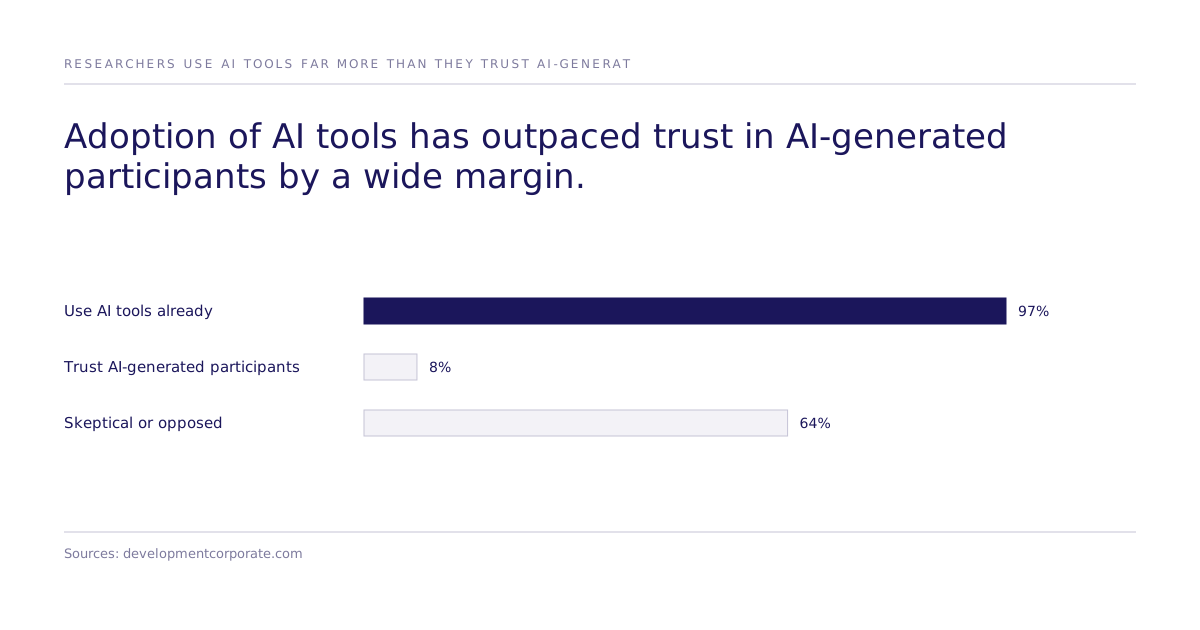
- Synthetic personas don't fix that: researchers who already use AI tools still say they don't trust AI-generated participants, by a wide margin.
- "Validate against a holdout sample" checks correlation with another uncontrolled sample, not causal identification.
- McFadden discrete choice, Mixed Logit, and ICLV are estimators; the randomized manipulation inside the experiment is what makes it causal.
- The buyer question that matters isn't who answered, it's whether the design can isolate which attribute moved the decision.
Is human versus synthetic even the right fight?
No. It's the fight the market is having, but it's the wrong one. Real capital is chasing the synthetic side of it: Simile raised $100 million in February 2026 with backing from Index Ventures, Fei-Fei Li, and Andrej Karpathy, and Aaru raised more than $50 million in December 2025 with Accenture as an investor. ESOMAR issued 2025 guidance requiring disclosure and holdout validation whenever synthetic data is used. All of that money and all of that guidance still assumes the deciding factor is which population answered the survey, human or simulated. It isn't. A panel of verified, real humans answering an unrandomized questionnaire and a chatbot persona answering the same unrandomized prompt fail the same way: both produce a stated preference with no controlled variation behind it, so neither can tell you what a specific price, feature, or message change caused in choice behavior.
Why don't human panels count as the trustworthy baseline anymore?
Because the baseline itself is contaminated. An estimated 40 percent of nonprobability survey interviews in 2025 were likely fraudulent, roughly 2 billion fraudulent interviews industry-wide, according to NORC at the University of Chicago. That estimate covers nonprobability panels specifically, not every survey method NORC tracks, but it's the segment most market research automation tools draw from. Worse, the industry's main fraud filter no longer works: AI agents completing surveys now pass 99.8 percent of attention checks, according to CloudResearch, the exact test panels use to catch inattentive or fraudulent respondents. That figure describes attention-check evasion, not an overall fraud rate, but it means the checklist researchers have relied on for a decade no longer separates real attention from bot behavior. A "verified human panel" claim is only as good as a verification method that bots now pass at nearly the same rate as people.
What does the researcher trust gap actually measure?
It measures that researchers already sense the problem, even without a causal framework to name it. In a 2026 survey covered by Development Corporate, 97 percent of surveyed researchers said they already use AI tools in their work, yet only 8 percent said they trust AI-generated participants outright, and 64 percent remain skeptical or opposed. The survey reflects self-reported sentiment, not a controlled trust experiment, but the gap between adoption and trust is the tell. Researchers are adopting AI for speed while withholding trust for the decisions that matter, which is a reasonable instinct pointed at the wrong target: the missing piece isn't more verification of the persona, it's randomization in the design.
Academic review of the underlying method is blunter. A 2024 study in Political Analysis examined whether large language models can stand in for human survey respondents and found systematic limits to treating LLM output as a replacement for individual-level human data, not just a bias to correct for (Political Analysis, Cambridge Core). That finding sits underneath the trust gap: researchers are right to withhold trust, they just haven't named why.
Does a holdout sample prove causation?
No, and this is the misconception the "disclose and validate" checklist doesn't correct. Validating a synthetic run against a human holdout sample checks whether the two uncontrolled samples correlate, not whether either one identifies what caused a choice. Correlation between a panel's stated answer and a persona's simulated answer tells you the two methods agree, or don't; it says nothing about which attribute, price, feature, or message, drove the outcome, because nothing in an unrandomized survey isolates that variable. Causal identification requires a randomized manipulation inside the experiment design itself. In Subconscious's own validation set, our best configuration reaches 87% of the measured human ceiling on one study: 0.832 rank correlation against the published human result, where two independent samples of real humans reach 0.959. Across all 43 studies that pass design filters the mean is 0.73 (the causal fidelity paper). That's a validation-set result, not a guarantee for a market that hasn't been tested yet, and it comes with a separate limitation worth stating plainly: published human studies used for this kind of check can already sit inside a model's training data. A replication protocol has to control for that risk directly; pretending it doesn't exist is worse than disclosing it.
Human panel, synthetic persona, or randomized experiment: how the three compare
| Human panel (unrandomized) | Synthetic persona (unrandomized) | Randomized discrete choice experiment | |
|---|---|---|---|
| What you get | Stated preferences from real people, no attribute randomization | Simulated preferences from an LLM persona, no attribute randomization | Choices across randomized attribute bundles (price, feature, message) |
| Known failure mode | ~40% of nonprobability interviews likely fraudulent in 2025; bots pass 99.8% of attention checks | No verified population behind the persona; only 8% of researchers report trusting it | Requires validation against a human baseline; results are population- and time-bound |
| What it proves | Correlation between a stated answer and a respondent profile | Correlation between a simulated answer and a prompt | Which attribute change moved the choice, within a stated confidence interval |
| Best for: | Exploratory, low-stakes reads where fraud screening is airtight and the budget covers verification overhead | A fast, cheap directional pre-screen before a bigger spend, never a launch decision | Decisions that need to know which specific attribute drives the outcome, with a confidence interval attached |
Where McFadden discrete choice, Mixed Logit, and ICLV fit
They're estimators, not causal methods on their own. Write it plainly: randomized experiments analyzed with discrete choice models, never "causal methods like DCE." McFadden discrete choice models, Mixed Logit, and ICLV all model the choices a respondent makes; what makes the resulting effect causal is the randomized manipulation of attributes inside the experiment design that precedes the modeling. Mixed Logit adds one practical advantage over a flat multinomial logit: it relaxes the independence of irrelevant alternatives (IIA) assumption, which matters directly for preference-share and substitution questions, since a flat logit can predict share shifts that don't reflect real substitution because it treats each alternative as unrelated to the others. ICLV adds latent constructs, useful when the attribute you care about (trust, perceived quality) isn't directly observable. None of the three, on its own, turns an unrandomized survey into a causal read. And if a vendor quotes a willingness-to-pay number from either a human panel or a synthetic run, ask whether the design is incentive-aligned; stated WTP runs high otherwise, a say-do gap, not a defect unique to synthetic data. A confidence interval from a randomized simulated experiment covers the effect within the population tested; it doesn't, by itself, bound what happens when the product ships to the real market.
A decision checklist for the senior buyer
Before signing with any market research automation vendor, human panel or synthetic, ask for three things:
- Was any attribute (price, feature, message) randomized across respondents, or was every respondent shown the same unrandomized survey?
- What confidence interval covers the reported effect, and for which population does it apply?
- Was the result checked against a held-out human study, and can you see the study, not just the match rate?
If a vendor can't answer all three, you're being sold correlation dressed as insight, regardless of whether the respondents were verified humans or LLM personas. The public leaderboard tracks method-by-method replication scores if you want to compare providers directly, and the methods and validation archive covers the estimator-level detail behind DCE, Mixed Logit, and ICLV in more depth than fits here.
Your next step doesn't require a call: pull your last three vendor reports and check whether any of them named a randomized attribute manipulation and a confidence interval, or just a sample size and a trust badge. If none did, you know what to ask for next time. When you're ready to test a specific pricing, feature, or messaging decision against a randomized design, book time with the team.