Classification of quality issues in survey sample
A pricing manager deciding whether to trust a survey sample before setting a launch price is really weighing two separate quality questions, and most tooling shipping in 2026 answers only one. The first is respondent-level: was this a real, attentive human, not a bot, a speeder, or a duplicate account. The second is causal: does that real human's answer predict what they will actually do. Fraud-detection tooling has gotten very good at the first question and has almost nothing to say about the second, which is the more expensive one to get wrong.
- Survey sample quality splits into two separate checks: respondent-level (was this person real and attentive) and causal (does an honest answer predict real behavior).
- Fraud screens (attention checks, digital fingerprinting, speed and consistency filters) catch fake or inattentive respondents; they say nothing about whether a real respondent's answer predicts real behavior.
- The costliest classification error isn't a fake respondent. It's a real, verified one answering a hypothetical question in a design that was never built to predict behavior.
What quality issues does 2026 survey tooling actually classify for?
Nearly all of it classifies for fraud, not measurement validity. NORC estimates that roughly 40 percent of nonprobability survey interviews in 2025 were likely fraudulent, an estimate the firm puts at around 2 billion interviews, extrapolated from panel-level fraud rates rather than a direct industry census, with valid response rates on some panels falling from about 75 percent to about 10 percent (NORC). Vendors like Qualtrics, CloudResearch, Prolific, Research Defender, and Veridata sell respondent-level screens in response: digital fingerprinting, speed and consistency checks, duplicate-IP detection, attention-check pass rates. These tools answer one question well: is the person on the other end of this survey real and paying attention. They were built for a real and worsening problem. LLM-driven bots have passed attention checks at up to 99.8 percent in proof-of-concept testing while writing coherent, polished open-ended responses, even though most current fraud volume is still human click-farm labor rather than bots (NORC). None of these tools, however, evaluate whether the survey question itself, answered honestly, tells you anything about future behavior.
The academic root: Total Survey Error's two branches
The respondent-versus-measurement split isn't new; it comes from Total Survey Error, the framework Groves and Lyberg formalized in Public Opinion Quarterly. TSE divides survey error into a representation branch (coverage, sampling, nonresponse error, roughly: did you reach the right people) and a measurement branch (construct validity, questionnaire design, processing error, roughly: did the question and the answer mean what you think they mean) (Groves & Lyberg). Most quality frameworks built since inherit this structure loosely. The problem is that 2026's fraud-detection tooling has almost entirely colonized the representation branch and left the measurement branch, where hypothetical bias lives, mostly unaddressed by comparison.
Why fraud detection dominates the current conversation
Fraud is dominating because it's acute, visible, and now coordinated across the industry. NORC frames fraud as an existential threat to the nonprobability panel model rather than a solvable edge case (NORC). In late 2025 and 2026, MRS, ESOMAR, the Insights Association, and SampleCon began coordinating shared fraud definitions and standards across the industry (MRS). This is legitimate, necessary work. A dataset that's 40 percent fraudulent, per NORC's estimate above, is unusable regardless of what else is true about it. But coordination on fraud definitions doesn't touch the second problem, and a buyer who reads "data quality" as solved once fraud is filtered is solving the cheaper half of the problem.
Can a fraud-clean sample still be causally wrong?
Yes. A sample can pass every fraud, bot, and attention-check filter and still be causally wrong, because passing those filters only proves the respondent is a real, attentive human, not that the question they answered predicts what they'll do. A verified, 100 percent human respondent answering "would you buy this at $12" is still producing stated-preference data, and stated preference is subject to hypothetical bias regardless of how clean the panel is: stated willingness to pay tends to run higher than what the same respondent would actually pay in a real transaction. No digital fingerprint or speed check touches that gap, because it isn't a fraud problem. It's a design problem: nothing about the question forced a real tradeoff the way an actual purchase decision would.
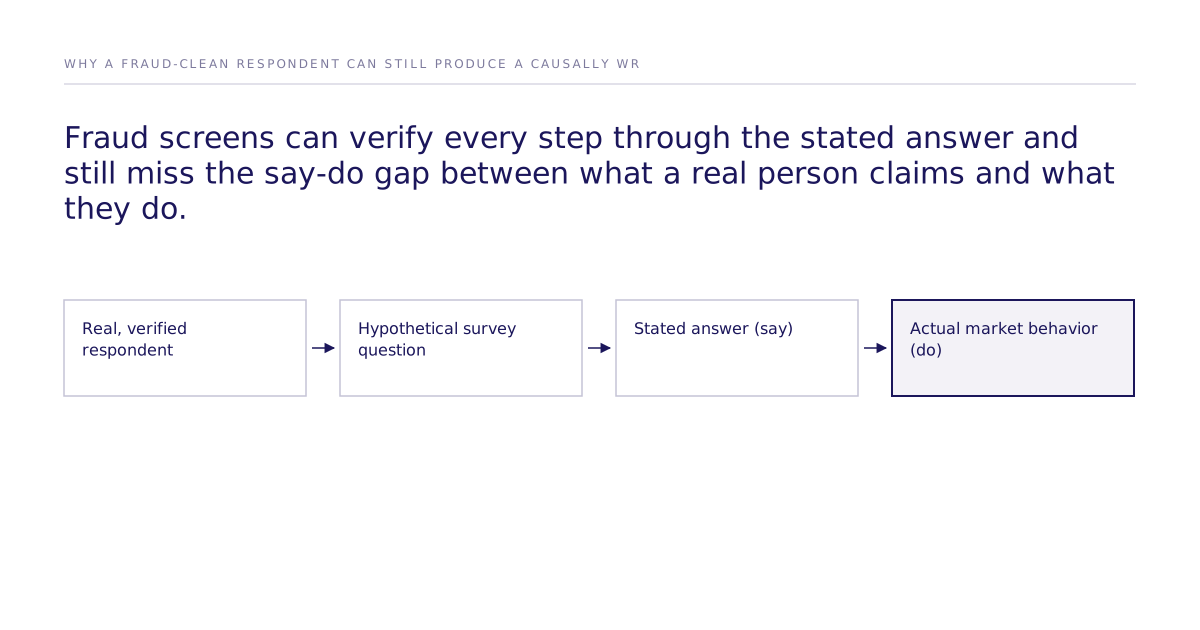
The two classification systems are answering different questions, and treating them as one continuum is the mistake:
| Respondent-level fraud screen | Causal validity check | |
|---|---|---|
| Question asked | Is this respondent real and attentive? | Does this design's answer predict behavior? |
| Tools | Digital fingerprinting, speed checks, duplicate-IP detection | Randomized manipulation, incentive-aligned design, held-out replication |
| Catches | Bots, speeders, duplicate accounts, professional panelists | Hypothetical bias, say-do gap, unpredictive question design |
| Blind to | Whether an honest answer predicts real action | Whether the respondent pool is representative or fraud-free |
| Best for | Cleaning a dataset before any analysis begins | Deciding whether the analysis, once run, is worth acting on |
How a causal validation approach classifies quality differently
A causal approach asks a different question. Not whether the respondent is real, but whether the design forces a real tradeoff, the kind that produces answers that predict behavior. Then it checks that prediction against a held-out human result. That means running a randomized experiment, where the manipulation itself identifies a causal effect, and analyzing it with discrete choice models: McFadden discrete choice, Mixed Logit, and ICLV are estimators for that analysis, not causal methods in themselves. The causal identification comes from the randomized manipulation in the design, not from the estimator applied afterward.
Subconscious runs this kind of study on a simulation of a market, then checks it against a real, held-out human study. Across that validation set, our best configuration reaches 87% of the measured human ceiling on one study: 0.832 rank correlation against the published human result, where two independent samples of real humans reach 0.959. Across all 43 studies that pass design filters the mean is 0.73, documented in the causal fidelity paper. That's a validation-set result, not a guarantee for a new market you haven't tested yet, and it comes with a caveat worth stating plainly: some of the published human studies used to validate it could sit in a model's training data, which is exactly the kind of contamination the replication protocol is built to catch rather than pretend doesn't exist. Results published on the public leaderboard carry a confidence interval scoped to the simulated population tested, not the real market unconditionally. More on how these studies are built and checked is on the methods and validation hub.
What should a buyer check before trusting a sample's quality?
Check both branches, not one. First, confirm the fraud screen: what bot, speed, and duplicate-detection methods were applied, and what fraud rate they found, given NORC's finding that some panels' valid response rates have fallen to about 10 percent. Second, and separately, confirm the design: was the question a hypothetical stated-preference item, or a randomized experiment with a forced tradeoff, and was it checked against a held-out human result rather than only against internal consistency. A spotless dataset that never answers the second question hasn't been validated. It's just been cleaned.
A reader can start by pulling one recent stated-preference study from their own program and asking whether it forced a real tradeoff or a hypothetical one. That single check surfaces most of the gap described above without any new tooling. For a closer look at how a specific market or decision would hold up under a randomized, replicated design, meet with the team.