Conversational surveys explained in 6 minutes
A research or insights leader evaluating an AI-moderated interview tool needs one distinction before signing a contract: a conversational survey produces a longer, more textured stated opinion, not a validated prediction of behavior. The format swaps static Likert and open-end items for an LLM that asks adaptive follow-up questions, which is how Outset.ai, Listen Labs, Conveo, Strella, and a growing list of vendors now pitch qualitative and quantitative research alike. That gets a buyer more words per respondent and a higher completion rate. It does not, by itself, get them evidence that those words predict what the respondent will actually do.
- What it is: a chat or voice interview where an LLM asks adaptive follow-ups instead of fixed survey items, marketed on completion rate and response depth.
- Why adoption is accelerating: embedded adaptive interviews report completion rates far above linked email surveys, at a moment when traditional response rates keep falling.
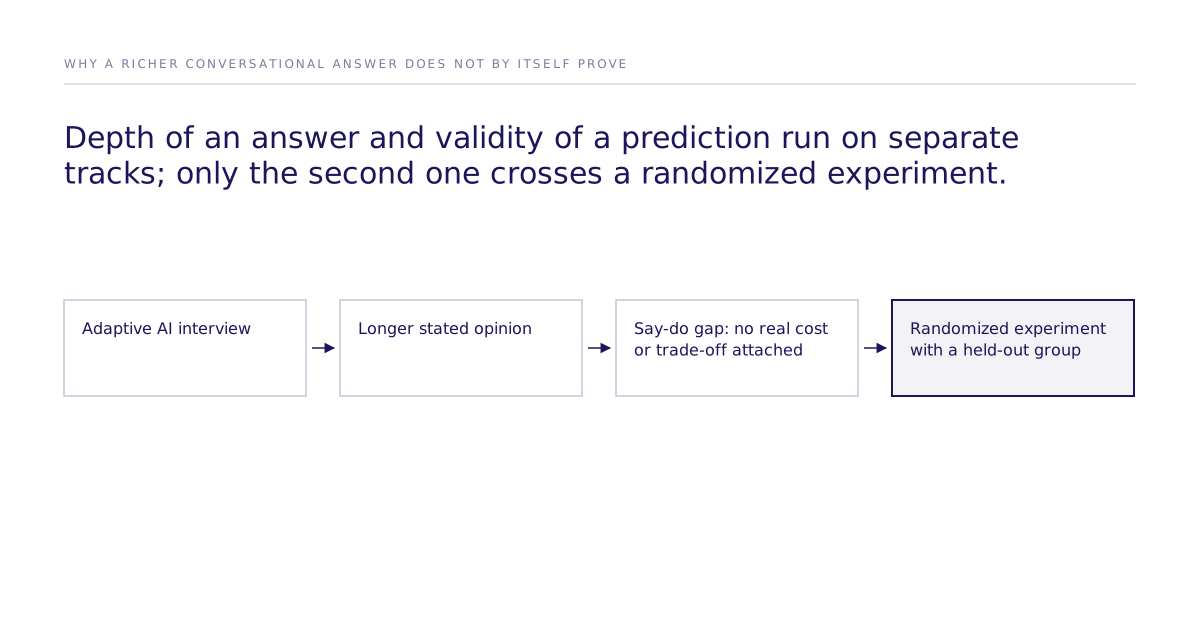
- What it doesn't fix: the say-do gap. Longer self-report is still self-report; nothing about the format attaches a real cost or trade-off to the answer.
- A new risk it adds: the AI moderator's own question-selection pattern is itself an uncontrolled interviewer effect, on top of the say-do gap.
- The fix: randomize the decision, not just the follow-up question, and check the result against a held-out human study.
What is a conversational survey?
A conversational survey is an interview in which an LLM asks adaptive follow-up questions based on what a respondent just said, instead of presenting the same fixed set of items to everyone. Outset.ai claims more than 500,000 AI-moderated interview hours across 10,000-plus studies in 85-plus countries, a vendor self-report on its own competitor-comparison page with no independent audit (Outset.ai). Listen Labs, Conveo, Strella, User Intuition, and Quals.ai run comparable products, and legacy platforms like Qualtrics and SurveyMonkey are adding conversational modules of their own. The pitch is consistent across vendors: richer, more human-sounding answers, gathered faster than a moderated human interview.
Why adoption is accelerating now
Adoption is accelerating because response rates to conventional surveys have been declining for years and conversational formats convert noticeably better on paper. Linked email surveys convert at roughly 6 to 15 percent, while embedded adaptive AI interviews report completion rates in the 40 to 70 percent range in early-2026 benchmark data (getperspective.ai). The two figures aren't measuring the same population: an embedded interview reaches someone already inside a panel or a live session, while a cold email invite has to earn the click first, so the gap overstates what switching format alone would buy. Vendors also advertise responses several times longer than matched open-end fields. For a research team measured on response volume, that gap is still enough to justify a switch on its own.
What a longer answer actually measures
A longer answer measures engagement and articulateness, not decision validity. None of the standard conversational-survey quality metrics are validated against what the respondent actually chose afterward: word count, completion rate, a vendor's proprietary "emotional intelligence" score. They measure how much a person said and how fluently, not whether saying it predicts doing it. That gap between stated opinion and actual behavior is the say-do gap, and it predates conversational formats. Adaptive follow-ups increase the volume and texture of an opinion; they do not attach a real trade-off or cost to it, so a respondent can still rationalize, anchor to what sounds socially acceptable, or answer a hypothetical as if it were free.
Does a richer answer predict an actual decision?
Not on its own, and current evidence points to a second problem stacked on top of the first. AAPOR's 2026 guidance states that generative AI is reshaping survey research faster than existing methodological and governance standards can keep pace, and it specifically flags unresolved questions about the interviewer effects an AI moderator introduces on its own (AAPOR, PDF). That concern isn't hypothetical: an AI moderator makes its own choices about which follow-up to ask next, and that choice is a form of interviewer effect, just one AAPOR says the field doesn't yet have standards to measure. Separately, academic work on reinforcement learning for adaptive follow-up selection (AURA) is trying to reduce satisficing and raise response depth algorithmically, but the authors treat this as an active, unsettled research area, not a finished standard (arXiv). So the AI moderator is not a neutral pipe for collecting deeper opinion; it has its own question-selection bias, layered on the say-do gap the format was supposed to fix.
Self-report or randomized experiment: what you're buying
The honest way to tell them apart is to ask what varies and what's measured against it.
| Conversational interview | Randomized experiment | |
|---|---|---|
| What varies | Follow-up questions, chosen by the AI moderator | Price, features, or messages, randomly assigned across respondents |
| What's collected | Stated opinion, in more words | An actual choice, forced or incentive-aligned |
| What validates it | Completion rate, word count, sentiment score | Replication against a held-out human study |
| Known bias | Say-do gap, plus the moderator's own question-selection bias | Hypothetical bias if the choice isn't incentive-aligned |
| Best for | Discovery, hypothesis generation, open-ended exploration | Deciding which action to take when the decision has real cost |
How a randomized experiment closes the say-do gap
A randomized experiment closes the gap by making the trade-off inside the question match the trade-off in the market, then analyzing the resulting choices instead of asking respondents to narrate their preferences. Subconscious runs randomized experiments analyzed with discrete choice models, specifically McFadden discrete choice, Mixed Logit, and ICLV; these are estimators that recover preference structure from a randomized manipulation, not causal methods on their own. The causal identification comes from the randomization built into the experiment design, not from the estimator that reads it out. Publishing the assumption behind a number is what lets a buyer check it before trusting the number. A plain multinomial logit model carries an independence-of-irrelevant-alternatives assumption, and Mixed Logit is one way to relax that assumption when substitution between options matters, so a preference-share number from a flat logit should be read with that constraint in mind.
Replication accuracy is the number worth pressing a vendor on. Our best configuration reaches 87% of the measured human ceiling on one study: 0.832 rank correlation against the published human result, where two independent samples of real humans reach 0.959. Across all 43 studies that pass design filters the mean is 0.73, per the causal fidelity paper. It's a validation result, not a guarantee for a market that hasn't been tested yet, and because some of the underlying published studies could plausibly sit inside a model's training data, that number alone doesn't rule out memorization; the replication protocol behind it, and the ongoing public results on the leaderboard, matter more than the headline figure.
Where conversational interviews still earn a place
They earn a place upstream, in discovery, not downstream, in the decision. An adaptive interview is a reasonable way to surface language, objections, and hypotheses before a study is designed; it's a poor way to validate which of those hypotheses will actually move a purchase, signup, or churn decision. The methodical version of that workflow, generate hypotheses conversationally, then test the ones that matter with a randomized experiment, is covered in more depth in the methods and validation hub.
Before renewing a conversational-survey contract, ask the vendor for one number: their predictive-validity or replication rate against real purchase, usage, or churn data, not completion rate, not word count, not a proprietary sentiment score. If they don't have one, the tool is measuring engagement, not decision validity. From there, book time to see how the replication protocol works against your own market.