How to get the most out of video interviewing in surveys?
A research buyer weighing video interviewing for an upcoming study is really deciding how much weight to put on what respondents say on camera versus what a randomized experiment shows they actually choose. The direct answer: video interviewing produces richer testimony and higher respondent satisfaction, but the camera itself changes the data. Respondents round numbers more and give more socially desirable answers on video than they do on a web survey. So the way to get the most out of it is to use it for hypothesis generation and stakeholder buy-in. Then validate the resulting claims with a randomized experiment that measures choice, not self-report.
- Use video interviews to surface language, objections, and hypotheses, not to measure demand.
- Expect on-camera bias: a 1,067-respondent study found live video interviewees round more numerical answers and give more socially desirable, less sensitive responses than web-survey respondents.
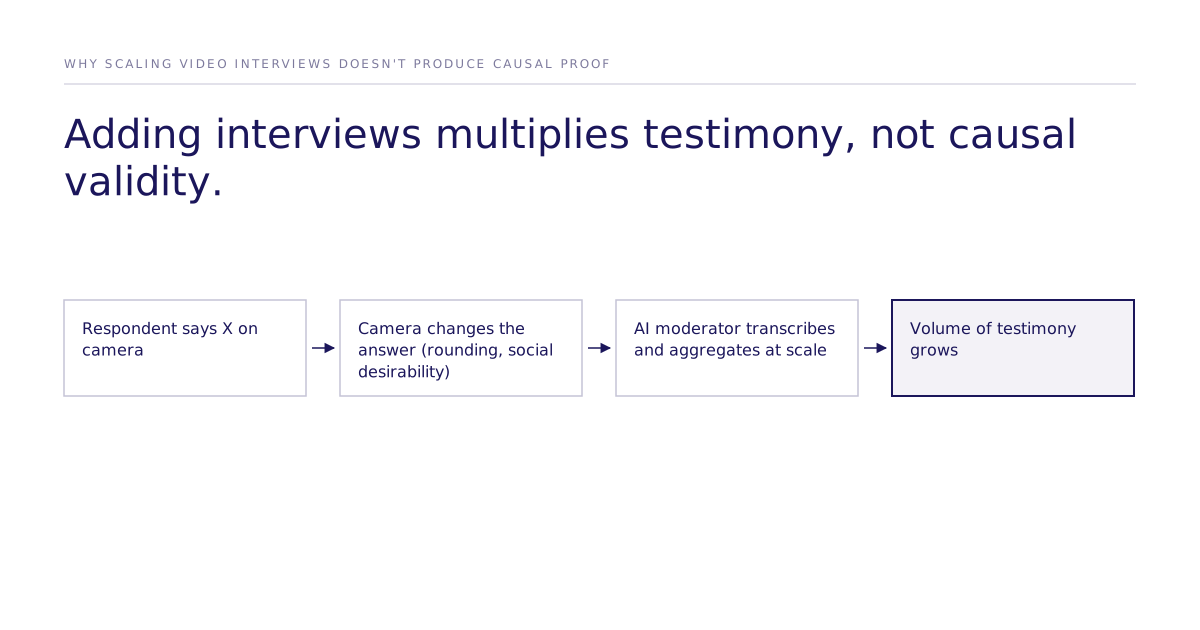
- AI-moderated scale changes volume, not causal validity: more interviews still means more stated preference, not a randomized manipulation.
- To find out what people will actually do, run a randomized discrete choice experiment, not a bigger interview program.
- Before trusting any simulated or synthetic result, ask for its replication accuracy and how that number is defined.
Does video interviewing change what respondents say?
Yes. The same peer-reviewed study vendors cite for "video improves engagement" also found that being on camera changes the substance of the answer. In a study of 1,067 respondents comparing live video, prerecorded video, and text web surveys, live video interviewees rounded more numerical answers and gave more socially desirable, less sensitive responses than web-survey respondents, even though they reported higher satisfaction with the experience (mda, 2023). A cited number is only useful once its boundaries are on record. That sample was drawn for survey-methodology research, not a commercial buying decision, so the exact bias sizes may not carry over to a product or pricing study, but the mechanism behind them, a person watching changes the answer, does. Peer-reviewed guidance on live video design attributes this to interviewer presence itself: a moderator on screen introduces time pressure and social presence effects that a text or async format doesn't have (Survey Practice). So the richness a video interview adds and the bias it introduces come from the same source: a person is watching. Warmer testimony and skewed testimony are not two separate effects to weigh against each other. They're the same camera.
"those interviewed via live video were less likely to select the same response for all statements in a battery (non-differentiation) and reported higher satisfaction with their experience but provided more rounded numerical (presumably less thoughtful) answers and selected answers that were less sensitive (more socially desirable)"
Conrad and colleagues, Methoden, Daten, Analysen (source)
Two vendor camps, and a new one scaling with AI
Video interviewing in market research has split into two camps for years, and neither solved the core trade-off between depth and scale. Voxpopme built async, self-recorded video depth: respondents film themselves answering prompts on their own time, which scales better than live moderation but loses the follow-up questions a moderator would ask. Discuss.io built live-moderated video panels: real depth through real-time follow-up, but bound by how many interviews a human moderator can run in a day.
The disruption is AI moderation. Listen Labs, founded in 2023, has conducted over one million AI-moderated video and voice interviews (VentureBeat), a company-reported figure relayed through VentureBeat, not independently audited. That volume changes the scale side of the trade-off. It does not change the depth-versus-truth question the mda study raised: an AI moderator asking better follow-up questions still can't stop the camera from changing the answer.
Does AI-moderated video interviewing at scale fix the causal gap?
No. Scaling video interviews with AI moderation multiplies the volume of testimony, not the causal validity of what it tells you. A million AI-moderated interviews is still purposive, stated-preference data: respondents opted in, nobody was randomly assigned to a condition, and there's no counterfactual against which to measure what they would have said or done otherwise. Qualitative methodologists have been raising a related warning for years about sample size in interview studies specifically: a systematic 15-year review found that qualitative interview sample sizes are predominantly characterized as insufficient, and justifications for "how many interviews is enough" are routinely absent or ad hoc (BMC Medical Research Methodology). Scale doesn't resolve that problem, it just makes the ungrounded claim bigger. More interviews narrow the confidence interval around what people said. They do nothing for the gap between what people said and what they'll actually do.
Video interviews versus a randomized experiment
| Voxpopme (async self-recorded) | Discuss.io (live moderated) | Listen Labs (AI-moderated, at scale) | Randomized discrete choice experiment | |
|---|---|---|---|---|
| Data collected | Self-recorded video testimony | Live moderated video testimony | AI-moderated video and voice testimony, over one million interviews conducted, company-reported ([VentureBeat](https://venturebeat.com/technology/listen-labs-raises-usd69m-after-viral-billboard-hiring-stunt-to-scale-ai)) | Recorded choices under a randomized manipulation |
| Sample logic | Purposive, self-selected recorders | Purposive, moderator-recruited | Purposive, AI-moderated at higher volume | Randomized assignment across experiment conditions |
| What it measures | What people say they'd do | What people say they'd do, with real-time follow-up | What people say they'd do, at scale and lower cost per interview | What people actually choose, with a measurable effect and confidence interval |
| Best for: | Fast, low-cost qualitative color when scale doesn't matter | Deep exploration where a live moderator can chase an unexpected answer | Qualitative depth at scale when speed matters more than causal proof | Decisions with real budget behind them, where you need to know which action moves the outcome |
When does video interviewing earn its place in a survey program?
It earns its place early, before you've decided what to test. The standard advice for running a good video interview still holds: ask open-ended questions instead of yes-or-no ones, keep prompts tight, pilot before fielding, and start with respondents who'll actually record comfortably on camera (Survey Practice). What that advice leaves out is the handoff. A good video interview program produces a shortlist of hypotheses and language, not a demand estimate. The mistake is letting a well-run interview study, or a well-run AI-moderated one, stand in as the evidence for a decision that has real budget behind it. That's where the study needs a second stage, one built to measure choice under a randomized manipulation rather than to collect a better-worded opinion.
How does a randomized experiment answer the question video can't?
A randomized experiment answers it by manipulating the thing you're actually deciding about (a price, a feature, a message) and measuring which action changes the outcome, instead of asking respondents to describe their own reaction to it. Subconscious runs these as randomized experiments on a simulation of the market, then checks the simulation against real human behavior. Our best configuration reaches 87% of the measured human ceiling on one study: 0.832 rank correlation against the published human result, where two independent samples of real humans reach 0.959. Across all 43 studies that pass design filters the mean is 0.73 (the causal fidelity paper). A raw performance number is marketing without its limits stated plainly. That's a validation-set result, not a guarantee for a market that hasn't been tested before. Published studies can also sit inside a model's training data, which is why the replication protocol tracks holdout studies rather than trusting any single published number blind. The public leaderboard tracks these runs model by model, so a buyer can check current accuracy before putting a number from a deck in front of their own stakeholders.
The choice data from these experiments is analyzed with McFadden discrete choice models, Mixed Logit, and ICLV: estimators that recover preference structure from the choices people made, not causal methods on their own. The causal claim comes from the randomized manipulation in the experiment design, not from the estimator. A plain logit model carries the IIA assumption, that adding or removing an alternative doesn't change the relative odds between the others, which breaks down fast in real substitution patterns; Mixed Logit relaxes that assumption, which is why it's the standard choice for preference-share and substitution questions. The leaderboard puts every miss on the same page as every hit, and this confidence interval is one of the misses worth stating. Every effect reported this way carries a confidence interval that covers the effect inside the simulated population it was measured in, not a bound on the real market until it's been checked against a human baseline. More on how the estimators and the randomized designs fit together is in the methods and validation hub.
Before fielding another round of video interviews, pull the transcripts from the last study and tag every load-bearing claim as either "said" or "chose." If most of the claims driving the decision are "said," that's the gap a randomized experiment closes, not a bigger interview budget. When you're ready to run a randomized experiment against your own market, meet is the place to start.