What is implicit testing? (with examples)
A marketing leader deciding whether to greenlight a campaign, a package redesign, or a price change will eventually hear a pitch for implicit testing: measure how fast someone reacts to a logo or a word pair, and you'll see what they "really" think. Implicit testing is a reaction-time method, most often a version of the Implicit Association Test (IAT), that scores how quickly a respondent pairs a brand, ad, or product with positive or negative concepts, on the theory that faster pairings mean stronger automatic associations. It tells you which associations fire fastest in someone's head. The miss gets stated next to the number so a buyer sees both. It does not tell you what that person would actually choose, at what price, against which alternative, which is the only question a launch decision needs answered.
- Implicit testing measures reaction-time latency to reveal associative strength, not a choice or a purchase.
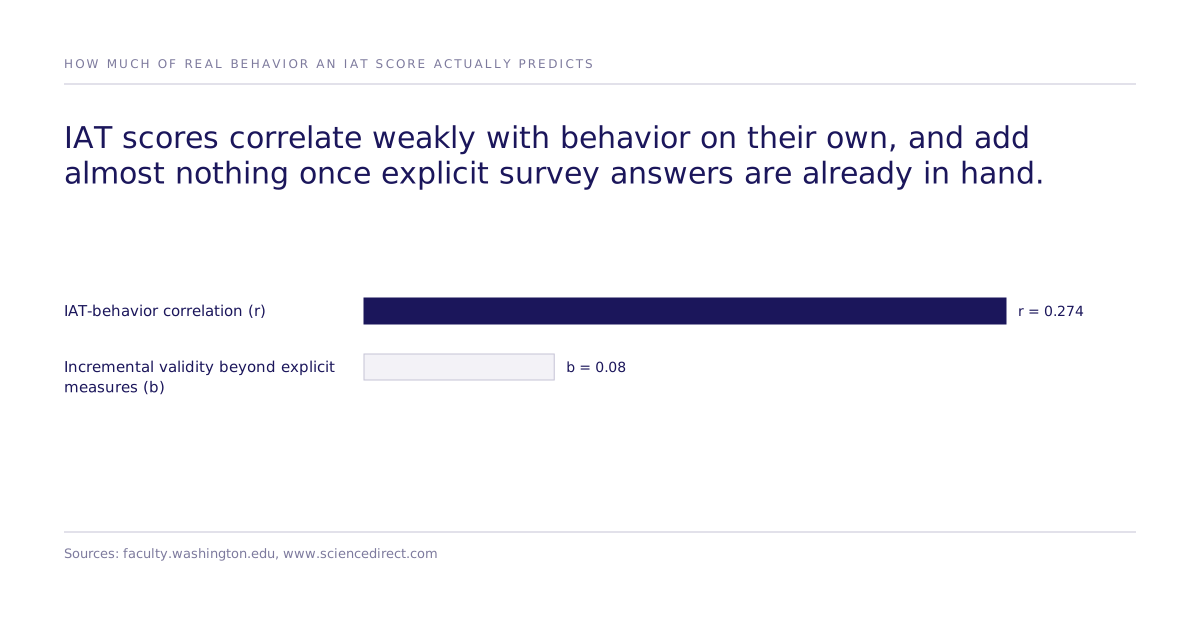
- A 2009 correlational meta-analysis by Greenwald et al., covering 122 studies and roughly 14,900 subjects, found IAT scores correlate with behavior at only .274; a correlational finding, not a causal one (meta-analysis).
- A re-analysis found IAT adds only b = .08 of incremental predictive validity once explicit survey answers are already in the model (re-analysis).
- NielsenIQ has publicly called commercialized reaction-time testing "modern snake oil," arguing vendors overstate what the underlying academic science supports (NielsenIQ).
- A randomized discrete-choice experiment gives a causal estimate of behavior change with a confidence interval, which is the input a launch decision actually requires.
How does implicit testing work?
Implicit testing measures the milliseconds it takes a respondent to associate a stimulus, a brand logo, an ad, a package, with a positive or negative concept. The assumption is that faster response times reflect stronger, more automatic associations that a person either can't or won't report in a normal survey question. Vendors position this as a fix for the say-do gap, the well-documented divergence between what people say they'll do in a survey and what they actually do, which researchers attribute partly to limited self-awareness and unconscious rationalization (cloud.army). The pitch: skip the rationalizing, measure the reflex.
What are examples of implicit testing?
The category covers a handful of related tools, all built on the same reaction-time logic:
- IAT (Implicit Association Test): the original academic instrument, pairing a target concept with positive or negative attributes and timing the response.
- SIAT (Single-Category IAT) and MIAT (Multi-category IAT): variants that test one brand or several brands against a fixed set of attributes, common in commercial ad and packaging pretests.
- Reaction-time ad and brand-tracker modules: sold as add-ons inside broader research suites from firms like Zappi, System1, Kantar, and Split Second Research, usually bundled alongside a standard explicit survey.
In every case, the output is a latency score or an implicit association index, not a choice, a purchase intent estimate, or a market share number.
Does implicit testing predict what people actually do?
Weakly, on its own, and barely at all once you already have explicit survey data. The most-cited meta-analysis of IAT predictive validity, Greenwald et al. (2009), covering 122 studies and roughly 14,900 subjects, found an average correlation of .274 between IAT scores and behavioral, judgment, and physiological outcomes (meta-analysis). A later re-analysis asked a sharper question: once you control for what an explicit survey already tells you, how much additional predictive power does the IAT contribute? The answer was b = .08, which the authors concluded is not a practically meaningful addition (re-analysis).
Is implicit testing "modern snake oil"?
Naming a competitor's criticism instead of burying it is what lets a buyer check the claim against the source. That's the term NielsenIQ used in print, and it's aimed specifically at commercialized reaction-time methods like System1's, not at the original academic IAT. NielsenIQ argues that the science behind these commercial products has drifted from what the underlying academic research actually supports, and that brands making campaign or spend decisions on reaction-time deltas are making costly mistakes as a result (NielsenIQ). The critique lands because it comes from inside the research industry, not from a company selling a competing method.
Implicit testing versus a randomized experiment
Both implicit testing and stated-preference surveys are proxies. Neither puts a respondent in front of a real tradeoff and measures what they choose.
| Implicit/reaction-time testing | Stated-preference survey | Randomized discrete-choice experiment | |
|---|---|---|---|
| What it measures | Response latency to a stimulus | What a respondent says they'd do or feel | What a respondent chooses when randomly assigned tradeoffs (price, feature, message) |
| What it can't tell you | What the person would choose, at what price, against what alternative | Whether the stated answer matches real behavior (the say-do gap) | Behavior outside the range of options tested |
| Validity evidence | r = .274 with behavior (Greenwald et al., 2009, [meta-analysis](https://faculty.washington.edu/agg/pdf/GPU&B.meta-analysis.JPSP.2009.pdf)); b = .08 incremental validity ([re-analysis](https://www.sciencedirect.com/science/article/abs/pii/S0022103119305682)) | No independent validity benchmark; documented say-do gap between stated and revealed preference | Causal identification comes from the randomized manipulation itself, not the estimator |
| Best for | Screening raw creative or logo associations early, when the cost of being wrong is low | Cheap, fast directional read when no decision is riding on precision | A launch, price, or messaging decision where the cost of being wrong is real |
What does a causal alternative look like?
Randomized experiments analyzed with discrete choice models. McFadden discrete choice, Mixed Logit, and ICLV (Integrated Choice and Latent Variable) are the estimators; they're not what makes the result causal. Identification comes from randomly assigning respondents to different prices, features, or messages and observing what they choose, the same logic as a randomized controlled trial, applied to a market decision instead of a drug. That's a materially different claim than a reaction-time delta: it's an estimate of behavior change with a confidence interval, and that interval covers the effect within the tested population, not a guarantee about the real market outside it.
Subconscious runs these randomized experiments on a simulation of a market and validates the results against real human studies. Our best configuration reaches 87% of the measured human ceiling on one study: 0.832 rank correlation against the published human result, where two independent samples of real humans reach 0.959. Across all 43 studies that pass design filters the mean is 0.73, published with methodology in the causal fidelity paper. That's a validation-set result, not a guarantee for a new, untested market, and because some published studies could plausibly sit inside a model's training data, the replication protocol is built to test against that risk rather than assume it away. Current replication results by study are public on the leaderboard. More on how the estimators and the experiment design fit together is in the methods and validation hub.
When does implicit testing still make sense?
Stating where a method still works is part of publishing its limits. For low-stakes, early-stage screening, ruling out a logo or tagline with an obviously negative gut association before spending on production, implicit testing is a cheap filter. What it isn't is evidence for a launch, price, or campaign-spend decision. The .274 correlation and the .08 incremental validity number are ceilings on what reaction time can tell you about behavior; they don't move regardless of how the test is packaged or which vendor sells it. A buyer weighing implicit testing against a randomized experiment is really choosing between an association-strength score and a causal estimate of what people would do, and only one of those answers the question a launch decision is actually asking.
Next step: pull the incremental-validity number for whatever implicit testing tool is on the table now. b = .08 is the published baseline. Ask the vendor what their design adds beyond that before signing off on it. If the decision warrants a causal estimate instead, get in touch.