A Latent Timing Segment Is a Hypothesis, Not a Reason to Move Budget
A model that groups customer activity by day and hour can hand you a clean story: "this segment is active Tuesday mornings." That pattern is already in the data. It does not tell you what happens if you change your timing, targeting, or messaging around it.
What decision does this method force marketers to make?
A CMO or head of marketing analytics who runs this kind of pattern-discovery model faces a narrow choice: treat the segment as an actionable driver and shift spend or scheduling toward it, or treat it as a hypothesis and test the action before committing budget.
Get this wrong and a team shifts spend, send times, or messaging toward a segment whose weekly rhythm is correlational, sees no lift, and only then learns the pattern described what already happened, not what would change under a new action.
How does the underlying model work?
The technique is Latent Dirichlet Allocation (LDA), the same unsupervised topic model used in natural language processing, applied here to discretized calendar timestamps instead of words.
The mapping:
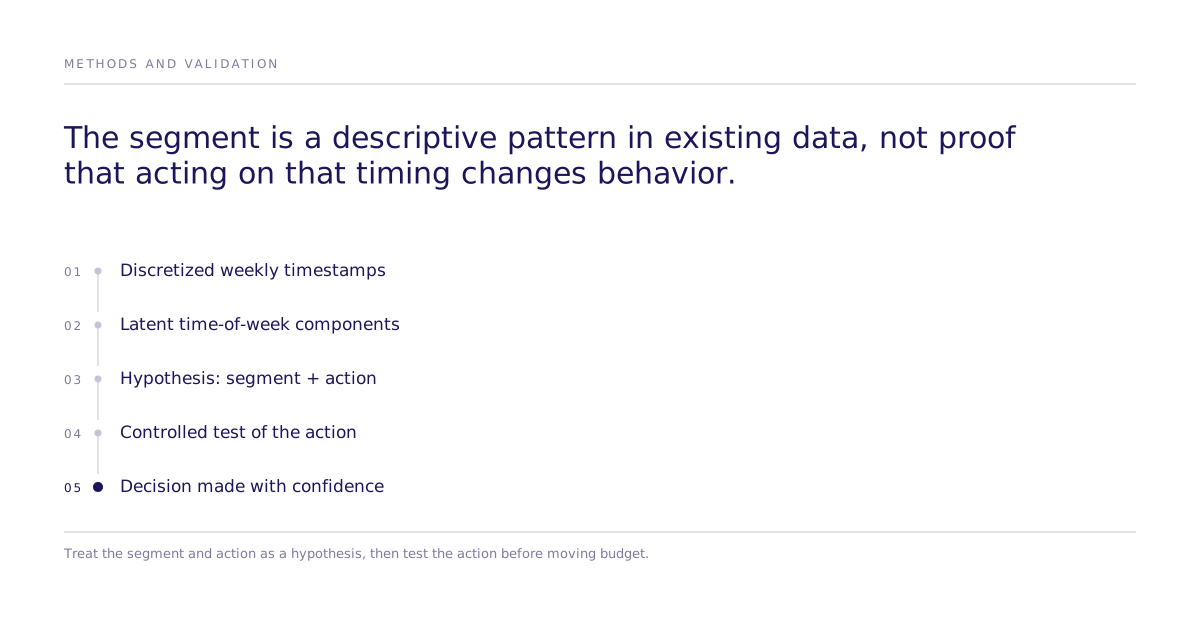
- Timestamps for an entity (a customer, a location, a driver) are discretized into calendar slots, such as day-of-week and hour-of-day.
- Each entity's slot counts become a "document," the same role a bag of words plays in text topic modeling.
- LDA learns a small number of latent time-of-week components, the role topics play in text: recurring patterns of activity concentrated in particular slots.
- Each entity gets a mixture over those components, so its weekly rhythm is described as a blend rather than a single hard label.
The result is a compact, interpretable summary of when different entities tend to be active, built entirely from timestamps already on hand. The foundational method is documented in Latent Dirichlet Allocation (Blei, Ng, and Jordan, Journal of Machine Learning Research, 2003).
Where the method's own limits show up
Two properties matter for how much weight a decision can put on the output:
- A segment name carries little weight until its scope is stated next to it. It is descriptive, not causal. LDA groups co-occurring time-of-week behavior into latent components. It does not establish that intervening on one component (say, shifting an offer earlier in the week) changes an outcome for those entities.
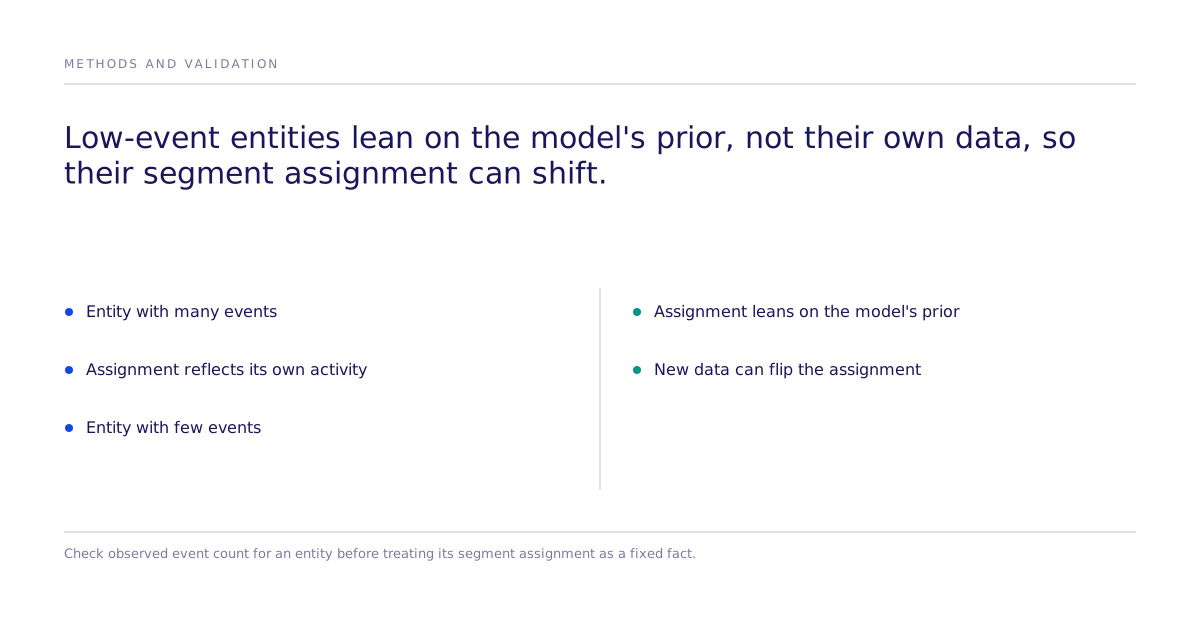
- Low-data segments are unstable. An entity with few observed events is assigned to a topic mixture that leans heavily on the model's prior rather than its own data, and that assignment can shift as more data arrives or prior settings change.
Stating what the method proves and what it leaves untested is what makes the output usable. The output is a discovered pattern, not a tested mechanism.
How do you turn the pattern into a tested action?
Subconscious complements this descriptive, unsupervised pattern discovery with controlled experiments that test whether a specific action changes an outcome for a defined segment, with confidence language where the study design supports it.
The practical sequence:
- Use the latent-component output to name a candidate segment and a candidate action, such as messaging it at a different time or with different content.
- Treat the pairing as a hypothesis, not a decision.
- Run a controlled test of the action against that segment before shifting spend or scheduling to match it.
When a decision depends on validating against real behavior, a team can move from a simulated experiment to a study with real human participants without changing the causal question being tested.
A checklist before acting on a timing segment
- Was the segment's assignment based on enough observed events, or is it leaning on the model's prior?
- Does the plan treat the segment as a hypothesis, or has spend already moved on the strength of the pattern alone?
- Has the specific action, not just the segment, been tested before it goes live?
Recurring weekly patterns are a starting point for a hypothesis, not a finished answer. See how Subconscious tests a specific action before it goes live.