The ROI of quality checks: never run consumer panels without them
Fraud screens catch bots. They don't catch a wrong pricing decision. Below is the article.
---
A VP of insights greenlighting a six-figure panel study has one real decision in front of them: whether a passed fraud screen is reason enough to trust the number that comes back. It isn't. Attention checks, digital fingerprinting, and speed traps confirm a respondent is a distinct, awake human. They say nothing about whether that human's answer predicts what they'll actually do when money is on the line. The return on a quality check that only authenticates the respondent is capped by the same say-do gap that has always undermined stated-preference research. The return that actually protects a launch or pricing call comes from replacing the stated-preference guess with a randomized experiment that reports its own confidence interval on the decision.
- A screen that checks authenticity says nothing about the decision on the other end, and that gap belongs on the record before the number does. Fraud screening (attention checks, digital fingerprinting, speed traps) verifies the respondent is real. It does not verify the answer is a causal prediction of behavior.
- Raw survey fraud runs 15 to 45 percent of responses depending on platform, and an AI agent can now pass as human 99.8 percent of the time against every detection method tested.
- Even a fully clean, human, attentive panel still overstates stated willingness to pay and purchase intent by roughly 1.35x to 3x, worse for novel or complex products.
- The ROI that matters isn't "fraud avoided." It's avoiding a pricing or feature decision that self-report data got backwards.
- Randomized experiments analyzed with discrete choice models report a confidence interval on the decision itself. Our best configuration reaches 87% of the measured human ceiling on one study: 0.832 rank correlation against the published human result, where two independent samples of real humans reach 0.959. Across all 43 studies that pass design filters the mean is 0.73.
What do fraud screens on a consumer panel actually verify?
They verify that the entity answering is a distinct, attentive human, nothing more. The industry baseline, ESOMAR/GRBN's Guideline on Online Sample Quality, specifies digital fingerprinting, geo-IP validation, machine-learning speeder detection, and "red herring" attention questions (shop.esomar.org). Every one of those checks operates on the respondent's behavior while taking the survey, not on the content of their answer. A respondent who clicks at a normal pace, passes every geo-IP check, and answers the red herring correctly can still tell you they'd pay a 20 percent premium for a feature they'd never actually buy. Authentication and validity are different claims, and procurement checklists routinely treat the first as a proxy for the second.
How much fraud is actually in panel data right now?
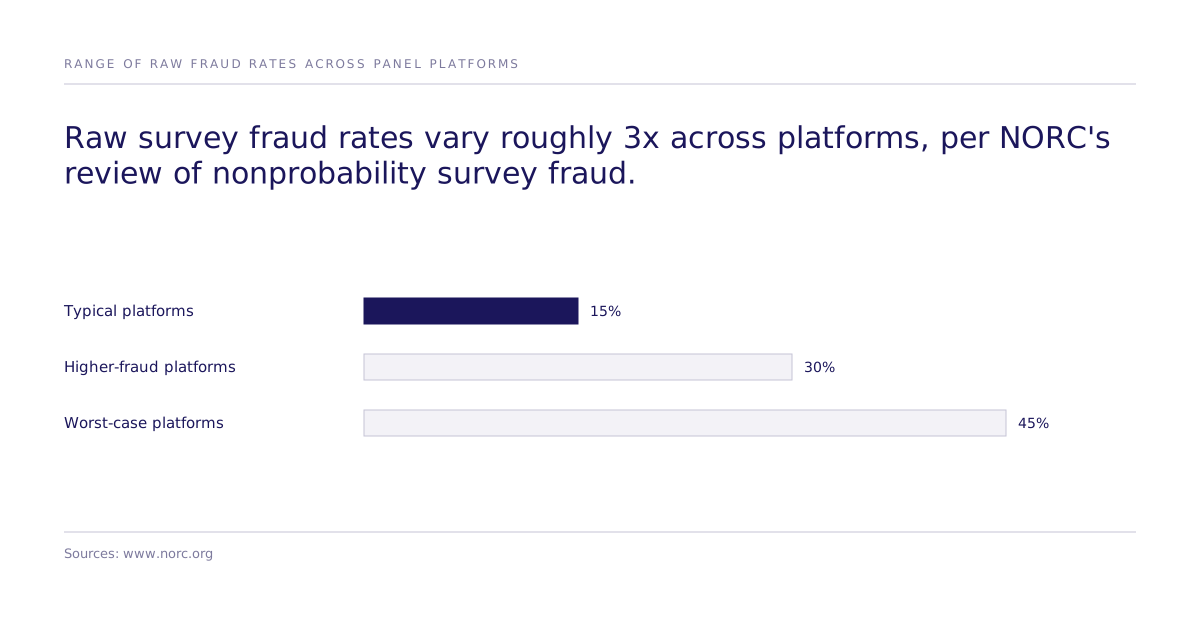
Enough that authentication alone is now a losing bet. NORC's literature review puts raw survey fraud at 15 to 30 percent of responses industry-wide, spiking to 45 percent on some platforms (norc.org). In 2025, Dartmouth's Sean Westwood built an AI agent that evaded every bot-detection method tested 99.8 percent of the time, producing a demographically-tailored survey response for about $0.05 against roughly $1.50 for a real panelist, and showed that injecting just 10 to 52 fake responses could flip the outcome of a major national poll (govt.dartmouth.edu).
"These aren't crude bots. They think through each question and act like real, careful people making the data look completely legitimate."
Sean Westwood, Dartmouth, Proceedings of the National Academy of Sciences (source)
Vendors like CloudResearch, Prolific, and Cint compete directly on layered screening against numbers like these. That's a real and necessary fight. It's also a fight that, won outright, still leaves the buyer with nothing more than a clean pipe carrying an unverified answer.
A clean panel can still hand you the wrong number
It can, because passing every ESOMAR-37 check says nothing about whether the choice a respondent made reflects real preference or agreeable guessing. This is the older, better-documented problem: the hypothetical bias literature, including Loomis's review of stated-preference valuation studies, finds that stated willingness to pay and stated purchase intent overstate real behavior by roughly 1.35x to 3x, and the gap widens for novel or complex products where respondents have the least grounded intuition about their own future behavior. Fraud screening was never designed to touch this. A verified, attentive, human respondent answering a hypothetical purchase-intent question is still answering a hypothetical question. Nothing about digital fingerprinting changes that.
Authentication checks vs causal quality checks
The two approaches to "quality" answer different questions, and a buyer who conflates them ends up paying for the wrong one.
| Fraud / authentication checks (ESOMAR-37, fingerprinting, speed traps) | Causal experiment validation (randomized experiments analyzed with discrete choice models) | |
|---|---|---|
| Verifies | The respondent is a distinct, attentive human | The relationship between a randomized manipulation and the resulting choice reproduces human behavior |
| Misses | Whether the stated choice predicts real behavior | Respondent authenticity by itself; it still needs fraud screening upstream |
| Supporting evidence | Industry baseline still passed by AI agents 99.8% of the time in Westwood's Dartmouth test | 87% of the measured human ceiling (0.832 against a 0.959 human-to-human ceiling; mean 0.73 across the 43 studies passing design filters) ([the causal fidelity paper](https://fidelity.subconscious.ai/papers/causal-fidelity/causal_fidelity_paper.pdf)) |
| Where it fails a buyer | A fully "clean" respondent can still overstate willingness to pay by 1.35x to 3x | The resulting confidence interval covers the effect within the simulated population studied, not an unconditional bound on the real market |
| Best for: | Screening non-human or inattentive traffic out of a study before analysis | Deciding whether an estimated effect is strong enough, and certain enough, to act on |
Where does the ROI actually come from?
It comes from avoiding the decision you'd have gotten backwards, not from the fraud you filtered. A randomized experiment, where the manipulation (price, feature bundle, message) is assigned at random and the resulting choices are analyzed with discrete choice models such as McFadden's multinomial logit, Mixed Logit, or ICLV, identifies causal effect through the randomization itself. The estimator doesn't make the claim causal; the design does. That distinction matters for a buyer's contract with the research: "randomized experiments analyzed with discrete choice models" is a defensible claim, "causal methods like discrete choice modeling" is not.
Our best configuration reaches 87% of the measured human ceiling on one study: 0.832 rank correlation against the published human result, where two independent samples of real humans reach 0.959. Across all 43 studies that pass design filters the mean is 0.73 (the causal fidelity paper); results are tracked on a public leaderboard. Two caveats a senior buyer should hold onto: this is a validation-set result, not a guarantee that it holds for a new, unstudied market, and because some of the human studies used for validation are published, they can sit inside a model's training data, which the replication protocol is built to detect and control for rather than a problem that goes away by assertion. The failure mode gets named here so a buyer can check it before betting a launch on it. A confidence interval produced this way covers the estimated effect within the simulated population studied. It is not an unconditional bound on what the real market will do.
One more precision worth naming: a plain multinomial logit assumes independence of irrelevant alternatives, so a preference-share or substitution question run on a flat logit should be checked against a Mixed Logit or ICLV specification, which relax that assumption, before a buyer treats the share numbers as final.
Does paying more for a cleaner panel fix the problem?
No, because cost and causal validity are separate axes and paying more only moves you along the first one. Cost per usable, high-quality respondent varies nearly 4x by platform: about $1.90 on Prolific and $2.00 on CloudResearch against $8.17 on Qualtrics panels, driven almost entirely by screening depth (NCBI/PMC). That's real money, and it buys a real thing: fewer bots, fewer inattentive respondents, a cleaner denominator. It does not buy a causal estimate. A buyer who pays $8.17 a head for the cleanest possible panel and then asks a stated-intent question has spent four times as much to get the same hypothetical-bias problem, just with fewer bots mixed in.
What should a senior buyer do before greenlighting the next study?
Separate the two budget lines. Keep fraud screening, at whatever tier the study's stakes justify, as the floor that keeps the input pool real. Then ask a second, harder question of the research design itself: does this study manipulate something at random and measure a choice, or does it just ask people what they'd do? If it's the latter, the "ROI" being reported is fraud avoided, not a decision protected, and that's worth saying out loud before the number gets treated as fact in a pricing meeting. Methods that make this distinction concrete, including how replication is scored against human baselines, are covered in more depth on the methods and validation hub.
Before the next panel study goes out, pick one decision already on the table (a price point, a feature tradeoff) and run it two ways: a standard stated-intent question through your usual panel, and a randomized experiment on the same decision with a held-out slice of respondents used to check replication. Compare the two confidence intervals side by side before either one reaches a deck. If you want a second pair of eyes on that design, the team is easy to reach.