Should I include adcepts in preference share simulations?
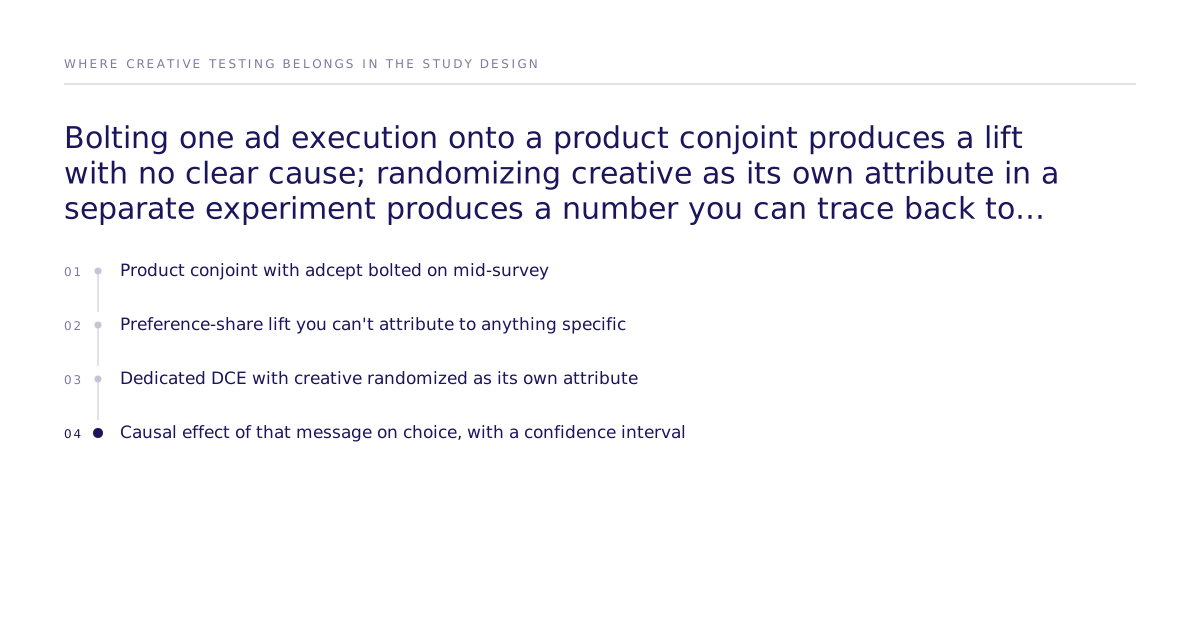
A senior buyer weighing whether to greenlight a new product does not need a preference-share number that has been massaged by an ad execution nobody randomized. Leave adcepts out of the simulation. If the message itself carries value, test it on its own: randomize the creative as an attribute in a dedicated discrete choice experiment (DCE) and read its causal effect on choice directly, instead of bolting one unblinded execution onto a product conjoint and reporting the resulting lift as a forecast.
- Don't fold an adcept into a product preference-share simulation. The lift it produces mixes concept value, execution quality, and pre/post order effects into one number you can't decompose (Wikipedia: Adcept).
- Adcepts descend from Brand-Price Trade-Off methodology and Nielsen's BASES system, which corrects the resulting bias with proprietary factors, not a causal estimate (BASES overview).
- A conjoint yields causal, component-specific effects only when every attribute, including message content, is randomized across respondents, not shown once to everyone (Hainmueller, Hopkins, and Yamamoto, 2014).
- If message value matters to the launch decision, run it as its own randomized DCE with creative as an attribute, and report a causal effect with a confidence interval, not a before/after percentage.
- The stated-intent overstatement documented by Jamieson and Bass in 1989 doesn't disappear because an adcept is inside the survey; BASES corrects it after the fact, a dedicated DCE avoids manufacturing it in the first place.
What is an adcept, and why does it break a preference-share simulation?
An adcept is exactly what the name suggests: a rough, halfway-finished ad, a "concept" version of "advertising," typically a picture board, a short video, or a piece of copy shown mid-survey to represent a message before it's polished into a real campaign (Wikipedia: Adcept). Researcher Richard Woods, cited on that same page, flags the core problem directly: when an adcept is too polished, respondents stop judging the underlying concept and start judging the specific execution in front of them, the picture, the actor, the tagline, none of which is the thing the buyer actually wants an answer about. That's the confound at the heart of this decision. A product conjoint is built to isolate the causal effect of each product attribute by randomizing them independently across respondents. Dropping one unblinded ad execution into the middle of that design, then re-running the choice tasks, doesn't add an attribute to the experiment. It adds an uncontrolled event that every respondent experiences identically, which is the opposite of what makes a conjoint identify anything at all.
Where adcepts came from: Brand-Price Trade-Off and Nielsen's BASES
Adcepts aren't a recent shortcut, they're inherited from Brand-Price Trade-Off (BPTO) methodology. When a conjoint tests an unfamiliar new product, respondents tend to penalize it simply because they don't recognize it yet, so vendors insert an ad execution mid-survey and compare "before adcept" share to "after adcept" share, treating the difference as the lift advertising will eventually buy. Nielsen's BASES system, the category leader since Burke Marketing built it in 1977 and Nielsen acquired it in 1998, formalizes this inside its Awareness-Trial-Availability-Repeat (ATAR) framework and claims sales forecasts within roughly ±10% of actual results across tens of thousands of launches (BASES overview). That accuracy claim is real, but it's earned by applying proprietary correction factors to stated purchase intent after the survey runs, not by a randomized manipulation that isolates the ad's own effect. The correction is doing the work the study design should have done.
Why an unblinded exposure isn't a randomized experiment
Hainmueller, Hopkins, and Yamamoto's 2014 paper in Political Analysis is the methodological line in the sand here: conjoint analysis produces causal, component-specific effects only when every attribute in the design, including message content, is fully randomized across respondents. Survey experiments that expose everyone to the same single treatment, rather than randomizing it, are limited to unattributable "catchall" effects, meaning you can observe that something changed, but you cannot say which part of what respondents saw caused it. An adcept shown once, mid-survey, to every respondent is precisely that catchall case. The "after adcept" lift BASES reports isn't wrong because the number is fabricated, it's underdetermined: it can't distinguish "this message concept has value" from "this particular picture board, video edit, or copy draft happened to test well that day."
The stated-intent bias adcepts can't escape
Jamieson and Bass documented in the Journal of Marketing Research in 1989 that respondents systematically overstate their purchase intent in surveys, which is exactly why BASES needs its correction layer in the first place. An adcept doesn't fix that bias, it inherits it: respondents are still stating intent in a hypothetical, unincentivized moment, now with the added confound of a single unblinded ad execution layered on top. BASES patches the result with proprietary adjustment factors calibrated against Nielsen's own historical launch database. That's a defensible business practice for a firm with tens of thousands of launches to calibrate against. It is not a causal estimate a buyer can inspect, replicate, or attribute to a specific message element.
Should I ever test messaging causally?
Yes, but as its own experiment, not as an add-on to a product simulation. Build a dedicated DCE where the message or creative execution is itself a randomized attribute, alongside whatever product features you'd normally test, and let respondents choose across combinations where creative varies independently. That gives you a causal effect of the message on choice, reported with a confidence interval, rather than a single before/after percentage point. The confidence interval describes the effect within the simulated population you tested, it doesn't bound demand in the real market unconditionally. And if the study reports preference share or substitution patterns from a standard multinomial logit, name the assumption underneath it: independence of irrelevant alternatives (IIA), which forces substitution to be proportional across every alternative regardless of how similar two options actually are. Mixed Logit relaxes that assumption by allowing preferences to vary across respondents, which matters when creative or product options are close substitutes for each other.
Adcept bolt-on vs. a dedicated randomized creative DCE
| Adcept bolted onto product conjoint | Dedicated randomized creative DCE | |
|---|---|---|
| What's randomized | Nothing; one execution shown to every respondent | Creative treatment is itself a randomized attribute |
| What the lift measures | Concept value, execution quality, and order effects, confounded together | The causal effect of message content on choice, isolated from product attributes |
| Bias handling | Proprietary correction factors applied to stated intent after the fact (Jamieson & Bass, 1989) | Hypothetical bias is named directly; incentive-aligned designs reduce it where possible |
| Accuracy claim on record | Roughly ±10% of actual sales, after correction (BASES) | 87% of the measured human ceiling (0.832 against a 0.959 human-to-human ceiling; mean 0.73 across the 43 studies passing design filters) |
| Best for: | Teams already committed to BASES norms who only need a go/no-go signal | Buyers who need to know which specific message element is driving the choice, with a number they can audit |
How is this validated, and what are the limits?
The way to trust any of this is to check it against real human behavior on studies the model wasn't built to answer. Our best configuration reaches 87% of the measured human ceiling on one study: 0.832 rank correlation against the published human result, where two independent samples of real humans reach 0.959. Across all 43 studies that pass design filters the mean is 0.73, in the causal fidelity paper. That's a validation result, not a guarantee for a market you haven't tested yet, and it doesn't erase a structural risk: some published human studies used for validation may already sit in a model's training data, which is exactly why the replication protocol treats reproduction against a holdout as the check, rather than treating any single match as proof. The current standings across methods and study types are public on the leaderboard. None of this is estimator-specific: McFadden discrete choice, Mixed Logit, and ICLV are estimators applied to a design, not causal methods in themselves. The causal identification comes from randomizing the attribute, including creative, inside the experiment. More on how that design discipline gets applied across study types is in the methods and validation collection.
If you're deciding right now whether to greenlight a launch simulation with an adcept baked in, the concrete next step is to split the study: run your product conjoint clean, with no ad execution inside it, then design a second, separate DCE where creative is a randomized attribute and read off its causal effect on choice as its own number. If you want a second set of eyes on that split before you run it, meet the team.