When an AI-Accelerated Marketing Mix Model Is Trustworthy
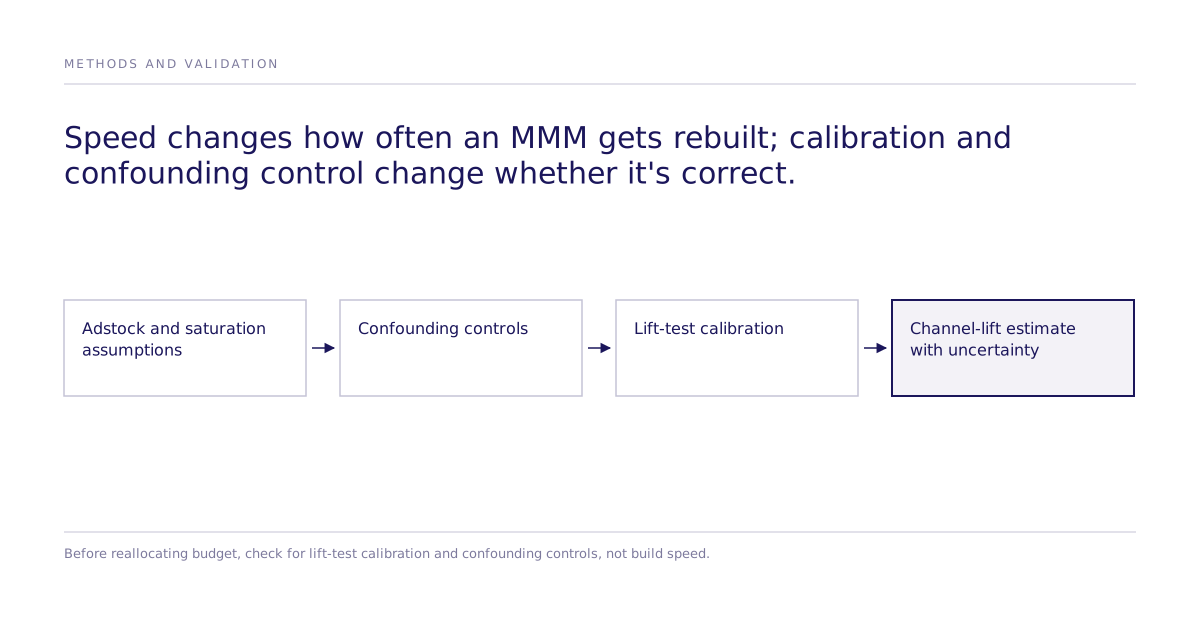
A marketing mix model can now be configured in hours instead of months. That speed changes how often a team can rebuild the model. It does not, by itself, change whether the model's channel-lift estimate is correct.
Bayesian marketing mix modeling (MMM) estimates how much each channel (paid search, TV, social, email) contributed to sales, and reports that estimate with uncertainty rather than a single number. Automation can remove most of the manual work in getting to that estimate: cleaning spend and sales data, choosing an adstock decay window, picking a saturation curve, and diagnosing a model that will not converge. None of that automation answers the harder question a VP of marketing analytics has to answer before moving budget: is this specific estimate grounded in anything other than the model's own assumptions?
Where automation actually helps
Configuring a Bayesian MMM involves a series of judgment calls that used to require a data science team:
- Merging siloed spend, sales, and promotion data and reconciling discrepancies between sources.
- Choosing adstock decay length and a saturation function (a Hill curve, an exponential curve, or another shape) for each channel.
- Diagnosing a model whose Markov chain Monte Carlo (MCMC) sampling will not converge, and deciding whether the problem is the priors or the input data.
An automated configuration is worth publishing only alongside the check it still needs. Automating this configuration step is a legitimate use of AI for proposing a structurally reasonable starting point, but adstock decay length and saturation shape are themselves empirical claims about carryover dynamics and diminishing returns that drive marginal-ROI estimates, and they still need outside validation like everything else in the model. Open-source Bayesian modeling libraries expose high-level APIs for exactly these components (carryover, saturation, seasonality), so an automated agent can propose a structurally reasonable model without hand-coding it.
What automation cannot do: prove the estimate is correct
A channel-lift number earns trust only when its structural risks are stated alongside it. Two structural risks apply to any MMM, whether it took a data science team three months or an agent three hours to build:
- Confounding. Observational spend and sales data can move together for reasons that have nothing to do with channel effectiveness: seasonality, competitor actions, or macroeconomic trends. A model that omits the right control variables will misattribute that shared movement to a channel.
- Uncalibrated priors. A Bayesian model's output is only as good as its assumptions about plausible effect sizes. Without an outside check, a mis-specified model can produce a confident-looking posterior that is confidently wrong.
A calibration against a real experiment, a lift test, a geo holdout, or another randomized intervention with a known effect, constrains the response curve for the tested channel at the tested spend level and time window. Naming where calibration stops is what lets a buyer check an estimate before moving budget outside the tested range. It does not remove omitted-variable bias for untested channels, untested spend regimes, or later periods. Common Bayesian MMM tooling supports adding lift-test measurements to a model before fitting, which lets the model's priors get pulled toward evidence instead of resting on assumption alone. This is one mechanism among several, alongside holdout validation and sensitivity checks on priors and specification, for making a channel-lift estimate more trustworthy. (See Measured's guide to marketing mix modeling, a vendor overview, and a hierarchical framework for uncertainty-aware channel attribution, an unrefereed preprint.)
The decision this changes
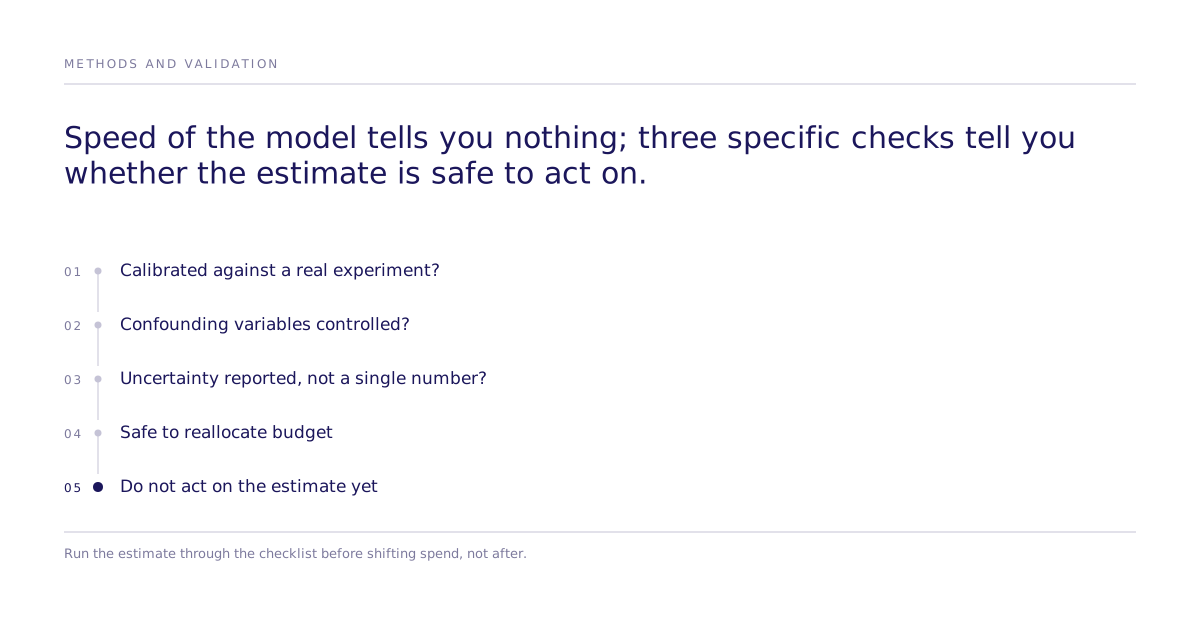
Before reallocating budget off any MMM output, the question worth asking is not "how fast was this produced," but:
- Was this model calibrated against at least one real experiment, or does it rest entirely on observational data and priors?
- Does the model include the control variables needed to isolate a channel's effect from correlated market movement, and does it account for spend being set in anticipation of demand rather than assigned independently of it?
- Is the reported estimate accompanied by uncertainty, or presented as a single point number?
Getting this wrong has a real cost: shifting spend off a channel that was actually working, or scaling up one that was not, based on an estimate the model never checked against reality.
Where this connects to causal experimentation more broadly
The same validity question underlies any modeled recommendation, not just MMM: does the estimate come from a controlled comparison, or from pattern-matching on observational data? Subconscious is not an MMM vendor, but the discipline of testing an action's causal effect before it ships budget, product, or go-to-market decisions is the same discipline an MMM team needs when deciding whether to trust a channel-lift number. Teams evaluating how a modeled estimate should inform a real decision can read more about how Subconscious approaches causal experimentation and the research behind it.
Limitations
This scope is stated so a reader can separate the methods claim from any product claim. This is a methods explainer about MMM calibration, not a Subconscious product claim or case study. No Subconscious accuracy, speed, or pricing figure applies here, and no named customer result should be inferred from it. The validity questions above apply regardless of which tool produced the model.