Comprehensive Guide to Pricing Strategies
A VP of Pricing weighing a renewal increase needs one thing from a research method: a number that matches what customers actually pay, not what they say they would pay. The right method isn't the fastest or cheapest one on the shelf. It's the one that has been checked against real purchase behavior, with a stated error rate and direction, before the price goes live.
- Van Westendorp and Gabor-Granger give a fast price range for a single product but ignore competitors, brand effects, and actual purchase prediction, according to a practitioner guide to the method (Business Initiative).
- Choice-based conjoint (Sawtooth CBC, Displayr, Qualtrics) is the standard for price-feature tradeoffs because it forces a choice instead of asking a direct price question (Sawtooth Software).
- Stated willingness-to-pay questions run about 18 percent above real WTP in mobile product studies on average; the same paper reports a broader meta-analysis of 77 studies putting the bias at 21 percent, worse for expensive and specialty products. The bias is upward, not random (MDPI, 2026).
- AI simulation vendors that skip fielded experiments haven't publicly disclosed a randomized control or a replication check against real human data, so that bias goes uncorrected rather than measured.
- The right ranking criterion for a pricing method is how much it overstates willingness to pay and whether that overstatement has been checked against real behavior, not how quickly it produces a chart.
What is the biggest risk in choosing a pricing research method?
The biggest risk is picking a method whose error you can't see. Hypothetical stated WTP runs about 18 percent above real WTP on average in mobile product studies; the same paper also reports a broader meta-analysis of 77 studies across 47 papers, putting the average hypothetical bias at 21 percent, with the gap widening for higher-value and specialty goods (MDPI, 2026). That's exactly the segment where a pricing mistake costs the most: enterprise tiers, add-on SKUs, anything with a renewal cycle attached. A method that doesn't disclose its own bias isn't neutral. It's just quiet about being wrong.
Van Westendorp and Gabor-Granger: fast, but blind to competition
Van Westendorp's Price Sensitivity Meter is still useful for a quick read on an acceptable price range for one product formulation. According to a practitioner guide to the method, it does not account for competitive pricing, brand perception, or actual purchase-behavior prediction, and it's typically limited to one product at a time (Business Initiative). Gabor-Granger has the same shape: a direct demand curve from direct price questions, with the same hypothetical-bias problem as any stated-preference method. Both belong in the toolkit for a same-week sanity check on a single SKU. Neither should carry a renewal-pricing decision on its own.
Why choice-based conjoint became the default for multi-attribute pricing
Choice-based conjoint (CBC) is positioned by Sawtooth as the current standard for pricing and preference research because it forces tradeoffs among attributes instead of asking about price directly (Sawtooth Software). Discrete choice modeling is the preferred approach specifically when pricing is the primary research objective, since it can model brand-by-price interaction effects that single-product methods like Van Westendorp can't capture (Ibbaka). One caveat worth naming: when a conjoint's preference-share output comes from a flat multinomial logit, it carries the independence-of-irrelevant-alternatives (IIA) assumption, meaning it treats the ratio of preference between any two options as unaffected by a third. That assumption breaks down when a new price tier is a close substitute for an existing one, which is common in SaaS packaging.
Can AI simulation panels replace fielded pricing studies?
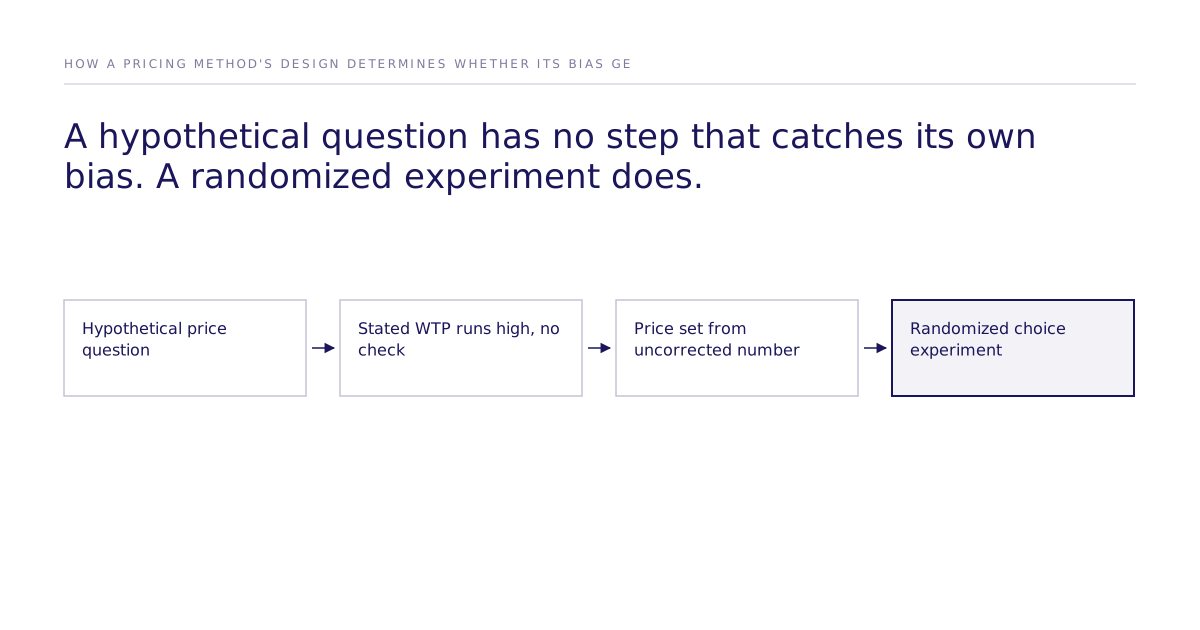
Not without a replication check, no. A newer wave of vendors (Aaru, Simile, Synthetic Users) promises instant synthetic panels without fielding a real experiment. The problem isn't synthetic data itself. It's that generating responses without a disclosed randomized control or a check against real human data means the hypothetical bias documented above doesn't get caught. It gets inherited.
The alternative is a randomized experiment run on a simulated population, analyzed with discrete choice models, and checked for replication against a real human study before it's trusted. Randomized experiments analyzed with discrete choice models such as McFadden discrete choice (DCE), Mixed Logit, and ICLV get their causal identification from the randomized manipulation in the experiment design, not from the estimator itself. Subconscious's published causal fidelity results reach 87% of the measured human ceiling on one study: 0.832 rank correlation against the published human result, where two independent samples of real humans reach 0.959. Across all 43 studies that pass design filters the mean is 0.73, per the causal fidelity paper. That's a validation-set result, not a guarantee for a market that hasn't been studied yet, and it comes with a real limitation: published human studies can sit inside a model's training data, so replication protocols have to design around that risk rather than pretend it doesn't exist. The current accuracy record across studies is public on the leaderboard, which is the kind of disclosure a synthetic panel without a replication step hasn't produced.
Ranking methods by validated accuracy, not speed
| Method | What it measures | Known bias | Replication check | Best for |
|---|---|---|---|---|
| Van Westendorp PSM | Acceptable price range, one product | No competitive or brand context; hypothetical WTP runs high | None published | A same-week sanity check on a single SKU. |
| Gabor-Granger | Direct demand curve | Same hypothetical-bias exposure as any direct price question | None published | A rough demand curve when there's no time for a fielded study. |
| CBC / DCE (Sawtooth, Displayr, Qualtrics) | Price-feature tradeoffs via forced choice | Lower than direct questions, but the flat-logit variant carries the IIA assumption | Method-dependent, not standardized across vendors | Multi-attribute price-feature decisions where package structure matters. |
| AI simulation panels | Synthetic responses, no fielded experiment | Not publicly disclosed | None disclosed publicly | No published replication rate. |
| Randomized experiment on a simulated population (Subconscious) | Causal effect from randomized manipulation, discrete choice models | No stated-preference bias; identification comes from the randomized design, not from asking about price directly | 87% of the measured human ceiling (0.832 against a 0.959 human-to-human ceiling; mean 0.73 across the 43 studies passing design filters); validation-set result; published human studies can sit in a model's training data ([the causal fidelity paper](https://fidelity.subconscious.ai/papers/causal-fidelity/causal_fidelity_paper.pdf)), tracked on the leaderboard | Renewal, bundling, and tier decisions where the cost of being wrong is high. |
Why picking the wrong pricing method costs more in 2026
The stakes for picking the wrong method have gone up, though the figures below come from one vendor-published research source and haven't been independently replicated. Seventy-nine percent of IT buyers saw renewal price increases in the past 12 months, with a median increase of 7.8 percent, which the source attributes largely to AI-SKU bundling (Zylos Research, 2026). A poorly handled increase triggers a 10 to 15 percent churn spike; grandfathering existing customers plus clear value communication produces 26 percent higher gross retention instead (Zylos Research, 2026). Usage-based pricing adoption jumped from 27 percent of SaaS products in 2023 to 42 percent in 2026, adding structural complexity that a single-question survey tool wasn't built to test (Zylos Research, 2026). A pricing structure with three price points and a usage tier needs a method that can hold multiple tradeoffs at once and report its own error rate. Van Westendorp can't do the first. An unvalidated AI panel can't do the second.
How should a senior buyer choose among these methods?
Rank candidates by their measured overstatement of willingness to pay against real behavior first, and by budget and timeline second. That order matters because the direction of the error is known and consistent: stated preference and hypothetical WTP questions run high, worst on the exact products where a mistake costs the most (MDPI, 2026). A comparison table of methods and their turnaround times is a menu. A comparison of what each method costs you in accuracy, with the number and its source attached, is a decision framework. If a vendor can't tell you their measured bias against real purchase behavior, or their replication rate against a held-out human study, that absence is itself the answer.
Before the next pricing committee meeting, pull the current numbers from the leaderboard and check whether the method under consideration for the renewal decision has a published replication rate against real human data. If it doesn't, ask why not.
To see how a randomized pricing experiment is set up for a specific SKU, meet the team.