How to Pre-Test a Retainer Renewal Deck Before the Client Meeting
A retainer renewal deck should be tested as a decision instrument, not reviewed only as a presentation. The account team needs to decide whether to keep pricing flat, raise it, or restructure scope, and which sequence of past results, future value, and pricing evidence will cause the room to support that choice.
Getting that decision wrong can produce a flat renewal, a scope cut, or a quiet move to RFP. A historical planning example may put a single renewal at six to seven figures of annual revenue, depending on retainer size. The relationship can matter for years: Agiled's 2026 compilation reports an average client lifespan of 56 months for agency retainers, compared with 24 months for project-based relationships (Agiled, Client Retention Statistics for Agencies).
What must a renewal deck defend and earn?
A renewal deck explains what the retainer delivered during the past twelve months, then makes the case for what the next twelve months should become.
As a planning example, imagine a draft that gives 70 percent of its slides to past results and 30 percent to the future. The client receives a detailed recap but little reason to expand the relationship. Reversing the ratio without enough evidence creates the opposite problem: ambition without a defensible record.
Pricing sits between those two jobs. A flat price can suggest that the current scope is the ceiling. A higher price can look like more money for the same work. A restructured scope can create confusion unless the deck explains what changes and why. The experiment should test the pricing frame together with the narrative that supports it.
Five decision-makers read five different decks
The same slide can create a different response depending on who reads it. A useful experiment represents the distinct roles that influence the renewal, including people who may review the deck after the meeting.
| Decision-maker | Decision they are trying to make | Evidence the deck must provide |
|---|---|---|
| Day-to-day client contact | Whether the working relationship should continue | A credible account of the work and a specific reason next year's plan matters |
| Budget-holding sponsor | Whether the spend can survive the next budget review | Outcome evidence and an argument they can repeat to finance |
| Skeptical adjacent leader | Whether the agency understands the wider business | A link between the proposed work and cross-functional priorities |
| CFO or finance partner | Whether the price is defensible | Clear scope, outcome logic, and engagement alternatives |
| Colleague considering a re-bid | Whether another agency is worth the switching cost | A concrete reason the current relationship should continue or expand |
This defines five buyer roles, the choices they influence, and the evidence each needs, not five invented biographies.
Turn deck review into a randomized experiment
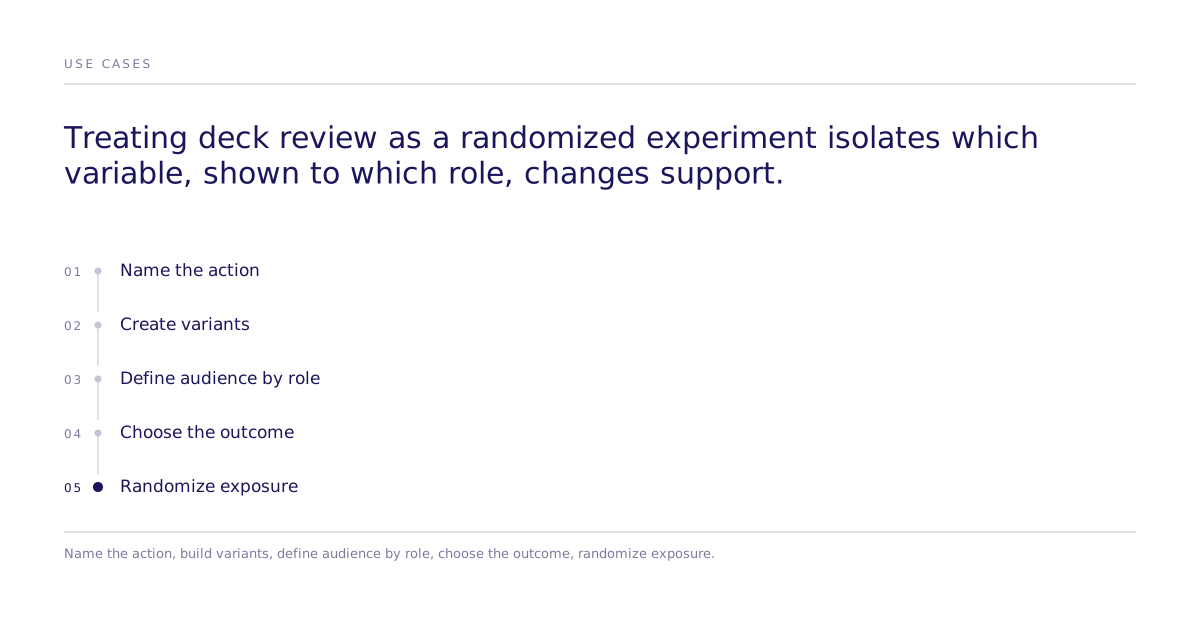
A useful pre-test changes one decision variable at a time. The team can then estimate which intervention changes support for renewal rather than collecting reactions to an entire deck.
- Name the commercial action. Choose among keeping pricing flat, raising it, or restructuring scope. Do not test an undefined goal such as "make the deck stronger."
- Create controlled variants. Compare past-results-first with future-value-first sequencing, different pricing frames, or different placements of ROI evidence. Hold the account facts, proposed work, and visual quality constant.
- Define the audience by role. Include the five decision-makers above in proportions that reflect the actual buying group. Keep known facts separate from assumptions about people who have not spoken directly.
- Choose the behavioral outcome. Measure which variant changes support for renewal, willingness to defend the spend, or preference among scope options. Aesthetic preference is not the commercial outcome.
- Randomize exposure. Show each participant or simulated buyer one controlled variant, then compare outcomes across conditions. The research approach is designed to identify which action changes the decision and where uncertainty remains.
Subconscious can run controlled studies against a person-level audience graph covering 800 million real people. A number without its limits is marketing. That figure describes audience reach, not a recruitable group of 800 million participants. The leading experiment can then be validated with real human participants without changing the causal question.
The five reads that expose a weak renewal argument
The experiment should preserve the practical questions that an experienced account team would ask in a live review.
Past-results read. Show the results section on its own. Ask which contribution matters most and whether the agency's attribution is credible. The day-to-day contact may remember the work, the sponsor the metric, and finance the cost.
Narrative read. Show slides one through the end. Ask what changed during the year and what that change makes possible next. If three out of five decision-maker roles infer different stories, the deck is still a collection of slides rather than a coherent renewal case.
Future-value read. Isolate the next-year proposal. Ask what new buyer or business outcome it is designed to cause. A list of three or four new capabilities is not a growth case unless each one connects to an outcome the client already values.
Price-fairness read. Place the pricing slide beside past results and future scope. Ask whether the price follows from the value and work proposed. Two or three engagement options can make the choice explicit, but they should represent real scope differences rather than cosmetic packaging.
Side-conversation read. Ask what each decision-maker would tell a colleague after the meeting. The deck needs to give internal advocates language they can defend on their own.
Plan enough room to act on the result
The value of the test depends on whether the team can change the deck after seeing the result. One inherited planning example reserves half a day for review three days before the meeting. That is a workflow illustration, not a Subconscious delivery commitment. The purpose is to leave space to revise the narrative, change an option, or remove an over-claimed result. A night-before review can identify the same weakness without leaving room for a considered response.
The revision should follow the evidence. If a future-first sequence increases support while pricing remains fixed, change the sequence. If support falls when the deck adds capability language, remove or reconnect that language to the client's stated outcome. If uncertainty remains high across all conditions, do not force a winner. Return to the account facts or ask the actual client.
What can and cannot the experiment decide?
A published limit lets a buyer check the tool before they rely on it. A causal test can compare defined renewal-deck interventions. It cannot guarantee that the client renews, predict the exact behavior of a named executive, or settle contract terms on its own. It does not replace direct conversation with the actual decision-makers, the account team's knowledge of the relationship, or legal and financial review.
The result is one input into the renewal decision. It is strongest when the alternatives are concrete, the audience definition reflects the buying group, and the measured outcome matches the commercial action. Naming the failure mode is what lets a buyer catch it before it does damage. It is weak when the team uses it to confirm a preferred story, treats generated language as evidence, or hides material account facts from the design.
Bring one live renewal decision
Start with the next consequential renewal on the calendar. Bring the current deck, the pricing or scope choice, the roles that influence the decision, and the outcome that would change the account team's plan. Book a working session to scope the variants, experiment, and human-validation boundary before the client meeting.