Pre-Testing a Conference Keynote Thesis Before It Reaches the Stage
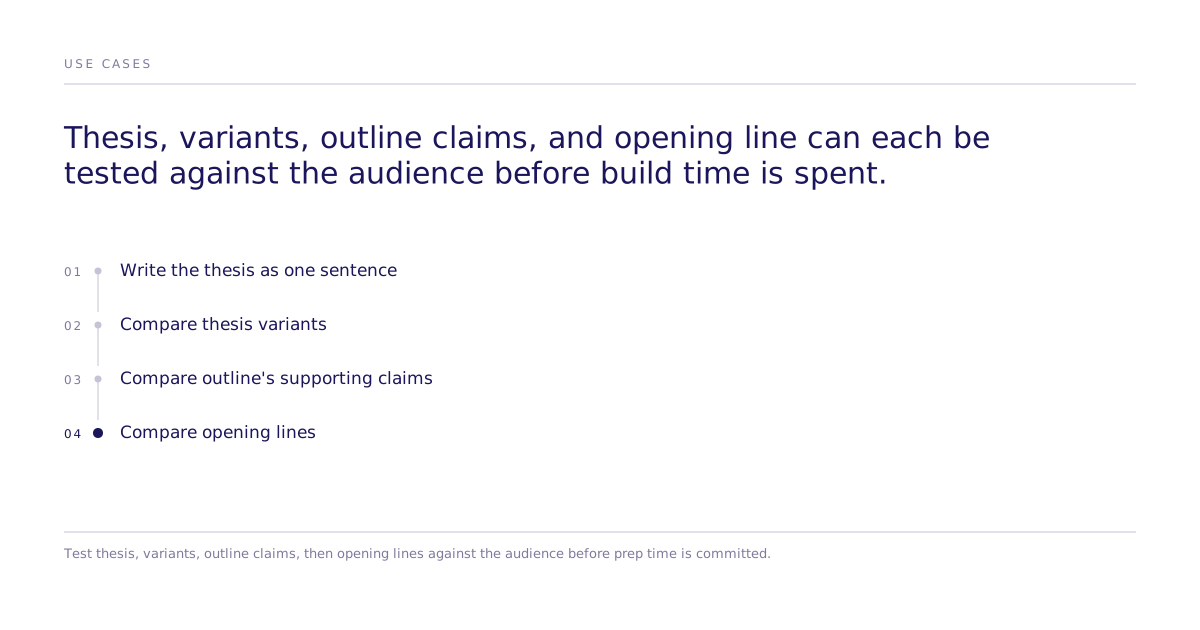
Choose the thesis before building the slides. Compare candidate claims against the audience segments the event actually draws, then commit stage time to the version more likely to change belief or intent.
The decision: which claim goes on stage
A flagship keynote is one of the highest-leverage public moments an enterprise brand or communications leader gets in a year. One historical planning example uses these quantities: forty minutes on stage, six months of inbound attention, a dozen inbound partnership conversations, and forty hours of prep. A number without its limits is marketing. Those figures are a planning example, not a current Subconscious benchmark, customer result, or promised outcome.
The question the executive's team has to answer before a flagship talk is narrow: which single claim should the executive defend in front of this specific room, and will it land with the analysts, enterprise buyers, press, and partners in the seats, fall flat, or backfire. A stage moment cannot be retested once the executive has said the sentence out loud.
Why is the cost of guessing asymmetric?
The room contains more analysts, prospects, and press in one sitting than most other calendar events combine. A thesis that misfires there does more than waste the slot. It can damage the executive's standing with the people in that room, and misalign the market narrative for a launch or campaign timed to the appearance.
Four ways a thesis fails before anyone reads a slide
The failure modes are predictable enough to name in advance and test before prep time goes into the talk.
| Failure mode | What happens in the room | Why it happens |
|---|---|---|
| Too safe | The audience nods, forgets it by the next session, and has no reason to follow up | The claim restates something the room already believes |
| Too contrarian | The room disengages in the first five minutes and closes for the rest of the talk | The claim is not earned with evidence, not merely sharp |
| Too narrow | The room hears a sales pitch instead of an argument | The claim works for the speaker's own business but does not generalize |
| Too broad | The audience cannot recall why this talk mattered versus the other options in the same slot | The claim is general enough that any speaker could have delivered it |
All four are failures of misjudging how a specific audience will receive a specific claim, the kind of question a controlled comparison can answer before the room does.
How does causal message testing fit before the thesis is locked?
Subconscious helps teams test product, pricing, messaging, and go-to-market actions before committing capital, time, or reputation to them. Applied to a keynote thesis, that means comparing candidate thesis statements against an audience segment built from the analysts, enterprise buyers, press, and partners the specific event actually draws, to estimate which framing is more likely to change belief or intent before the executive commits stage time to it. This sits inside message and positioning testing: comparing claims against a causal response, not collecting generic opinion.
Pre-testing a message against its intended audience before broad release is established practice outside AI-assisted testing too; public-health communicators routinely pretest message drafts with representative audience segments before a campaign goes live, since a flawed message is cheaper to catch in draft than after it reaches the room (The Compass for Social and Behavior Change: How to Conduct a Pretest). The keynote case applies that same logic to a single high-stakes claim rather than a campaign.
A workable sequence for a flagship talk:
- Write the thesis as a single sentence. It cannot be a topic or a title; it has to be one declarative claim the executive is ready to stand behind. Test that sentence against the audience segment before a single slide gets built.
- Compare thesis variants. Write a conservative version, a provocative version, and a more contrarian version of the same claim, and compare how the audience segment ranks them. The ranking regularly surprises the executive: a provocative claim can lose to a conservative one when the audience reads the provocation as unearned, and a contrarian claim can win when the executive was underselling their own point of view.
- Compare the outline's claims. Once the thesis is fixed, break the talk into five to seven supporting claims and check which the audience already believes, which are new, and which read as filler. This is where redundant setup gets cut and the genuinely new claims earn more time.
- Compare opening lines. The first ninety seconds decide whether the room leans in. Write three opening lines and compare them against the audience segment before rehearsal, turning the choice into a comparison instead of a guess.
- Surface the strongest objection. Ask which claim in the talk the audience segment would challenge first, and pre-empt that objection inside the talk itself rather than discovering it live during Q&A.
What this does not cover
The misses go on the public page next to the hits. Causal message testing answers which claim is more likely to change belief or intent for a defined audience segment. It does not evaluate delivery, stage presence, vocal performance, live Q&A handling, or room chemistry on the day, all of which require human rehearsal and real-room feedback, not a claim comparison. A thesis that tests well can still be delivered badly.
Naming this failure mode is what lets a buyer check the method before booking the talk. The audience segment used to compare claims is not the same as recruiting real people to sit through a mock talk. Subconscious can test or validate studies with real human participants, and a team that wants to move from a simulated comparison to a live read-through with real people can do so without changing the underlying question being asked, but that is a separate step, not something the claim comparison itself performs.
How do you build a library of tested claims over time?
An executive who runs this comparison ahead of every flagship appearance builds, over a year of regular speaking, a catalog of thesis framings that have already held up against a given audience. That catalog compounds: the claims that survived testing and then survived the room become the basis for the next talk, the next byline, and the next appearance, instead of starting from a blank page each time. The keynote stops being a one-off bet and becomes the most visible entry in a longer sequence of tested claims.
If a flagship talk is on the calendar this quarter, start by writing the thesis as one sentence and comparing it against the audience segments the event actually draws, before a slide gets built. Learn more about how Subconscious runs a causal experiment, see current research, or start a comparison before the next stage commitment.