Pre-Testing the Renewal Deck Before the Client Reads It
An agency's quarterly account review is one meeting with no second chance. The room holds a day-to-day sponsor, a budget-holding executive who skims for the headline, a cost-focused finance reviewer, a skeptical outsider primed to push back, and sometimes a newcomer with no account history. One deck has to answer five questions in roughly forty minutes, and the standard prep, a partner read the Friday before, tests it against one reader, not five.
The decision an account lead faces: run a segmented test of the deck's narrative and proof points against each stakeholder viewpoint before the meeting, or rely on an internal review that never simulates the room. Getting it wrong costs more than an awkward Q&A. A deck that reads as activity instead of proof to the person who signs the renewal, or that buries the objection the skeptical outsider was primed to raise, can stall the account with no chance to fix the story once the meeting starts.
Why one review can't stand in for five readers
Most client-facing decks have a single audience with a shared goal. A quarterly account review does not. The budget-holding executive walks in with three minutes of attention and no memory of the weekly status updates. The day-to-day sponsor, who lobbied internally to keep the relationship, reads every line for the wins they personally championed. The finance reviewer wants a ratio, not a narrative. The skeptical outsider has been hearing complaints from their own team and reads for the gap between the deck's story and that experience. The newcomer has no banked context and needs the deck to stand on its own.
A single partner review can catch typos and tone. It cannot tell an account lead whether the executive's three-minute read lands on the same outcome as the sponsor's careful one.
Five stakeholder viewpoints, one renewal decision
Each viewpoint maps to a different stake in the renewal, not to an industry or function:
| Viewpoint | What they're reading for | What changes their answer |
|---|---|---|
| Day-to-day sponsor | The wins they personally defended internally | Whether their specific contributions are named |
| Budget-holding executive | The headline outcome and next quarter's return | Whether the ask is clear in three minutes, not buried |
| Cost-focused finance reviewer | The ratio between cost and outcome dollars | A number that reads as proof, not activity |
| Skeptical outsider | The gap between the story and their team's experience | Whether the deck addresses the complaint before they raise it |
| Newcomer with no history | Whether the deck stands on its own | Assumed context the team has stopped noticing |
Testing against all five before the meeting turns a single guess into five separate, checkable answers.
How does Subconscious test this?
Subconscious runs controlled causal discrete-choice experiments, including Mixed Logit models, that measure how clearly defined respondent segments respond to a message, framing choice, or set of proof points, reported as effect sizes with confidence intervals rather than one averaged read (ISPOR Conjoint Analysis Good Research Practices Task Force; Mixed logit). Applied to a renewal deck, that means testing the same slide, headline, or proof point against each of the five viewpoints as distinct segments, instead of asking one internal reviewer to imagine all five reactions at once. This is the same causal testing method Subconscious applies to other pre-launch message and framing decisions.
What testing sequence should run before the meeting?
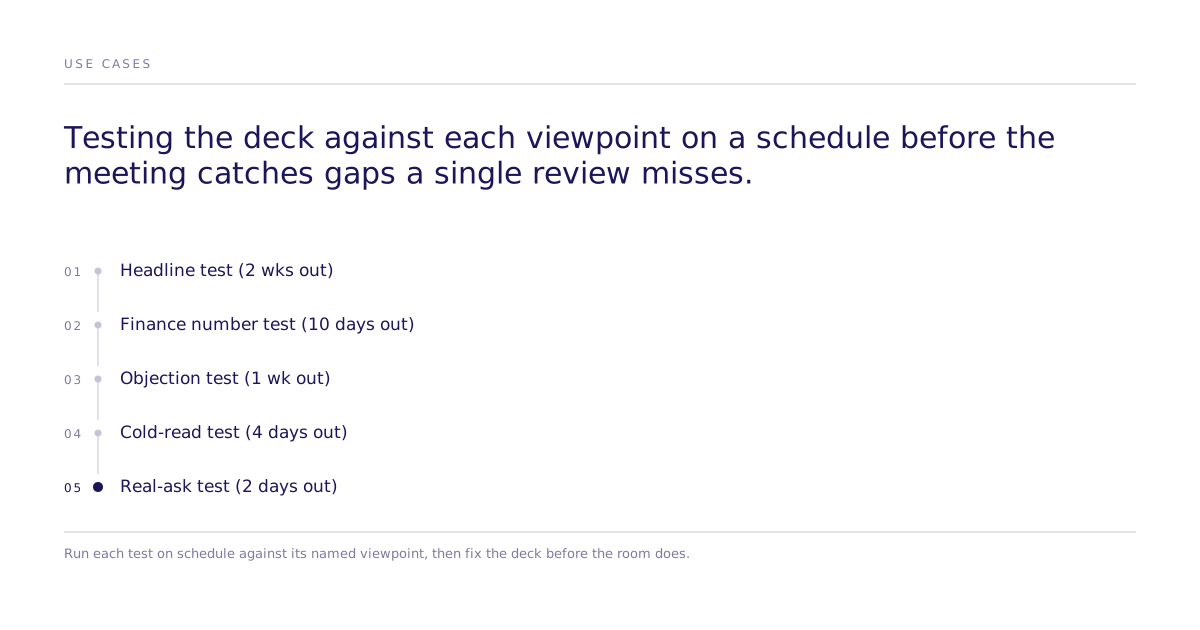
One useful sequence works backward from the meeting date: roughly two weeks out, test whether the headline lands the same way for the sponsor and the executive; around ten days out, ask the finance viewpoint which number reads as proof and which raises a question; about one week out, ask the skeptical-outsider viewpoint whether the deck addresses the complaint their side has been raising; around four days out, ask the no-history viewpoint to read the deck cold and state what the engagement is for; and roughly two days out, ask every viewpoint what they think the meeting's real ask is. This sequence states where the schedule is fixed and where a team can adjust it, because a timeline presented as rigid when it isn't would mislead the reader. The spacing is a scheduling choice, not a fixed requirement.
Patterns a segmented read catches that a single review misses
A few problems repeat across account-review decks, and tend to surface only when the same page is read through more than one lens:
- The wins slide is overcrowded. Packing twelve wins into one recap because none feels safe to cut buries the two or three that would land with the budget-holding executive, who remembers few and forgets many.
- The data is framed for the wrong reader. The sponsor wants funnel metrics; the executive wants outcome-to-cost ratios; the finance reviewer wants cost per outcome. Decks tend to default to the metric the account team discusses weekly, rarely the one that convinces the person who signs the renewal.
- The roadmap reads as a task list. Next quarter's plan described as activities lands differently than the same plan described as the outcomes those activities produce.
- The renewal ask is either buried or too blunt. Leaving it unnamed leaves the executive unsure when that conversation happens; front-loading it turns the meeting into a pitch. A segmented read surfaces where the middle sits for a given account.
- The skeptical outsider's concern has no slide. The team outside the day-to-day relationship almost never gets addressed directly, because the sponsor has no reason to have flagged the friction back to the account team.
What does this testing not cover?
Publishing where a test's reach ends is what lets an account lead check the claim before relying on it. A segmented panel test measures how a defined respondent segment, modeled on a stakeholder role rather than a specific named person, responds to a message and its framing. It is not a rehearsal of one client executive's individual politics or history, and it is not a recruited human focus group reading the deck live. It does not predict a specific renewal decision on its own and does not replace direct knowledge of the client relationship. It narrows where the deck's story is likely to lose a reader before the meeting.
Where this fits beyond one account review
The same five viewpoints, lightly adjusted, apply to any meeting where one deck faces a room of stakeholders who don't share a reading strategy: a renewal, a scope-expansion conversation, or a new-business pitch. An account lead can review how this fits into a broader testing workflow, or move directly to scoping a test against an upcoming renewal-critical review through Subconscious.