Validate a Business Idea Before You Build It
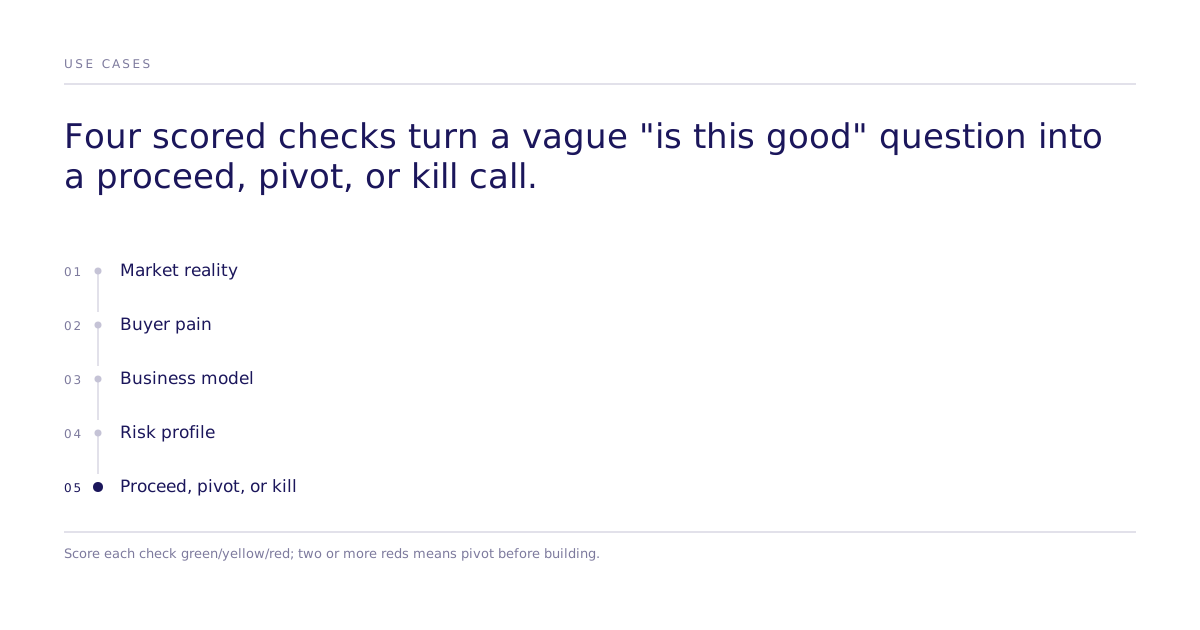
You have a business idea, but you don't know whether its buyer problem is real enough to support a business. Before committing to a build, hiring, or fundraising, turn the idea into four testable questions: market reality, buyer pain, business-model viability, and failure conditions.
The decision, and what it costs to get wrong
The decision in front of a founder before any interviews or spend happen is not "is this a good idea." It's whether to proceed, pivot, or kill a specific idea before committing real time, hiring, or a fundraising cycle to it. CB Insights ties roughly four in ten startup shutdowns to no market need or poor product-market fit, the exact failure mode a founder is trying to catch before it costs a runway. (CB Insights: The Top 20 Reasons Startups Fail)
Four checks before you commit
A useful triage sequence runs the idea through four separate pressure points.
Check 1: Market reality
Ask what the market actually looks like: how big it is, who else is already in it and what they do well or poorly, what's driving demand, and whether the space is growing, flat, or shrinking. A market that reads as tiny, saturated, or declining is information worth having before anything else gets built.
Check 2: Buyer perspective
Ask the people who would actually buy the product, not a general audience, what their biggest unmet pain is in this area, how they cope with it today, whether they'd pay for a product that did what you're proposing, and what would make them switch from their current option.
Check 3: Business-model pressure test
Present the rough model (product, target market, proposed pricing) and ask whether the unit economics work, whether customers can be acquired profitably, and where the biggest risk in the model sits.
Check 4: Critical challenge round
Ask for every reason the idea could fail, what's being missed, and what would have to be true for it to work. This is the same set of questions investors, competitors, and the market will eventually ask.
Score the result
| Dimension | Green | Yellow | Red |
|---|---|---|---|
| Market | Big, expanding, not yet crowded | Mid-sized and contested | Niche, crowded, shrinking |
| Buyer pain | Sharp, immediate, no real fix exists | Real but only half-addressed | Minor, already handled well |
| Business model | Healthy margins, obvious route to revenue | Viable once reworked | Broken at the core |
| Risk profile | Risks are identified and containable | Several open unknowns remain | More than one risk could sink the company |
Two or more reds points toward a pivot. All greens is a reason to move toward real customer validation. A mix means addressing the yellow and red areas before going further.
What doesn't this triage answer?
This sequence is a first pass, not a full diagnosis. It's no substitute for actual conversations with prospective buyers, a prototype built and put in front of users, or a live market experiment. What it does is tell a founder whether those next steps are justified.
It also doesn't resolve the one question that decides whether the idea is worth building: does the specific value proposition or price point actually move a defined buyer group's stated preference. That question needs a fixed choice set and a named audience, not an open-ended "is this a good idea" conversation.
How do you test the claim that actually decides it?
Where an unstructured panel discussion gives a subjective read on an idea, Subconscious runs a controlled discrete choice experiment against a defined target-buyer population, so the value proposition or price point at the center of the idea gets tested for whether it actually drives stated preference, with a causal effect and a confidence interval attached (methodology). Our best configuration reaches 87% of the measured human ceiling on one study: 0.832 rank correlation against the published human result, where two independent samples of real humans reach 0.959. Across all 43 studies that pass design filters the mean is 0.73. It requires a defined decision and audience segment, such as one value proposition tested against one named buyer group, rather than an open-ended discussion with no fixed choice.
Subconscious can test or validate a study with real human participants, which lets a founder move from a simulated read of the value proposition to a real-human check on the same question without changing what's being tested.
How do you move from a scored idea to a tested one?
A green-heavy score from the four checks is a reason to commit to real customer validation, not a substitute for it. Reviewing the method behind these tests or seeing how a study is set up is a reasonable next step once the idea has cleared triage. A demo walks through setting up that test against your own value proposition and audience, and past studies show what the results look like.