10 Audience-Evidence Methods Agencies Are Using Before a Pitch in 2026
Clients now expect a pitch deck to carry audience evidence, not just a creative point of view. A pitch team whose best answer is a promise of three weeks of qualitative research before anyone knows anything is losing ground to teams that walk in with an AI-generated synthetic-panel read already in slide four. That shift has pulled a wide set of AI research tools into the agency stack, raising one buyer question before any of them get budget: what does this specific method prove, and what would it be wrong to conclude from it?
Industry research backs the shift in expectation, even where individual tool claims vary: a 2026 survey of agencies found AI research and multi-step, self-directed AI workflows moving from experiment to standard practice (Digital Applied's 250-agency adoption survey).
The 10 audience-evidence methods agencies reach for
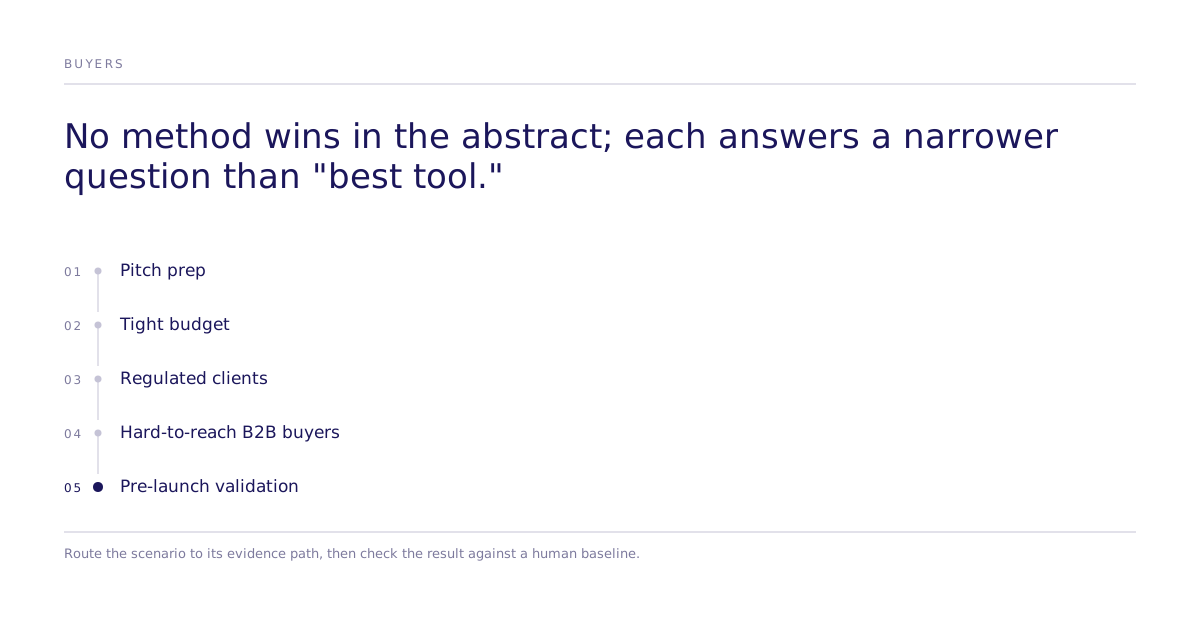
Agencies rarely pick one tool for every brief. The methods below cover the ten situations that come up most often across a retainer. None outranks the others in the abstract; each answers a narrower question than "which tool is best," so fit depends on the decision in front of the account team.
1. What is a controlled experiment with a human-baseline check?
For a client-facing recommendation that has to survive scrutiny, the strongest evidence path runs a controlled test on defined alternatives and then checks the result against real human participants without changing the underlying question. Subconscious runs this way: it tests actions as causal experiments and can validate a study with real people afterward, reporting the effect rather than a raw preference score.
2. Self-serve synthetic focus groups for a tight budget
Smaller shops and boutique agencies without a research function often need the cheapest viable way to get a directional read on a creative or message before it ships to a client.
3. Qualitative AI respondents for product-led clients
Agencies working B2B SaaS or fintech accounts use conversational AI respondents to pressure-test product positioning and feature framing in a format that mirrors how a product manager would read the output.
4. Synthetic crowds for large consumer brands
Enterprise consumer and media accounts sometimes need audience simulation built and maintained at the brand's scale, with a dedicated onboarding process rather than a self-serve signup.
5. Behavioral simulation for campaign rollout dynamics
Strategy-led engagements that need to model how a message or feature spreads through a population, rather than test a single reaction, reach for multi-agent simulation platforms built for adoption and virality questions.
6. Panels built for hard-to-reach B2B decision-makers
CFOs, IT buyers, and other scarce respondent pools are difficult to recruit for traditional qualitative research. Platforms built specifically around B2B decision-maker audiences fill that gap for enterprise-facing agency work.
7. What are audit-trail platforms for regulated industries?
Agencies serving automotive, finance, energy, or pharma clients need a documented, defensible research trail alongside the result itself, which points them toward platforms built around audit and compliance requirements rather than speed.
8. Verbatim synthesis on top of human qualitative research
Agencies that still run traditional qualitative studies use AI synthesis tools to summarize and cluster open-ended verbatim responses at scale, keeping the human fieldwork and adding a faster read on the output.
9. What is simulated pre-launch testing for product features?
Product-strategy agencies use simulated-user testing to screen a feature or roadmap item before it reaches real users, catching an obviously wrong direction before a live beta would.
10. Local-market digital twins with real-time data feeds
Agencies with a regional client base sometimes need a research partner with local data integration and a local support relationship, rather than a global platform run from a different market.
Matching the method to the decision
The table below is the check to run before a result reaches a client deck: what question each evidence path can actually answer, and what happens when a team asks it to answer a different one.
| Evidence path | Question it can answer | Defensible client claim | Failure when misapplied |
|---|---|---|---|
| Qualitative discovery with real participants | What motives, language, or unanticipated concerns are present? | Participants raised these themes in discovery. | Open-ended findings get presented as a controlled comparison. |
| Controlled simulated-audience experiment | Which defined alternative produces the stronger directional response under the test conditions? | This first-pass test favors one alternative over another. | A directional estimate gets presented as guaranteed market performance. |
| Simulated experiment plus human-baseline validation | Does the simulated result hold up against real people on the same question? | The same causal question was tested twice, in simulation and with real participants. | The validation step gets skipped and the simulated result ships as if it were already confirmed. |
| Real-world campaign measurement | What happened after launch? | The campaign produced these observed results. | An observed outcome gets treated as proof of why it happened, without a design suited to that question. |
What the agency workflow actually looks like
Across a retainer, the same four moments recur: pitch prep, where a directional read goes into the deck before the client asks for one; onboarding, where a client-specific evidence approach gets set up once and reused across briefs; creative and message testing, where a shortlist of variants gets narrowed before client sign-off; and a pre-launch or high-stakes call, where the team decides whether a human-baseline check is worth the extra step before the recommendation ships.
Subconscious can run controlled studies against a person-level audience graph covering 800 million real people. That describes audience reach for study design, not a recruitable panel of 800 million participants standing by to answer questions.
Historical planning figures, labeled
Earlier agency planning examples described a 10-person audience test, screening five to ten creative variants, a three-week qualitative panel, and a roughly $40,000 baseline-research line item, kept here only as reference points with different scopes. They are not current Subconscious prices, delivery times, or guarantees, and should not be read as benchmarks for any tool named above.
Where this breaks if a team skips the check
None of these methods replaces the others, and none is a self-serve chat tool an account lead can treat as a live oracle in a pitch room. A controlled experiment with human-baseline validation takes longer than an open-ended synthetic-panel chat because it answers a narrower, better-supported question. Using it as a pitch-room parlor trick, or skipping the human-baseline step on a decision that will get expensive if wrong, both undercut the reason to run a controlled test at all. The check before anything goes on a client slide is simple: name the decision, name what would have to be true for the test to answer it, then pick the method.
Teams weighing whether a specific decision needs a human-baseline step can review how Subconscious structures that workflow, see the method applied in past studies, or compare it against the broader research approach before choosing a path.