Should Your Agency Add a Research-Validated Retainer Tier?
Clients on a retainer expect proof the work will land before the media budget goes out, not performance metrics after it does. Impressions, clicks, and conversion rates are trailing indicators. An agency that wants to charge for confidence, not just output, needs a way to test creative before it ships and defend that test when a client asks what it actually proved.
Why the standard retainer pitch stalls
Most agencies have tried the same fix: run a survey or focus group ahead of each major campaign to validate the creative direction. It reads well in a proposal and breaks down for three recurring reasons.
Cost. A panel provider's price for even a quick 300-respondent quantitative read swings between roughly $5,000 and $15,000, and that's before layering on a proper qualitative round (Drive Research's 2026 market research cost guide). Multiply that by four campaigns a year and the research line item can exceed what the client pays in total monthly retainer fees.
Speed. Traditional research runs four to eight weeks from brief to results. An agency often has two weeks to produce creative for a launch, with no room to commission a study and get results before the work goes live.
Frequency. A focus-group finding from three months ago describes a market that has since moved. Consumer sentiment, competitive dynamics, and cultural context shift continuously, so a quarterly snapshot often answers a question that has already changed by the time the campaign runs.
The real decision: how much rigor sits behind the extra fee
Agencies that solve the cost and speed problem still face a second decision: what kind of evidence backs the "validated" label. Two different products hide under that word.
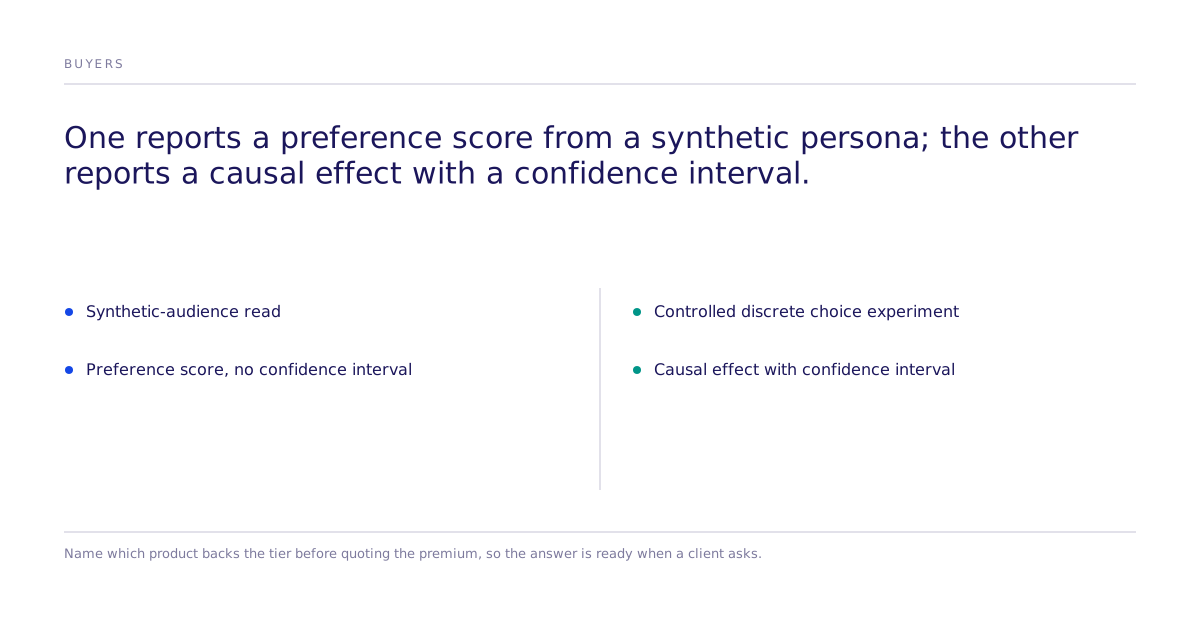
One version runs a synthetic-audience read and reports what an AI-modeled persona said it liked. That's directional: useful for catching an obviously wrong creative direction early, weak as a defensible claim once a client asks why the campaign underperformed.
The other version runs a controlled discrete choice experiment: it holds a creative concept against defined alternatives, measures which one changes stated buyer behavior, and reports a causal effect with a confidence interval rather than a preference score. Subconscious runs studies this way, and a team can move the same causal question from a simulated run to a real-human validation step without re-scoping it. That distinction matters commercially: an agency charging a premium for "validated" creative is exposed the moment a client asks what the validation demonstrated. A directional opinion and a causal estimate are not interchangeable answers to that question.
What the extra tier is worth charging for
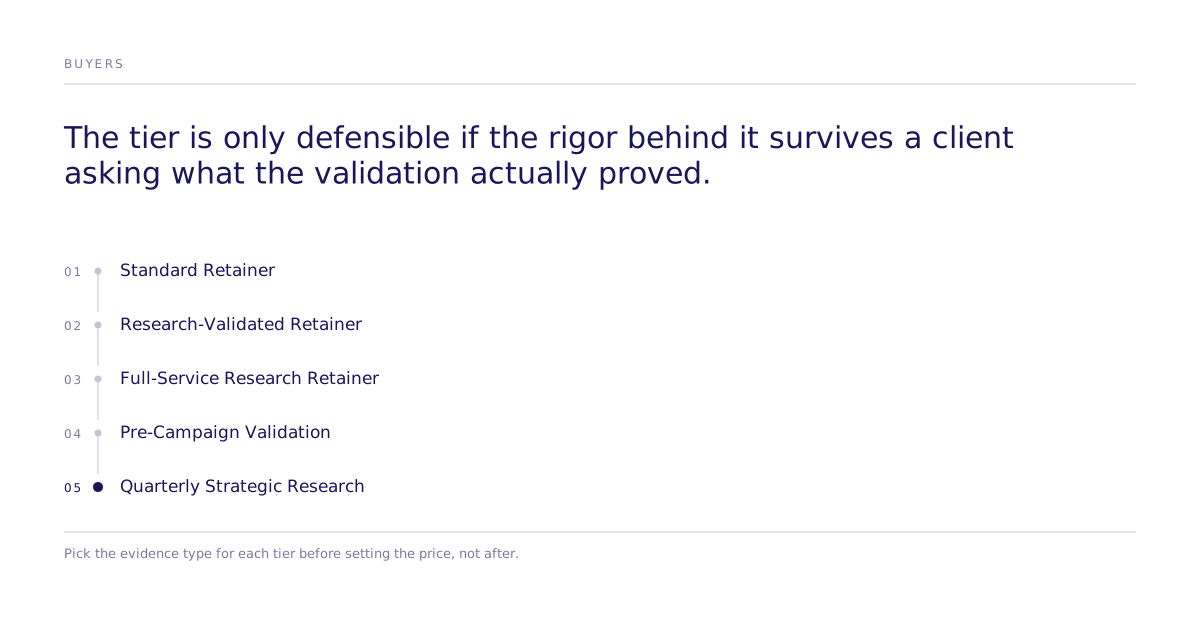
The retainer-tier idea is increasingly common: a 2026 review of agency retainer models found AI-assisted research moving from a pilot add-on toward a standard planning line item (AI Smart Ventures on the 2026 agency strategy retainer). The structure agencies have converged on has three tiers:
- Standard Retainer: creative production and campaign management, no attached research claim.
- Research-Validated Retainer: the above, plus pre-campaign validation and a recurring audience-intelligence report.
- Full-Service Research Retainer: ongoing panel or audience management, competitive intelligence, concept testing, and quarterly strategic research.
From one agency's public pricing, a client paying $10,000 per month for a standard retainer was quoted $2,000 to $4,000 more per month for the research-validated tier. Treat that spread as a starting anchor to test with your own clients: it reflects one vendor's retainer economics, not a benchmark Subconscious sets or a Subconscious price.
Positioning it as risk reduction, not research
Clients rarely pay more because "we added research." They pay more because the research answers a question they already worry about: will this work before we spend the media budget on it. Framing that tests well:
- "Before your media budget goes out the door, we can already tell you whether this creative changes behavior." This reframes the fee as insurance against wasted spend, not a research line item.
- "We catch the creative problem before your customers do." No client wants to learn a campaign underperformed three weeks after launch; a pre-campaign test catches it while it's still cheap to fix.
Keep the claim behind that framing honest. If the test behind the tier is a directional synthetic read, say so and price it as directional. If it's a controlled experiment with a causal estimate, that's the claim that survives a client asking "prove it." See how a comparable test reads in a published case study.
How to add the tier without overselling it
- Pick two or three clients on the roster where pre-campaign validation would matter most. Longer sales cycles, higher-stakes launches, or a recent history of creative disagreement are the strongest candidates.
- Scope one testable causal question per client, not a general "audience read." Define the two or three creative alternatives worth comparing before building anything.
- Run a pilot on the next live campaign concept and show the client the difference between a validated decision and an unvalidated one, with the actual result, not a hypothetical.
- Price the tier to the evidence, not the label. A directional synthetic read and a controlled experiment with a confidence interval are not the same product and shouldn't carry the same premium.
- Build the report into the recurring client meeting, so the research becomes an expected part of the retainer rather than a one-off deliverable.
Where this breaks down
A claim without its edges is marketing. This tier has edges. A research-validated tier is not a substitute for a fast, embedded creative-feedback loop built for weekly retainer cadences, and nothing here should be read as a same-day or minutes-level delivery promise. It also isn't proof of campaign performance: a causal estimate from a controlled experiment shows which concept is more likely to change behavior in the test population, not what happens once the campaign is live, subject to media placement, creative execution, and market conditions the study didn't model. Real-human validation, when it's used, confirms the same causal question against real participants. It doesn't upgrade a concept test into a guarantee. Agencies that sell the tier as certainty instead of evidence recreate the exact credibility problem the tier was supposed to fix. To see how the underlying method works before pricing a retainer amendment around it, book a walkthrough.