How Advertising Agencies Choose Which Creative Direction to Pitch
An agency new-business team has to pick which creative direction to lead with before it spends more production time or tells a client it will work. Get it wrong and the agency either loses the pitch to a competitor that showed evidence, or wins on a direction the audience never responds to, with no defensible answer when the client asks how it knows.
Why gut feeling stops working at the pitch stage
Getting one pitch ready can consume weeks on strategy, work through dozens of candidate concepts, and cost hundreds of senior staff hours. Despite that, most agencies still walk into the room relying on senior creatives' experience and intuition about what the target audience will respond to, because a full research engagement before the client is signed rarely fits the pitch timeline or budget. Commissioned market research runs into five figures on a normal engagement, well outside what most agencies can justify before they have the account (Drive Research, 2026).
A marketing buyer who already tracks acquisition cost, engagement rate, and campaign performance in real time is not satisfied by a mood board and confidence. The question an agency has to answer before it can lead with a direction is: how do you know this will work with our audience, not how long has your creative director worked in this category.
Run a causal experiment on the concepts before the room, not after
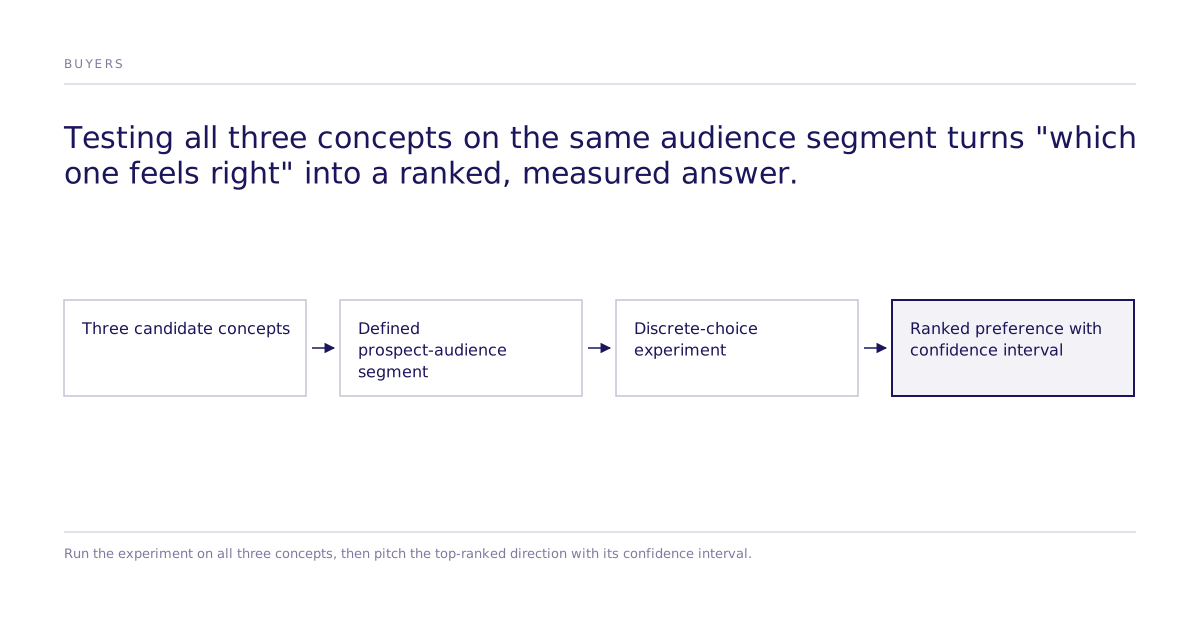
The cost of being wrong at the pitch stage is not abstract: it is the account. Subconscious runs a controlled discrete-choice experiment that compares the candidate creative concepts across a defined prospect-audience segment and returns a measured causal effect on response, with a confidence interval, rather than an open-ended reaction from a handful of reviewers. A stated preference is not the same claim as a measured effect on what the audience actually chooses head to head.
An agency preparing three directions for a client audience defines the segment along the dimensions that matter (age range, category behavior, income band, or whatever the brief specifies), then runs each concept through the same causal comparison. The output is a ranked answer to which direction the defined audience actually prefers, with a confidence interval around that answer.
How do you present the results in a pitch?
Three formats carry a measured result well in a pitch room, each fitting a different meeting and level of client sophistication.
| Format | What it shows | Best used when |
|---|---|---|
| Live walkthrough | The exact comparison run, live, so the client sees the setup and the result together | The meeting is in person or on video and the client wants to see the method, not just the number |
| Results scorecard | A one-page summary of each concept against the measured effect and its confidence interval | The client wants a leave-behind that stands on its own after the meeting |
| Response excerpts | Selected response detail from the audience segment tested, alongside the aggregate result | The team wants to pair the number with texture on why the audience responded |
A live walkthrough is the hardest of the three to dismiss as cherry-picked: the client watches the question get asked and the result produced in the room.
How do you use this beyond the pitch?
The same causal comparison extends past the win: run it for a client on a recurring basis ahead of major campaign launches, delivering a research-backed recommendation before creative goes live. That turns the agency relationship from "we made ads and hoped they worked" into "we tested this creative against your audience before it launched."
What does this comparison not replace?
A controlled comparison of creative concepts measures which direction a defined audience segment prefers; it does not measure emotional response, replace client discovery, substitute for moderated qualitative research, or stand in for observed in-market campaign performance, and it is not itself real-human validation. When a client's decision depends on that distinction, a team can move from a simulated experiment to testing with real human participants without changing the causal question, but the two remain separate claims: simulated audience scale is not a recruited human sample.
See /research for how Subconscious structures and validates these causal experiments, and /case-studies for examples of the method applied to a real decision. To scope a comparison for an upcoming pitch, see /how-we-work or book a demo.