How Market Researchers Become Strategic Advisors
Market researchers become strategic advisors by owning the decision, not only the deliverable. They define the action under consideration, the alternatives, the relevant population, the evidence threshold, and the uncertainty that remains.
A capability claim printed without its limits functions as marketing. Automated drafting, summarization, and open-ended model output can support exploration. They can also produce a fluent answer before the underlying decision is clear. Presenting that answer as validated evidence can damage the researcher's credibility and direct budget toward the wrong action.
Strategic Value Moves Closer to the Decision
In 2026, production skill still matters. Strategic value sits in choosing which evidence a decision requires and explaining why that evidence deserves trust.
Federal labor projections through 2034 show continued growth in market research analyst and marketing specialist jobs, according to the U.S. Bureau of Labor Statistics (U.S. Bureau of Labor Statistics). The pressure is on how the role is performed, not on whether it exists.
The researcher should answer these questions before selecting a method:
- What action will change because of this work?
- Which alternatives are actually under consideration?
- Which buyer or market population does the decision depend on?
- What evidence would justify acting, and what would still require validation?
The researcher is not defending a process from automation. The researcher is preventing the business from confusing a plausible output with evidence for a specific action.
Choose the Right Read for Each Stage
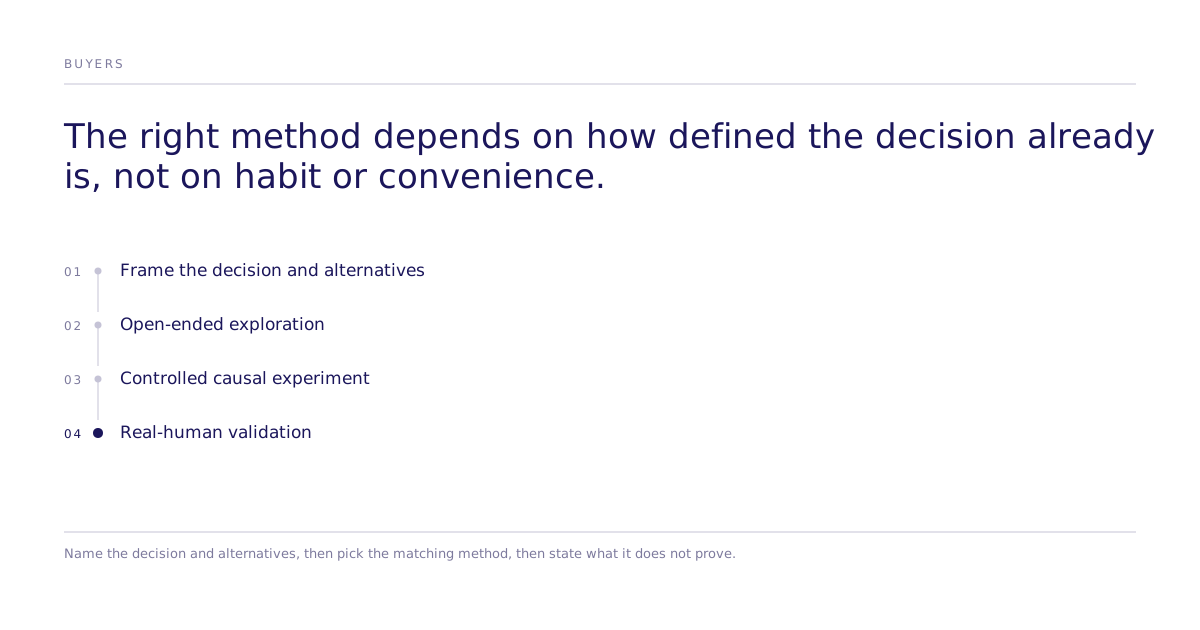
The method should match the decision and the cost of choosing poorly.
| Method | Decision it supports | Evidence boundary | Appropriate use |
|---|---|---|---|
| Open-ended exploration | Forming hypotheses, objections, and possible explanations | It does not estimate which defined action will change an outcome for a defined population | The decision and alternatives are still being framed |
| Controlled causal experiment | Comparing defined alternatives for a defined population and estimating the effect of an action | It does not prove that real customers will pay, adopt, or behave exactly as modeled in the field | The decision has named alternatives and a material cost of choosing poorly |
| Real-human validation | Testing whether the causal result holds with recruited real participants | It does not remove the need to evaluate real market behavior after the decision | The decision is expensive, public, or requires confirmation with people |
Subconscious fits the middle stage. Its research approach uses controlled, discrete-choice-style experiments to compare defined alternatives across a defined population. A study can estimate causal differences and report a confidence interval when its design supports one. This gives the researcher a defensible layer between open-ended exploration and fielded human research.
One transition matters when the decision requires stronger validation: the team can move from a simulated experiment to real-human validation without changing the causal question. The working method keeps the alternatives and outcome aligned while the evidence source changes.
Audience definition for a simulated experiment is not participant recruitment; recruited people belong to the real-human validation stage.
What Is an Evidence Contract?
A planning framework has four layers: exploration, controlled causal testing, human review, and validation. A strategic researcher makes the evidence boundary visible across all four before presenting a recommendation. The contract can be short:
- Decision: State the action the executive will approve, reject, or revise.
- Alternatives: Name the options compared. Open-ended themes are not alternatives.
- Population: Define the buyers or market participants whose behavior matters.
- Method: State whether the work is exploration, a controlled causal experiment, or real-human validation.
- Estimate: Report the causal comparison and uncertainty only to the extent supported by the study design.
- Limit: Name what the work does not establish and what evidence should come next.
Instead of presenting a collection of findings, the researcher presents an action, the evidence for choosing it, and the conditions under which the recommendation could fail.
Why Should Method Boundaries Stay Visible?
A method's failure modes belong on the record next to its successes, where a buyer can check both. A controlled causal experiment does not replace the researcher's judgment, stakeholder framing, fielded human research, or observation of real market behavior. It does not guarantee revenue, adoption, or market performance. It does not make someone a strategic advisor by itself.
The human skill is deciding which question deserves a controlled test, defining meaningful alternatives, identifying the relevant population, and refusing to present an exploratory output as conclusive evidence. The method strengthens that judgment. It does not substitute for it.
Present the Recommendation as a Decision
An executive-ready research recommendation should answer:
- Which action should the business consider?
- What alternative did the test compare it with?
- Which population and outcome does the estimate cover?
- How uncertain is the estimate?
- Which assumptions or failure conditions matter?
- What validation is required before an expensive or public commitment?
These questions keep the recommendation connected to behavior and make scrutiny useful. A stakeholder can challenge the population, alternative, outcome, or evidence threshold instead of debating a polished narrative.
What to Do This Week
Start with one visible project that has a live decision behind it.
- Write the business decision in one sentence.
- Define the alternatives and the population.
- Use open-ended exploration to frame the question, not to settle it.
- Use a controlled causal experiment when the alternatives and cost of choosing poorly are clear.
- Present the recommendation with its uncertainty, limits, and next validation step.
Add a decision-impact line to the next report before adding another data table. Review one decision-impact line once a week for a month. The point is to build a repeatable evidence practice, not to promise a delivery schedule.
Where Does This Leave the Researcher's Role?
Naming what a method cannot decide is what lets a buyer trust what it can decide. Automation changes who can produce a draft, summary, or plausible answer. It does not decide which action the business should take or which evidence justifies that action.
The strategic advisor owns that boundary. They connect the buyer decision to the right method, state what the evidence supports, and name what still needs validation. Talk to Subconscious about where a controlled causal experiment fits in a research workflow, or review past studies.
The evidence boundary should be visible at every stage, not just in the final deck.