Prepare for Agency Discovery Calls by Testing Buyer Hypotheses First
Spend the hour before a client discovery call testing three to five falsifiable claims about the client's customer, not rereading the client's website. That moves the meeting from exploration to validation: you arrive with a position the client can confirm or correct, instead of questions they have answered 30 times to 30 vendors.
What the discovery call is actually for
Strip the meeting to its 4 real goals:
- Confirm or correct your model of the client's customer.
- Surface the constraints nobody wrote down: a budget ceiling, internal politics, a regulatory limit, or the one partner whose sign-off blocks everything else.
- Agree on the problem being solved, often different from the one in the request for proposal.
- Establish strategic credibility. The client should leave feeling they hired a thinking partner, not a vendor.
None of that needs forty-five minutes of the client walking you through who buys from them. The working target: customer basics about 90 percent settled before the call starts, a planning target, not a measured standard. Published agency guidance agrees: research the account first so the call qualifies fit and aligns on the problem (AgencyAnalytics, How To Level Up Your Agency-Client Discovery Meetings).
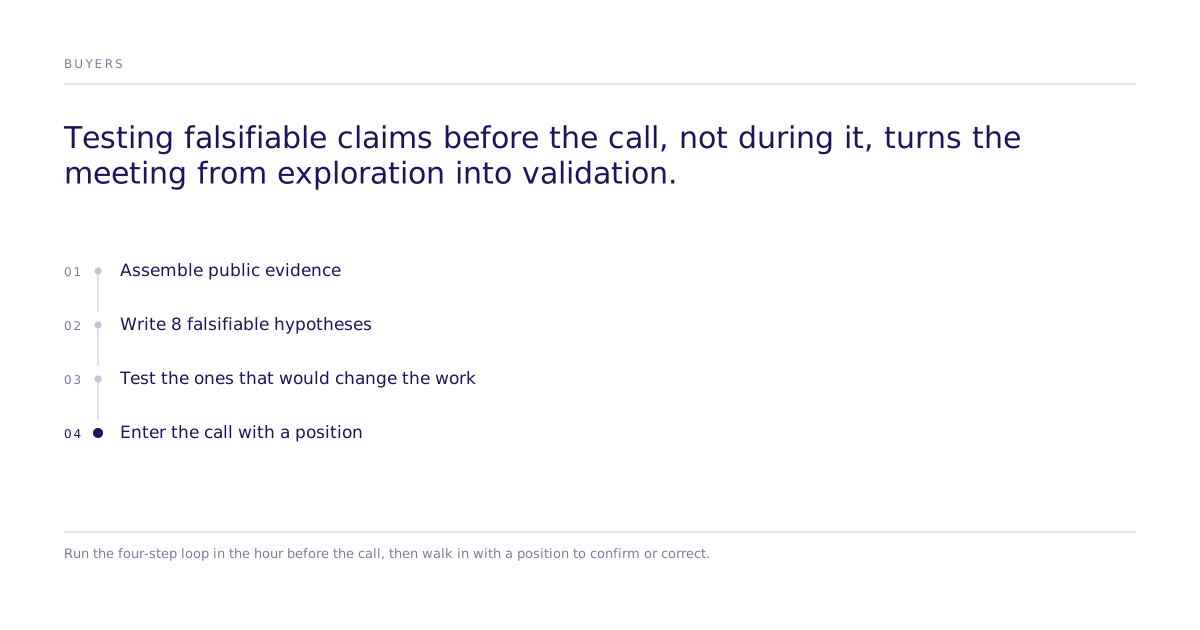
The prep window: four moves before the call
Run this loop the morning of the call; it is one team's prep hour, not a Subconscious SLA.
Assemble the public evidence on the client's customer
Pull what's public about who the client sells to:
- The client's website, especially case studies and customer logo pages.
- The client's LinkedIn profile for headcount, funding stage, and geography.
- A handful of customer reviews, 3 to 5, pulled from G2, Capterra, or a similar review site.
- Press coverage that profiles the client's customers.
- The original request for proposal or brief, if you have one.
When a client sells to two clearly different buyer types, say marketers and sales leaders, treat each as its own audience definition. A claim that holds for one often inverts for the other; averaging them hides the effect you care about.
Write eight falsifiable hypotheses
Write 8 statements about the client's customer that would change your approach if true:
- Their customer's primary decision criterion is X, not Y.
- Their customer shortlists 3 to 5 competitors before deciding, and Z keeps winning the final round.
- Deals stall once price crosses a specific dollar figure, lower than the sales team assumes.
- Tools A and B are in daily use, while C sits unused despite its spot on the integration list.
- X is the objection that comes up most often once a prospect reaches the sales team.
- Their primary growth lever is X channel, but Y would return more.
- X is the title on the org chart, but Y is the person who signs off.
- The self-image X is what the customer is buying, more than the stated feature list.
Make each one specific and falsifiable. A statement the client cannot disagree with tells you nothing.
Which hypotheses should you test before the call?
Test the hypotheses whose answer would change the work as controlled comparisons, not opinion prompts: present a defined audience with two or more alternatives, vary one thing at a time, and report which alternative moved the choice.
Subconscious runs randomized experiments on a simulation of a defined market and estimates which action moves the outcome, using discrete-choice methods, not opinion generation. The method and its validation are on the research page. Our best configuration reaches 87% of the measured human ceiling on one study: 0.832 rank correlation against the published human result, where two independent samples of real humans reach 0.959. Across all 43 studies that pass design filters the mean is 0.73. A performance number on its own is a marketing claim. Attached to its boundary condition, it becomes something a buyer can check. It is a validation result, not a guarantee for a new market; the causal fidelity paper has the full method.
Put three questions to every hypothesis:
- Does the evidence support it or contradict it?
- If it is contradicted, what is the more accurate statement?
- Which of the confirmed statements would most change how this buyer chooses an agency or a tool?
How many findings should you turn into call-ready prompts?
Pick the 3 to 5 findings worth bringing into the room and write each in 1 to 2 sentences, in the same shape: the hypothesis tested, what the test showed, and the question for the client.
For example: "We tested decision authority for your category, and the evidence points to the VP of Operations rather than the Director of Product your job-title targeting assumes. Does that match your sales conversations?"
That format brings thought into the room instead of extracting information: reactions to a specific claim are sharper than answers to an open question. Discovery checklists written for agencies make the same point (Tim Kilroy, Discovery Call Checklist for Agencies).
How does the call change when you arrive with tested hypotheses?
Two things shift. The client's feedback gets more precise: a vague question earns a vague answer, but a specific claim gets a specific correction, plus context you could not have found from outside.
Your credibility lands in the first ten minutes, which is when pricing and scope get shaped. A client who sees you already understand their buyer is negotiating with an advisor; a client who watches you take notes on the basics is negotiating with a vendor.
What this method cannot tell you
This method's misses sit next to its hits, on the record, for anyone deciding whether to rely on it. A tested hypothesis is not a substitute for the client conversation. The constraints that decide whether an engagement succeeds, budget ceiling, internal politics, approval chain, history with the last agency, exist only in the client's head. No experiment surfaces them; the prep work buys you the room to ask.
Two more boundaries:
- Naming exactly what the test cannot see is what lets a buyer decide how much weight to put on it. A simulated experiment estimates how a defined audience chooses between alternatives you specified. It does not tell you what the client's named accounts did last quarter, and it does not observe anyone using a product.
- Confirmed hypotheses are inputs to a brief, not proof of market performance. Treat them as a starting position to defend and revise, not a finding to present as settled.
Where the two methods belong:
| Stage | Simulated experiment | Real-human research |
|---|---|---|
| Discovery prep | 100 percent of the work. There is no time or budget for interviews this early. | None at this stage. |
| Brief development | Generate and test the hypotheses. | 3 to 5 customer interviews to check the most strategic ones. |
| Strategy testing | Most of the breadth work across segments and alternatives. | 2 or 3 interviews for qualitative depth. |
The escalation path matters more than the split. Subconscious can test or validate a study with real human participants, so a hypothesis that survives the simulated experiment can go to real people without rewriting the causal question: same alternatives, same audience definition, same outcome. That keeps the second study a check on the first, not a new project. That sequence is described in how we work.
Making it standard agency practice
Three patterns hold up:
- Make hypothesis testing the default step before every discovery call. A junior account executive can run the tests; a senior strategist picks the hypotheses and reads the results.
- Keep the audience definition per client. It is reusable for the brief, message testing, and quarterly reviews. Rerun it when the decision changes.
- Package the output. Some agencies now charge for the pre-call research itself, pricing it as a standalone audit in the $5k to $15k range before the larger engagement starts, a historical example from agency practice, not a Subconscious price; check it against your own market before quoting it.
Run this on your next three discovery calls
After 3 prepped calls, compare close rate, average deal size, and how clients describe you against the calls you didn't prep.
Decisions tested this way are collected in the case studies. To test a specific hypothesis about a client's customer before your next call, book a working session.