Should Your Agency Build a Research Practice, or Stay Execution-Only?
Build the practice only if the agency can define a client action, compare alternatives under controlled conditions, and defend the limits of the result. Otherwise, outsource the work or remain execution-only. A weak research offer does more damage than no offer because it turns an uncertain recommendation into a claim the client expects the agency to prove.
Retainers reward continuing value, not a new label
A research practice can strengthen a retainer when it gives the client a repeatable way to decide what to do next. A number without its limits is marketing, so this limit gets stated directly. The retainer itself does not prove that research caused better retention. A 2026 report lists annual churn at 18% for retainer-based agencies and 42% for project-based agencies (Focus Digital, "Average Marketing Agency Churn: 2026 Report"). Treat those figures as industry benchmarks, not as a forecast for an agency that adds a research line.
A historical planning example put added contract value at $10K-$50K per engagement depending on scope. The misses sit next to the hits so a buyer can weigh both. That range is not a current Subconscious price, a market average, or an expected result. An agency still has to model its own labor, method review, account economics, and demand.
The offer should answer which action changes behavior
The unit of value is not a report format. It is a tested decision. The agency should be able to name:
- the action the client may take, such as changing a price, claim, or launch message;
- the alternatives being compared;
- the buyer group whose behavior matters;
- the outcome that would change the client's decision;
- the uncertainty and assumptions that limit the recommendation.
A generated-response survey can summarize plausible reactions. Naming the failure mode here lets a buyer check the claim against it. It cannot, by itself, establish that changing one action caused a behavioral outcome to move. A causal experiment is designed around that intervention and comparison.
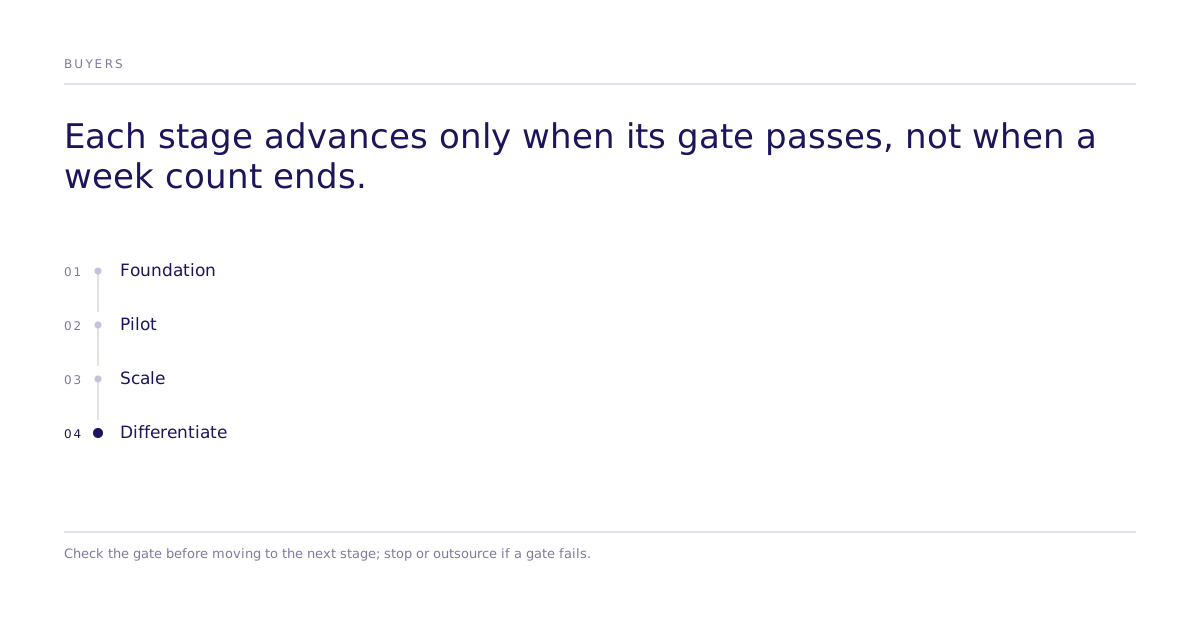
Use a four-stage plan, with a gate at each stage
The windows and staffing quantities below are historical planning examples, not current Subconscious timelines, staffing requirements, or delivery commitments.
| Historical planning stage | Operating choice | Gate before advancing |
|---|---|---|
| Foundation (Weeks 1-4) | Assign 2-3 existing strategists, define one decision-led offer, and create reusable study briefs | Another strategist can identify the action, alternatives, audience, outcome, and method limit from the brief |
| Pilot (Weeks 5-8) | Work with three existing clients across different industries | Each pilot produces a decision record that separates evidence, interpretation, and recommendation |
| Scale (Weeks 9-16) | Add the offer to relevant retainers; at 3-5 studies per month, reassess ownership | A named research lead or accountable reviewer can enforce method and claim quality |
| Differentiate (Ongoing) | Publish the method, assumptions, and failure conditions | Clients can see what the agency tests, what it does not test, and when human confirmation is required |
The gates matter more than the dates. An agency should scale because the method produces a defensible record across more than one client decision, not because a calendar window ended.
Proof has to match the promise
The first proof should show a real decision, the tested alternatives, the result, and the boundary around that result. One documented pricing case identified $60 as the price for maintaining market share and reported approximately $65,000 in traditional research costs avoided (Subconscious case studies). Publishing this limit is what makes the number usable instead of marketing. These are case-specific outcomes that do not guarantee the same result for another client or agency.
Subconscious's research approach is relevant when the client needs to test which product, pricing, messaging, or go-to-market action is more likely to move a defined outcome. Where the decision warrants it, Subconscious can test or validate studies with real human participants without changing the causal question. A modeled audience definition and recruited human participants are separate capabilities and should not be presented as one.
Three questions determine whether to build or outsource
Do clients bring repeated intervention decisions?
Build when several clients repeatedly choose among consequential actions and the agency already owns the surrounding strategy. Outsource when demand is sporadic or when an independent method partner would carry more credibility.
Can one person refuse an unsupported claim?
Assign a method owner before selling the offer. That person must be able to reject a study that lacks a defined comparison, uses an outcome the method cannot support, or turns directional evidence into certainty. If no one has that authority, the practice is not ready.
Can the agency state where the offer stops?
The agency remains responsible for pricing, staffing, quality control, and client interpretation. Subconscious does not currently confirm a packaged agency-reseller program, named pricing tiers, an hour-by-hour delivery workflow, or a specific revenue projection. A causal study also does not automatically prove real-market performance. High-stakes decisions may require real-human validation or evidence from the market after the client acts.
Scope the first offer around one live decision
Start with one client action that has clear alternatives and a costly downside if chosen poorly. Write the decision brief before writing the sales page. Review the study workflow, then scope a pilot only after the agency can state the action, comparison, outcome, proof standard, and stopping rule.