Should You Expand to a New Market? A Causal Framework for Founders
A founder should prioritize the candidate market where a controlled discrete-choice experiment measures the strongest causal effect for a clearly defined buyer segment, rather than the market that feels most familiar. A founder with traction in one market is often asked to bet on a second one: a new geography, a new vertical, or a new customer segment. The decision that matters is not whether expansion sounds attractive, but which candidate market to prioritize, and which positioning, price, or offer to test with that market's buyers before committing engineering, compliance, or go-to-market budget.
Why is this decision hard to get right?
Runway and team focus are a startup's least replaceable resources. Spending months chasing a market that never responds is usually discovered only after the GTM spend is gone and the home market has lost attention. CB Insights' 2024 analysis of startup failure found that 43% of failed startups cite poor product-market fit as a primary cause. A wrong expansion bet is the same failure mode, run a second time with less runway to recover from it. Traditional options for reducing that risk are limited: guess based on instinct, ask an existing network biased toward what already works, or commission outside research that takes weeks to return a report of general market-size estimates rather than a testable answer.
The five questions any expansion decision has to answer
Before spending on market entry, a founder needs answers to five questions:
- Does the new market have the same pain point the product solves?
- Are buying behaviors different enough to require a new sales playbook?
- What local competitors or substitutes already exist?
- What regulatory or cultural factors could block entry?
- Is the timing right, or is the team too early or too late?
Each question traditionally requires its own research stream, expert conversation, or competitive scan.
What causes market-entry bets to fail?
Founders usually do not fail on execution. They fail on selection: choosing a market where the pain point is weaker than assumed, where the buying process runs through a committee instead of a single decision-maker, or where a well-funded local incumbent already owns the category. None of those conditions are visible from a TAM estimate. They only show up once real buyers compare specific offers against specific alternatives.
How does a causal approach test expansion candidates?
Subconscious runs a controlled discrete-choice experiment comparing defined positioning, pricing, or message alternatives across a precisely defined buyer segment in the candidate market. The output is a measured causal effect with a confidence interval: which alternative changes buyer behavior, for which segment, and by how much. That is different from an open-ended interview or panel discussion, where a founder collects opinions with no defined alternative to compare against and no measured effect size.
"Does this market have the pain point we solve?" and "which message resonates?" are not the same kind of question. The first is discovery. The second is a comparison between defined alternatives, which a controlled experiment is built to answer.
| Approach | What it tests | What it returns | Where it fits |
|---|---|---|---|
| Internal network / gut instinct | Nothing structured | An opinion, biased toward existing wins | Fast, but not decision-grade evidence |
| Traditional market research or consulting engagement | Market sizing, qualitative themes | A report, typically over weeks | Useful for broad landscape context, slower than a single decision cycle |
| Open-ended AI panel or interview | Whatever the founder asks | Plausible-sounding qualitative responses | Useful for early discovery, not causal validation of an offer |
| Controlled discrete-choice experiment | Defined alternatives (price, message, positioning) against a defined segment | A causal effect with a confidence interval | Best fit once the founder has candidate offers to compare, not just an open question |
Running the comparison
- Narrow the decision to two or three candidate markets or verticals.
- For each, define the buyer segment and the specific alternatives worth testing: a positioning statement, a price point, or a messaging angle.
- Run the controlled experiment against each candidate segment and compare the measured effects side by side.
- Prioritize the market where the effect is strongest and the buyer segment is best defined, rather than the market that feels most familiar.
This does not replace judgment about which markets are worth considering. It replaces guessing about which offer will land once candidates are on the table.
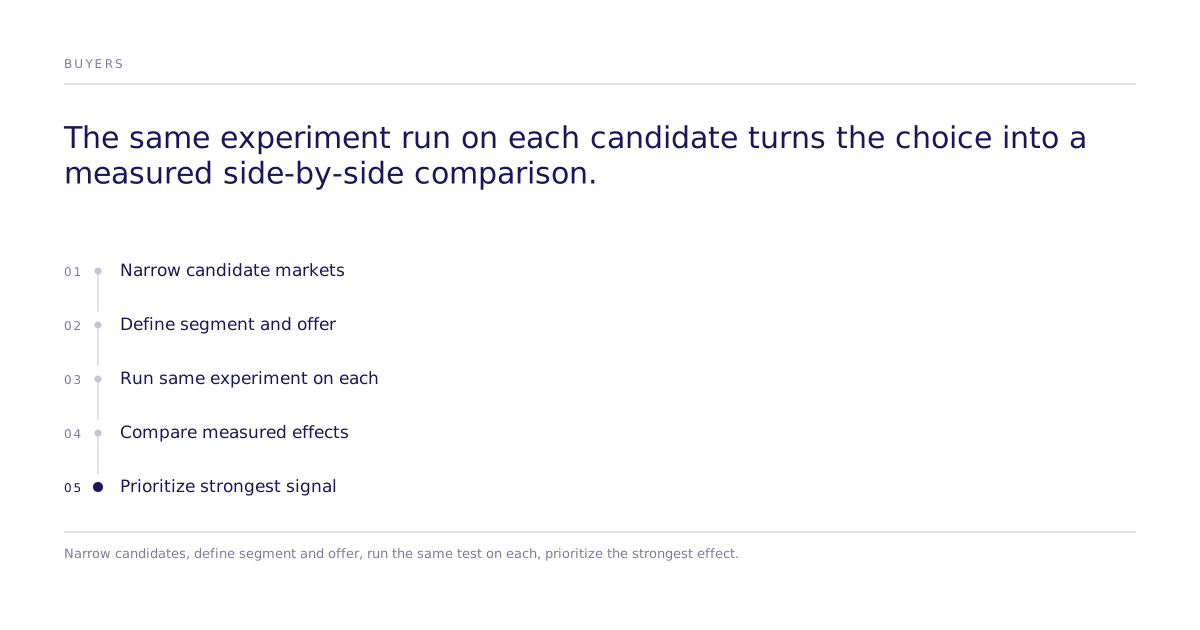
Ranking candidate markets on the same measured effect, rather than on separate conversations, is what turns the comparison into evidence.
Limitations
A controlled experiment does not replace regulatory or compliance review, local competitive intelligence, sales relationships in the new market, or go-to-market execution. It answers one question well: given a defined set of alternatives and a defined buyer segment, which alternative is more likely to change behavior.
Audience reach describes the scale of the simulated experiment; it is not the same as recruiting real people to participate. When a decision is consequential enough, a team can move from a simulated experiment to a study with real-human participants without changing the underlying causal question. See /research for how Subconscious structures and validates these experiments, and /case-studies for outcome examples.
Practical next step
A founder does not need a full market-entry study before making a first move. A directional, causally measured comparison between two or three candidate markets is enough to decide where to spend the next quarter of engineering and go-to-market effort. Book a walkthrough or read how Subconscious structures a market-entry experiment before committing budget to a guess.