When a Yield Difference Isn't the Treatment: A Field-Trial Case Study in Spatial Confounding
A field trial testing a microbial treatment's effect on plant yield found a difference between treated and untreated plots. Before that difference could be trusted as a treatment effect, a Bayesian consultancy had to answer a prior question: how much of it was actually caused by where each plot sat in the field.
What confound hides in a field trial?
Soil quality, moisture, and drainage vary across a physical plot, and that variation does not respect treatment boundaries. A plot near a wetter corner of the field can outperform a drier one regardless of what was applied to it. Field-trial statisticians have documented this spatial-correlation problem for decades: in trials without randomized, replicated block assignment of treatment to plots, treatment comparisons that ignore the spatial layout of plots can attribute yield variation to the treatment when the real driver is location. For a biotech or agtech R&D team, that mistake produces a false-positive product claim or a rollout built on noise.
How do you isolate the spatial pattern before reading the treatment effect?
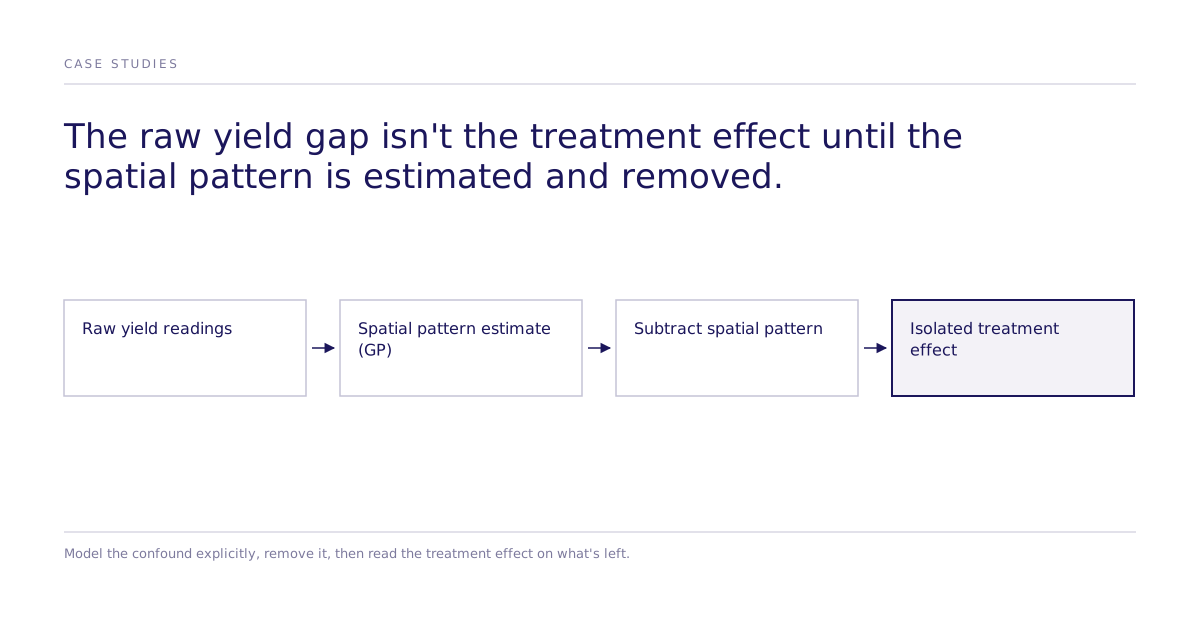
The consulting team's approach, described in the project's blog post write-up, was to model the spatial pattern rather than let it hide inside the treatment estimate. Using a Gaussian process over each plot's location, they estimated a smooth spatial surface across the field, then subtracted that surface from the raw yield readings before comparing treated and untreated plots. What remained after removing the spatial estimate is what they read as the treatment effect.
This two-step separation (estimate the confound, then remove it) is a weaker relative of the joint-estimation approach in Bayesian spatial modeling in three-dimensional agricultural trials, where a spatial Gaussian process is fit alongside the treatment term in a single model so the treatment coefficient cannot be contaminated by unmodeled position effects.
Why this generalizes past one field
The project had limited data: a small number of plots, a single field layout, and one microbial treatment. That constraint is common in on-farm precision experimentation, where spatial variability in crop response to agronomic inputs is large enough that a treatment comparison without a spatial term can point the wrong direction even when the sample looks adequate on paper. The decision this case illustrates is not specific to microbes or yogurt cultures: any team drawing a causal conclusion from physical trial data has to ask whether the effect it sees would survive a spatial control, before it survives a launch decision.
The same discipline, a different population
Subconscious's causal testing method rests on the same core move as this field trial: isolate which action actually drives an outcome, under quantified uncertainty, rather than accept an observed difference at face value. In a simulated population the confound is usually an unbalanced design or an unmodeled interaction rather than field geography, but the discipline is identical: name the candidate confound, model it explicitly, and read the treatment effect only after it is accounted for. Teams that want to move a causal question from a simulated population to real-human testing without changing what's being asked can see how that transition works on how we work and in the broader research documentation.
What does this case not show?
This is a third-party consulting case study on physical agricultural field-trial data. It is not a Subconscious customer engagement, and Subconscious did not perform or replicate this analysis. The write-up did not report an accuracy figure, an effect size, or a named outcome beyond describing the modeling approach, so none is asserted here. A biotech or agtech team applying this same discipline to its own trials, physical or simulated, still needs its own spatial or design-based check; the lesson generalizes, the numbers do not.

Sources
- Treatment comparisons in agricultural field trials accounting for spatial correlation, Journal of Agricultural Science (Cambridge Core)
- A Bayesian analysis of an agricultural field trial with three spatial dimensions, ScienceDirect
- Spatial variability of crop responses to agronomic inputs in on-farm precision experimentation, Precision Agriculture (Springer)