Before You Build the Survey: Testing What Actually Drives the Decision
A controlled discrete-choice experiment, testing structured tradeoffs between attribute combinations, identifies which attributes actually move a decision before a survey measures them at scale. A research or insights lead who already runs closed-ended surveys faces a narrower question before the next one goes out: which attributes, price points, or messages are even worth asking about. A survey scores dimensions the team has already chosen. It cannot tell them whether they chose the right dimensions.
Where a closed-ended survey runs into its own design
A survey question implicitly defines the space of possible answers before a single response comes in. Take a 1–5 rating on "How satisfied are you with our product?": the wording already treats satisfaction as the dimension that matters. If the real driver is "impressed by the capability but frustrated with the pricing model," a Likert scale cannot capture that split. SurveyMonkey's own product description is explicit about what the tool is for: distribution at scale, templated question types, and quantitative analysis across large samples: a 20-question survey sent to 5,000 people and segmented by demographic is exactly the job it's built to do well.
Open-ended fields inside that same survey don't close the gap. Respondents typically write 5 to 15 words in a free-text box: "onboarding was confusing," "too expensive," which register as signals, not explanations. SurveyMonkey's own guidance on open-ended questions recommends them for added context, not as a substitute for structured follow-up: getting from "onboarding was confusing" to which part was confusing, what the respondent was trying to do, and what they did next requires a conversational follow-up a fixed-field survey form doesn't run.
The result: teams that go straight to a survey often measure the wrong dimension with high statistical precision, then re-run research after launch to learn why a decision that looked solid on paper didn't hold up in the market.
What does a controlled experiment add before the survey gets written?
A discrete-choice experiment doesn't ask people to rate a dimension the researcher picked in advance. It presents respondents with structured tradeoffs, combinations of price, feature, and message attributes, and estimates which specific attributes and levels causally move the choice, each with a confidence interval on the effect size. That output is a ranked, quantified answer to "which of these things actually matters," not a satisfaction score on a dimension nobody has tested.
Scope limits published alongside a method are what a buyer checks before committing budget. This is upstream of a tracking survey, not a replacement for it. A discrete-choice test on a synthetic population identifies which attributes are worth asking about at all; a SurveyMonkey-style survey then measures those specific attributes at scale, on a cadence, across a large sample.
| Closed-ended survey | Controlled discrete-choice experiment | |
|---|---|---|
| Question it answers | How does a defined population rate a dimension the researcher already chose? | Which attributes and levels causally move the decision, and by how much? |
| Respondent format | Fixed-choice or Likert-scale questions, optional short free text | Structured tradeoffs between attribute combinations |
| Output | Percentages and cross-tabs on a predefined scale | Ranked causal effects with confidence intervals |
| Where it fits in the sequence | After the relevant dimensions are known, to track them at scale | Before the survey, to find out which dimensions are worth tracking |
Where does the causal test stop?
Naming what a method doesn't cover is what lets a buyer check the fit before they commit budget. A discrete-choice experiment is not an open-ended qualitative interview. It doesn't run sentiment analysis on free-text responses, and it isn't a survey-distribution or analytics platform: those stay squarely in SurveyMonkey's category. A causal test also doesn't answer questions where the researcher already knows which attribute matters and only needs to measure it at scale across a real population; that's a survey's job, not an experiment's.
Publishing a result's validation status is what turns it from a claim into evidence a buyer can act on. The findings from a synthetic-population experiment are simulated-audience results, not observed market behavior, and they're only as trustworthy as their real-human validation. Audience reach and recruited real-human validation are two distinct claims: a synthetic experiment can run at a scale a recruited panel can't match, but confirming that its findings hold requires testing the same causal question against real respondents before a team commits budget to it. Where that validation step changes the answer, run it before scaling the survey; where it doesn't change the answer, the causal test result stands on its own.
How do you sequence the two methods?
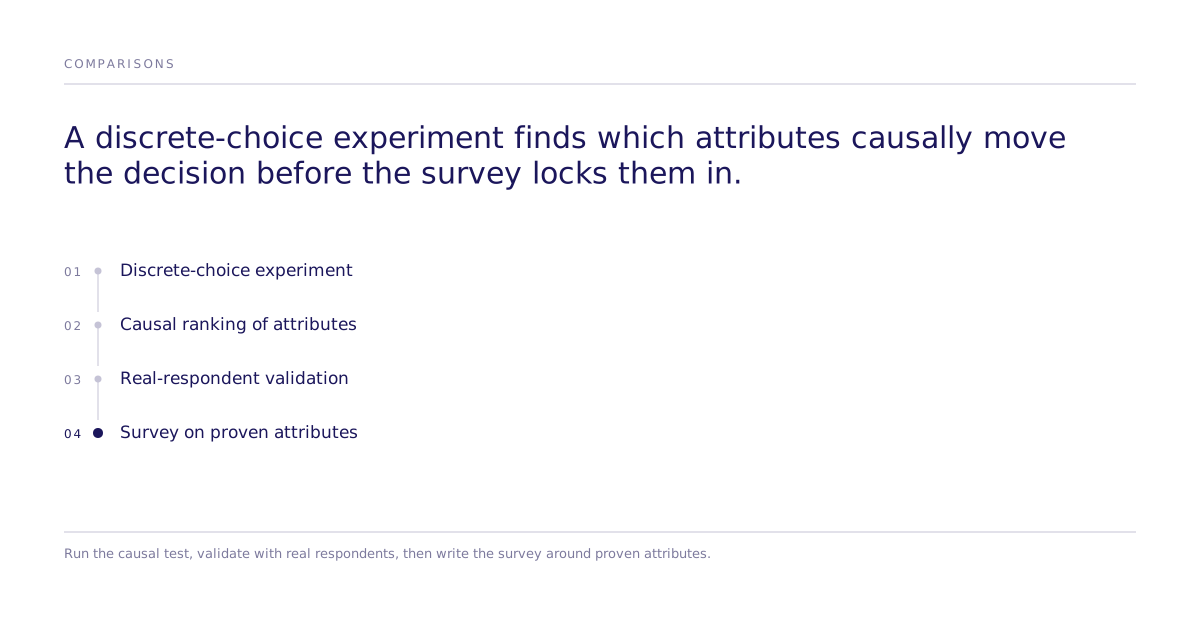
A workable order looks like this: run a controlled experiment to find which attributes causally move the decision, validate the result against real respondents where the stakes justify it, then write the survey to track those specific attributes over time at scale. The research methodology explains how the discrete-choice design and confidence-interval reporting work; how a study moves from question to result covers the practical sequence a team runs through end to end.
Starting with a causal test before the survey answers a narrower question than "what's the best research tool": which dimensions are worth quantifying at all, before the team spends survey budget on the wrong one.