Continuous Feedback Monitoring vs. Controlled Behavioral Experiments
Continuous feedback monitoring tracks whether customers notice or react to a change, while a controlled behavioral experiment isolates which specific variable caused a behavior change and by how much. A pricing change, a positioning shift, or a feature bet needs more than a reaction. It needs a test that isolates which specific change moved customer behavior, and why. A day-to-day product tweak usually doesn't need that much rigor. Confusing the two wastes either a research cycle or a decision.
Discrete choice experimentation is the research method for that isolation problem: it holds some attributes constant, varies others, and estimates which attribute change actually drove the choice (ISPOR Conjoint Analysis Good Research Practices Task Force Report, ScienceDirect / Value in Health). A reaction stream and an open-ended research conversation can feed into that design. Neither is that design by itself.
Two workflows product teams often mix up
Some tools give a continuous stream of reactions: a lightweight signal that flags whether something might be working, checked as often as a team ships. The question is narrow: did people notice this change?
Other workflows are deliberate. A team defines the question, designs a comparison between specific alternatives, runs it, and extracts an answer before a launch, a price change, or a positioning shift. The question is broader: which alternative moves behavior, and by how much? Only a controlled comparison answers it.
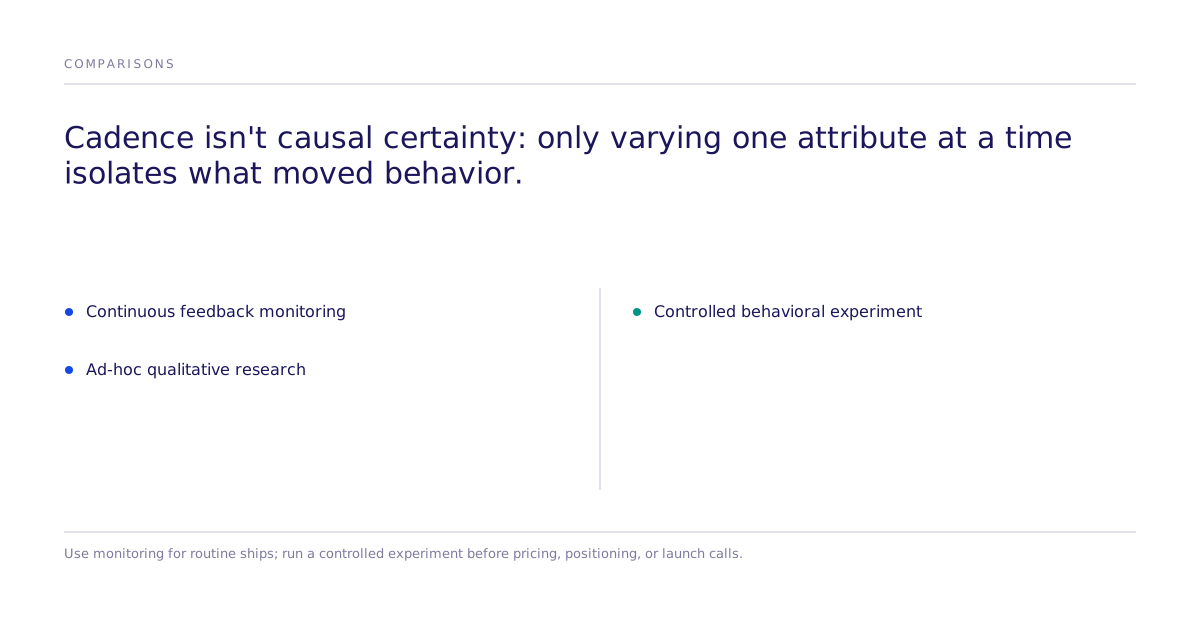
Neither cadence is universally better. The mistake is applying the wrong one: treating an ambient reaction trend as proof that a pricing change will work, or running a full controlled study on a routine tweak a lighter check would have answered just as well.
Cadence is not the same as causal certainty
A method's limits belong on the record next to its use cases, so a buyer can check the fit before relying on it. A continuous feed of reactions tells a team whether something changed. It does not isolate which change caused the shift, or rule out other things that moved at the same time. That's a structural limit of always-checking-in workflows, not a flaw in execution.
A controlled experiment holds everything constant except the one variable under test: a price point, a message, a feature bundle, and estimates that variable's effect on behavior. A team that needs to know "will this price move conversion" needs that answer, not a reaction trend.
Comparing the three common approaches
| Method | Question it answers | Depth | Best fit |
|---|---|---|---|
| Continuous feedback monitoring | Did people notice or react to this change? | Lightweight, frequent reactions | Fast-shipping product teams tracking day-to-day changes |
| Ad-hoc qualitative research | What do customers say they think or prefer? | Open-ended, interpretive | Early discovery, understanding language and framing |
| Controlled behavioral experiment | Which specific action changes behavior, and by how much? | Isolates one variable's causal effect | Pricing, positioning, launch, and other consequential decisions |
When is continuous monitoring enough?
If a team ships frequently and wants a running check on whether customers are reacting well or badly to incremental changes, a lightweight continuous check fits. Naming what a tool can't do is what lets a buyer pick the right one for the decision at hand. It isn't built to isolate causes; it's built to catch something worth a closer look.
When the decision needs a controlled experiment
Getting that kind of decision wrong is expensive: a team reads a reaction trend as proof, ships the change, and later finds the trend had nothing to do with the actual driver. It needs a test that isolates the one variable in question and estimates its effect, not a directional read on general sentiment.
Subconscious is built to help here. It runs controlled experiments on a simulated market, comparing specific alternatives, such as a price, a message, or a bundle, and estimating which one is more likely to change a defined behavior, with a person-level audience built for that comparison. It is the deliberate side of this distinction, proven with a randomized experiment rather than an open-ended conversation.
Subconscious can also test or validate a study with real human participants, moving from a simulated run to real-human validation without changing the underlying causal question, which matters when a pricing or positioning call is consequential enough to warrant that second check.
Subconscious runs controlled studies against a person-level audience graph covering 800 million real people. A capability number without its boundary is marketing copy, so the boundary goes on the record too. That graph is not a recruitable panel of standing participants; recruiting real people for the validation step above is a separate, explicit part of the workflow, not an automatic guarantee attached to every study.
How do you choose between them?
Most strategic decisions, such as pricing, positioning, or a major feature bet, benefit from a controlled comparison. Most day-to-day development cycles benefit from a lighter, continuous check.
For a decision that fits the second category, see how Subconscious approaches case studies of causal action testing, or book a walkthrough of a controlled experiment on your own market.