Lakmoos and Neuro-Symbolic Simulation: What a Regulated-Industry Buyer Should Actually Compare
An insights or pricing leader at an automotive, financial-services, or energy company evaluating a simulation vendor is usually comparing the wrong thing. The question isn't which tool produces answers that look most like a real customer's answers. It's whether the tool tells you which action moves the outcome you're deciding on, with enough certainty to commit budget or capital.
Lakmoos is one of the more distinct vendors in this space, and deserves evaluation on its own terms, not as a stand-in for every simulation tool.
What Does Lakmoos Actually Do?
Lakmoos builds neuro-symbolic AI: neural networks paired with symbolic reasoning, aimed at modeling how people in specific regulated sectors think, feel, and decide (Science behind: Neuro-symbolic AI, Lakmoos AI). A symbolic reasoning layer can help a model apply an explicit decision rule, which matters where the actual choice a person makes is governed by one: a compliance threshold, a safety standard, a tariff structure.
The company builds within three verticals: automotive, finance, and energy (About, Lakmoos AI). Inside those sectors it builds calibrated models meant to reflect industry-specific behavior patterns, regulatory context, and stakeholder dynamics, rather than one general-purpose simulation applied across any market.
The gap a similarity score doesn't close
The real category question, for any vendor whose central claim is how closely a simulated response matches a real one: does that similarity score tell you what to do?
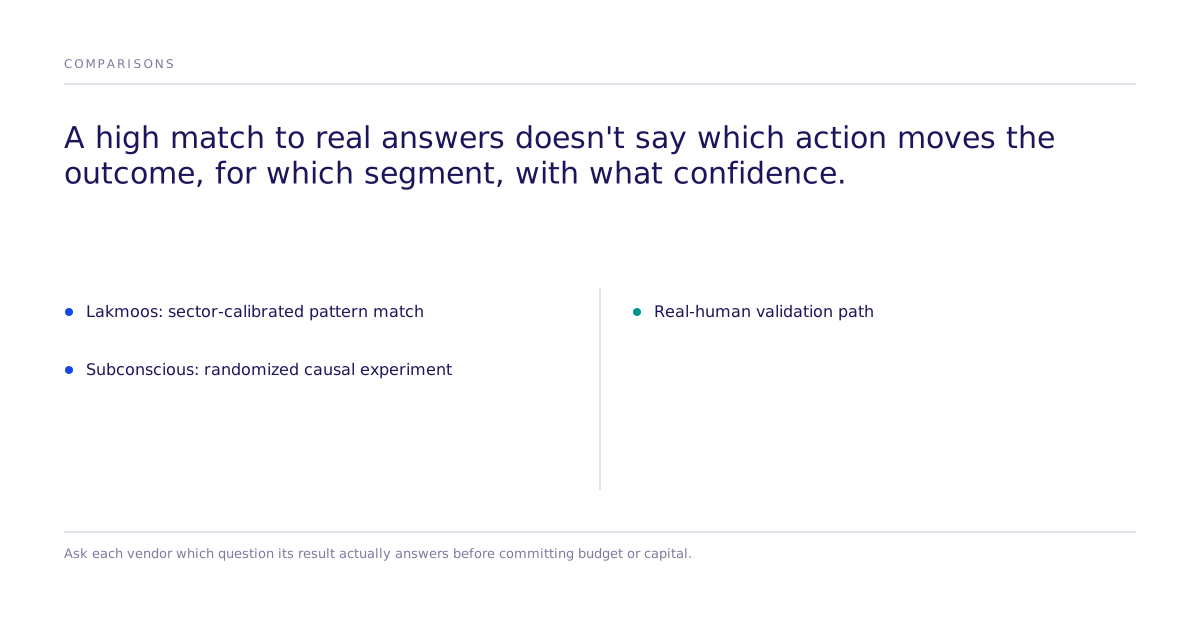
Matching how a population would likely answer is an input to a decision, not the same as identifying which action causes a shift in the outcome you care about, for which segment, with a quantified range of confidence. A pattern-matching tool can be well-calibrated to a sector's behavior and still leave open the question a pricing, launch, or positioning call turns on: if you do X instead of Y, does the target metric move, and by how much?
The cost of skipping that step compounds in a regulated vertical. A pricing or claims decision that ships on a plausible-sounding simulated response, never checked against a controlled comparison or a real-human holdout, can trigger a compliance review after the fact, waste a launch cycle, or commit capital to the wrong segment before any real-market signal exists.
Comparing what each approach is built to answer
| What you're deciding | Lakmoos | Subconscious |
|---|---|---|
| Core method | Neuro-symbolic AI: neural networks combined with symbolic, rule-based reasoning ([Science behind: Neuro-symbolic AI](https://lakmoos.com/science)) | Causal behavioral platform: randomized experiments on a simulated market estimate which action moves an outcome, for which segment, with quantified uncertainty |
| Industry scope | Calibrated specifically to automotive, finance, and energy ([About, Lakmoos AI](https://lakmoos.com/about)) | A cross-industry causal method, applied to the buyer's specific pricing, launch, or positioning question |
| What a result tells you | How a modeled respondent in that sector is likely to think, feel, or answer | Which action causes the outcome to move, before capital is committed to it |
| Path to real-human evidence | Not disclosed in Lakmoos's public materials | Studies can extend into real-human participant testing without changing the underlying causal question |
What proof should look like before capital moves
If a vendor's central claim is a similarity or accuracy score, the follow-up question: reproduced against what, and how often? On this measure, Subconscious's best configuration reaches 87% of the measured human ceiling on one study: 0.832 rank correlation against the published human result, where two independent samples of real humans reach 0.959. Across all 43 studies that pass design filters, drawn from a broader corpus of roughly 300 replicated human studies across 9 domains, the mean is 0.73 (the causal fidelity paper). That figure describes replication of study outcomes on a validation set, not a guarantee for a new market.
The practical advantage: a team can start with a simulated experiment and, when the decision warrants it, move to a real-human validation study or holdout without re-deriving the causal question.
Where Doesn't This Approach Help?
Subconscious does not ship a packaged calibrated decision model for automotive, finance, or energy the way a vertical-focused vendor might. It is not a rule-based, neuro-symbolic reasoning architecture, nor a self-serve, instant-signup product tier. If the actual decision in front of you turns on a narrow, rule-governed regulatory logic question inside one of Lakmoos's three sectors, and the scope exists for a tailored vertical build, that architecture may be the more direct fit.
Simulation, of either kind, has a hard boundary: a validated simulated study is not an observed usability session, a clinical trial, or automatic proof of market performance. Real-human validation extends the causal test; it doesn't turn it into a different kind of evidence.
How Do You Make the Actual Decision?
Before comparing vendors on similarity or accuracy claims, define the decision itself: name the specific action under consideration, the outcome it's supposed to move, and the segment it applies to. Then ask each vendor two questions. First, does the output estimate a causal effect of that action, or does it describe how closely a response matches a population pattern? Second, is there a path to check the result against real human behavior without restarting the analysis from scratch?
How Subconscious structures that process, including the move from a simulated study to human validation, is covered in more detail in how Subconscious works, with methodology grounding in Subconscious research and applied examples in case studies.