A Price-Guessing Benchmark Is Not a Pricing Decision
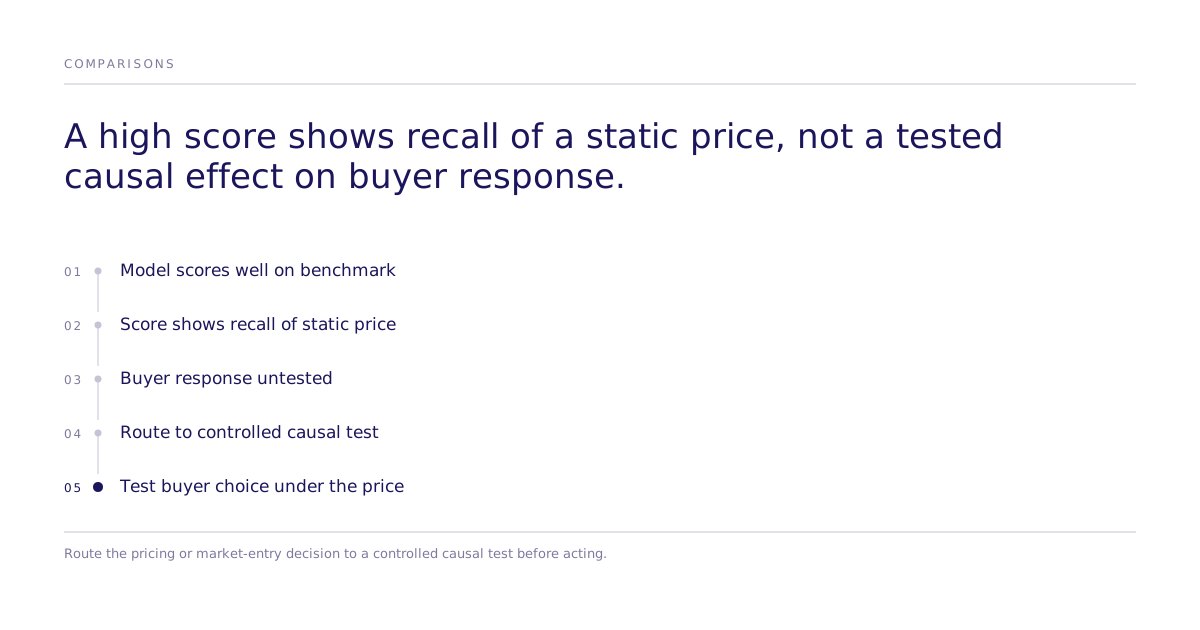
A price-guessing benchmark measures how closely a model recalls a known product price, while a pricing decision depends on the causal effect that price has on real buyer demand. A large language model that scores well on a price-estimation benchmark raises a question: does that say anything about how real buyers respond to a specific price or market entry? It does not. A model that recalls plausible grocery prices has demonstrated background knowledge, not a tested causal effect on demand.
What Does a Price-Estimation Benchmark Actually Measure?
One published benchmark tests large language models on a Price Is Right–style Showcase game: models see ten example products with known prices, then estimate the total cost of three unseen products without going over. Performance is scored three ways: Mean Absolute Percentage Error (MAPE) for how close the bid lands to the true price, an overbid rate for how often the model breaks the no-overbid rule, and an Elo rating that combines both across simulated head-to-head matchups.
The dataset behind it holds 820 real grocery items pulled from the show, priced at west-coast manufacturer suggested retail levels. Each model runs 50 to 100 Showcases, with results replayed in simulated tournaments rather than live competition.
Why the score is background knowledge, not a demand signal
The benchmark's own stated caveats matter as much as its scores. Prices in the dataset are static, drawn from a single source, and limited to west-coast retail; the benchmark does not model promotions, inflation, or regional price differences. Elo ratings can also vary meaningfully at 50 to 100 Showcases per model, since the random assignment of items to tournaments introduces sampling variance.
That is not a flaw in the benchmark's design for its stated purpose. It is a boundary on what the score can support. A model that produces a low MAPE has shown it can recall or infer a plausible price for a can of coconut water. It has not shown how a real buyer's willingness to purchase shifts when that price moves, how a competitor's price changes their choice, or what happens to demand when the product enters a market it has never been sold in.
Two questions that look similar and are not
The benchmark's leaderboard shows models trading raw accuracy for rule compliance in different ratios. A model with a low MAPE can still carry a high overbid rate, and vice versa, because minimizing average error and following a hard constraint are different optimization targets. That tradeoff illustrates a broader point: a single accuracy number rarely captures the property a decision depends on. The same gap separates price recall from a tested pricing action.
| Price-estimation benchmark | Causal pricing or market-entry test | |
|---|---|---|
| What it scores | How close a model's guess lands to a known static price (MAPE), and whether it stays under budget (overbid rate, Elo) | The causal effect of a specific price or entry action on buyer choice, with a confidence interval |
| Data source | 820 grocery items at a single west-coast retail price point | A defined population responding to the specific price or entry scenario under test |
| What a strong result shows | The model's background knowledge of plausible consumer prices | How demand or choice actually shifts when the price or entry action changes |
| What it cannot show | Elasticity, demand response, or any causal link between a price and buyer behavior | n/a |
Model coverage varies by provider and version, so any comparison of "which model estimates prices best" is also a comparison of specific model releases at a point in time; check current model documentation for what a given release supports before citing its benchmark score (Anthropic model overview).
Why Do Market Entry, Elasticity, and Compliance Still Need a Causal Test?
The benchmark's own framing connects price estimation to market entry, price elasticity, economic indicators, and regulatory compliance. Each of those applications depends on knowing how a price or entry decision changes buyer behavior, which a static price-recall score cannot show.
Subconscious runs a controlled discrete choice experiment against a defined population before a pricing or market-entry decision ships, and returns the causal effect of the specific price or entry action, with a confidence interval, rather than a single point estimate of what a price "should" be. A team can move from that simulated experiment to real-human validation without changing the causal question tested: the same experimental design, run with recruited human participants instead of a synthetic population.
This distinction cuts both ways. A causal experiment on a defined population answers how a specific pricing or entry action changes choice, not what the objectively correct price is, and it does not replace demand forecasting, cost accounting, or regulatory review. A price-estimation benchmark is not a market-entry study or a proof of demand response; it is a test of whether a model's background knowledge produces plausible numbers under game rules. Shipping a price on the strength of a benchmark score alone means the market's actual response was never tested.
Before that decision ships, see current model coverage on the leaderboard, or book a demo to scope a pricing or market-entry test.