Research Agency, Self-Serve AI Panel, or Causal Experiment: Choosing by Decision, Not by Vendor
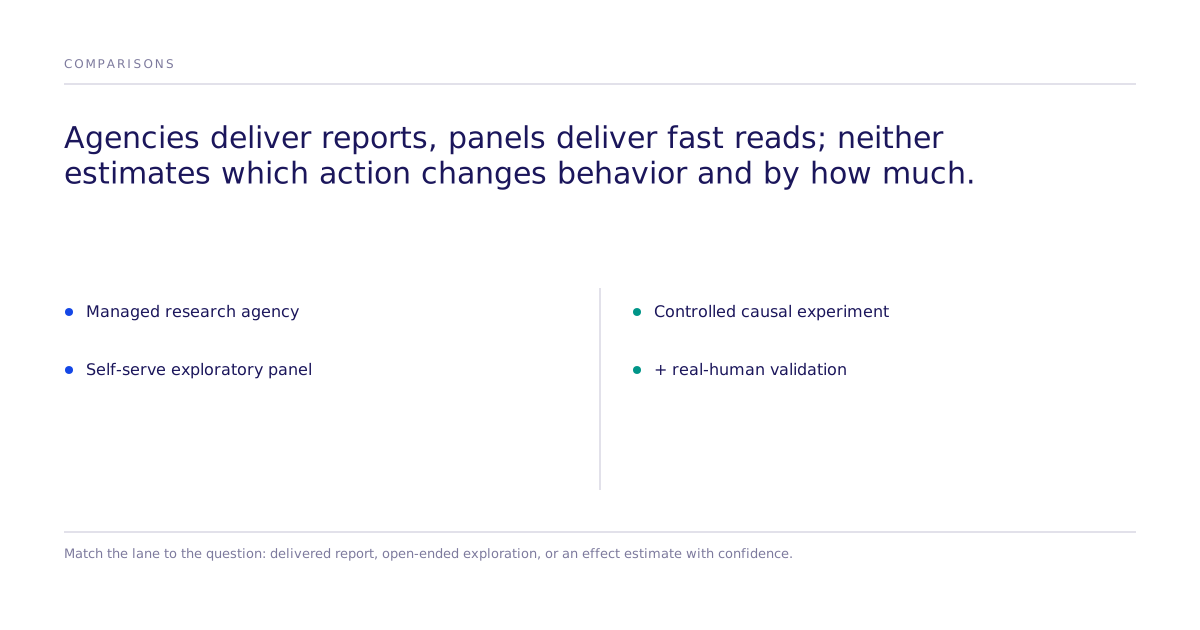
A team deciding how to test a pricing, product, or messaging question usually reaches for one of two defaults: hire a managed research agency, or run a fast self-serve exploratory tool. Neither answers the question a lot of buyers actually have, which is not "how fast" or "how polished," but which action will change what customers do. That gap is where a third option, causal experimentation, fits.
The two defaults, and what each is built for
A managed research agency scopes a project, designs and runs the study, and delivers a report. RAD Research illustrates the model: brand and product teams bring it a question, and it designs custom qualitative and quantitative studies to answer them. Buyers who choose this route usually have an existing research workflow the agency plugs into. The strength is depth and defensibility for a single, high-stakes study. Publishing where a method runs out is what lets a buyer check it against their own timeline. The limitation is that the process runs on a project timeline and a project budget, so it does not scale to many small, fast questions.
A self-serve exploratory tool lets an operator brief a panel of AI-simulated respondents directly and get a directional read back quickly, without a project manager in the loop. This model trades rigor for iteration speed: a follow-up question against the same panel costs little, so a team can explore many more angles than a single commissioned study allows. The tradeoff is that a directional read is calibrated against historical patterns, not validated against a new set of real respondents for the specific question being asked.
What do both approaches miss?
The buyer's real decision is rarely "what do customers think of this." It is "if we change the price, the message, or the feature, which version moves the behavior we care about, and by how much." An agency study can measure stated preference well. A self-serve panel can generate a fast directional signal. Naming what a method doesn't measure is what makes its measurements trustworthy. Neither is designed as a controlled comparison between specific alternatives with an estimate of the effect size and its uncertainty.
This is the same limit the broader research on AI-simulated respondents has flagged: models can often recover plausible aggregate patterns, but elicitation design, calibration against a real baseline, and the risk of mistaking correlation for causation remain open problems in the field, not solved ones.
Where does causal testing fit?
Subconscious is a causal behavioral platform. It runs controlled discrete-choice experiments against a defined population and returns causal effects with confidence intervals where the study design supports them, rather than a single predicted answer or a report built from stated preference. That makes it a third lane, not a faster agency and not a more accurate self-serve panel.
Subconscious can run controlled studies against a person-level audience graph covering 800 million real people, which is a reach claim, not a recruitable panel. Separately, when a team needs to check a simulated result against real respondents, Subconscious can validate the same study with real human participants, without changing the underlying causal question. A team can start with a simulated experiment and move to real-human validation on the same design when the decision warrants it.
What does causal testing not replace?
A platform that lists only what it covers is marketing. This is what it does not cover: Subconscious does not offer full-service agency deliverables. Dedicated project management, a delivered agency report, and bespoke qualitative moderation are not part of the platform. Nor does it publish a directional accuracy percentage the way a self-serve exploratory product might, because the platform is built around estimating causal effects for a specific comparison rather than scoring how closely a persona matches a historical benchmark. A team that wants a fully managed engagement with a written deliverable, or a lightweight always-on chat panel for open-ended exploration, is better served by one of the two defaults above.
Matching the tool to the decision
| Question you're actually asking | Better fit |
|---|---|
| "What do our existing agency workflow and stakeholders expect delivered?" | Managed research agency |
| "I want to explore an open-ended question quickly and iterate on it myself" | Self-serve exploratory panel |
| "Which specific action, among these alternatives, is likely to change behavior, and with what confidence?" | Controlled causal experiment |
| "I need to check a simulated result against real people before I act on it" | Causal experiment with real-human validation |
Historically, source material for this kind of comparison framed the agency lane as reserved for decisions defending roughly $10 million or more in business impact. Treat that threshold as a planning example rather than a fixed rule: the real filter is whether the decision needs a defensible, delivered report (agency), fast open-ended exploration (self-serve), or an estimate of which action causes the outcome (causal experiment).
Limitations and failure conditions
These failure conditions sit on the record next to the results, so a buyer can check the method before relying on it. A causal experiment is only as good as the alternatives and the population it is built against. It does not replace real-world confirmation, discovery-stage qualitative work, or regulatory-grade fieldwork where those are required. A controlled comparison answers the specific question it was designed to test, not a general-purpose substitute for the other two lanes.
Next step
Teams evaluating which lane fits a specific decision can review how the platform runs a study, see worked examples, read the underlying research, or book time to scope a comparison against a real pending decision.