Single Buyer Conversation vs. Segmented Causal Study
A single simulated buyer conversation is useful for exploring language, objections, and hypotheses. It is not enough evidence to approve positioning, pricing, or messaging when several buyer segments may respond differently. That decision needs controlled alternatives, segment-level effects, uncertainty, and, at final launch stakes, recruited human validation.
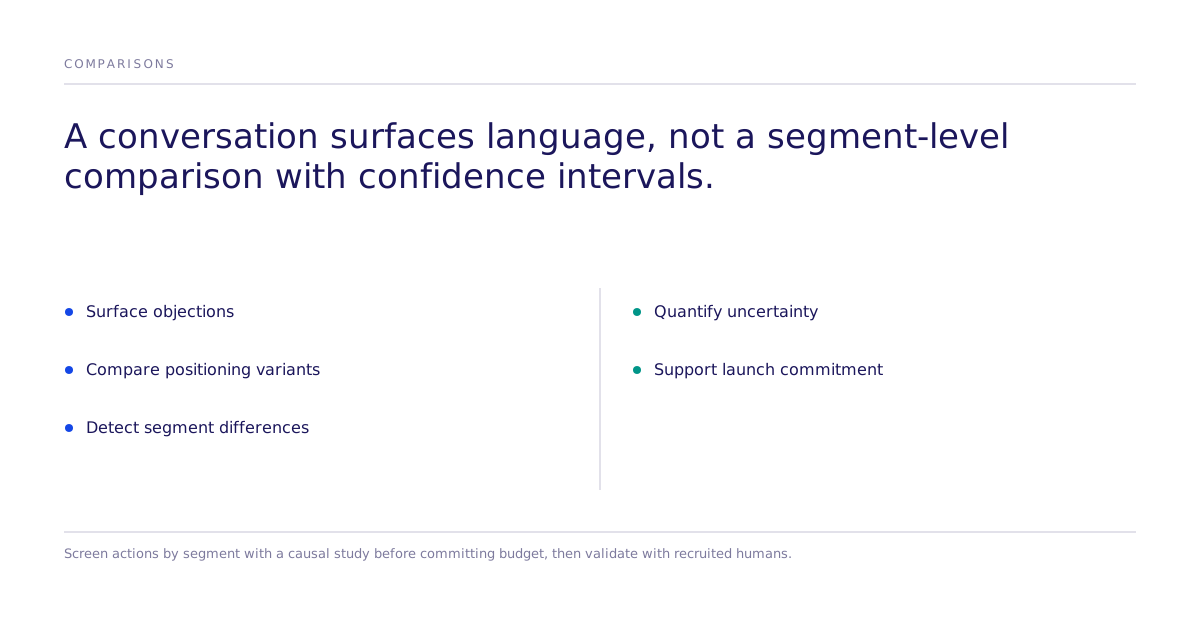
A buyer conversation opens a question. A controlled study compares the actions.
Start with the consequence, not the interface
An exploratory conversation can help a team hear a possible objection or improve a question. It cannot show whether one positioning action causes a better choice than another across a buying group.
One current competitor describes its offer as a synthetic market research platform. That category can suit early exploration. The evidence threshold changes once the team is about to commit launch budget, a pricing tier, or a campaign narrative.
What's the difference between a buyer conversation and a causal study?
A conversation asks, “What might this buyer say?” A causal study asks, “Which action changes choice, for which segment, and with what uncertainty?”
| Decision need | Single buyer conversation | Segmented causal study |
|---|---|---|
| Surface language or an objection | Produces an open-ended qualitative reaction | Not the primary purpose |
| Compare positioning or messaging variants | Offers an impression of each option | Holds the comparison structure constant across segments |
| Detect segment differences | Represents one modeled point of view per session | Estimates how the same alternatives perform by defined segment |
| Quantify decision uncertainty | Does not establish a confidence level by itself | Reports a causal effect size with a confidence interval for the supported study design |
| Support a final launch commitment | Generates a hypothesis | Screens actions before recruited human validation |
Buying groups create the failure mode
A buying group often has three or five buyer types, rather than one. Treat that range as an example, not a universal benchmark. A VP of Engineering may care about implementation risk, a CFO about the commercial case, and a Head of Procurement about terms and switching constraints.
Separate conversations can produce three plausible transcripts without a common comparison. The team still cannot tell whether the same message moved choice across the segments, whether an alternative worked better, or whether the apparent difference exceeds the study uncertainty.
A free-form conversation can create false confidence here. The cost is not a weak transcript. It is a go-to-market commitment built around the wrong segment response.
How does controlled choice evidence change the action?
Subconscious uses discrete choice experiments and Mixed Logit to run the same positioning or messaging alternatives against multiple buyer segments in one controlled study. The output is a causal effect size with a confidence interval by segment, a comparison of actions rather than another turn-by-turn impression.
A number without its limits attached is marketing. This one comes with both. Our best configuration reaches 87% of the measured human ceiling on one study: 0.832 rank correlation against the published human result, where two independent samples of real humans reach 0.959. Across all 43 studies that pass design filters the mean is 0.73. See the causal fidelity paper. It is a validation result, not a guarantee for a new market.
A team can see which positioning action moved the target choice, where the effect differed by buyer segment, and how much uncertainty remains before committing budget.
Population modeling belongs to a different branch
Large-scale agent simulation can model broader market behavior. A published wealth and asset management example describes using multi-agent simulation to explore client decisions, market dynamics, and growth scenarios. The implementation is documented by the firm that published the work.
That approach answers a population-modeling question. It is not automatically better for a bounded messaging decision, where the alternatives and buyer segments are already defined and the useful evidence is the causal comparison between those actions.
Does the final launch decision still need human validation?
Naming where a method stops is what lets a buyer check it before the decision gets made. Synthetic experiments are not a substitute for recruited real-human validation when the launch decision carries high stakes. Simulated audience reach and recruited participants are different evidence pools.
Subconscious can carry the same causal question from the simulated experiment into real-human validation without changing the alternatives or outcome being tested. That continuity makes the human study a direct validation step. The misses belong on the public record next to the hits. It does not turn the work into an observed usability session, a clinical trial, or automatic proof of market performance.
Use a three-part buying rule
Choose the method by answering three questions:
- Is the goal discovery or action selection? Use a conversation to form a hypothesis. Use a controlled study to compare actions.
- Is there one buyer segment or a buying group? Multiple segments require a common experimental frame if their effects need to be compared.
- What evidence would justify the commitment? As the cost of being wrong rises, require quantified uncertainty and recruited human validation.
For a segment-spanning decision, examine the research record, see how the study process works, and review decision examples. A demo can translate a live messaging, positioning, or pricing choice into a testable causal question.