Structured Survey Tracking vs. Upstream Causal Exploration
A research-ops or growth-marketing lead running a recurring satisfaction or NPS program on a real respondent list faces a narrower question than "which tool is better": should hypothesis generation stay inside the structured survey tool, or move upstream to a causal experiment platform, leaving the survey tool for what only real respondents can confirm?
What does picking the wrong layer cost?
Design, distribution, completion rates, and analysis can constrain a survey's delivery time. An existing customer list may make fielding easier, but an unfamiliar audience may need screening and recruitment. Obtain scoped estimates instead of assuming days or weeks for every question. A synthetic result also needs validation before use as a customer-tracking statistic.
What is a structured survey tool like Survio built for?
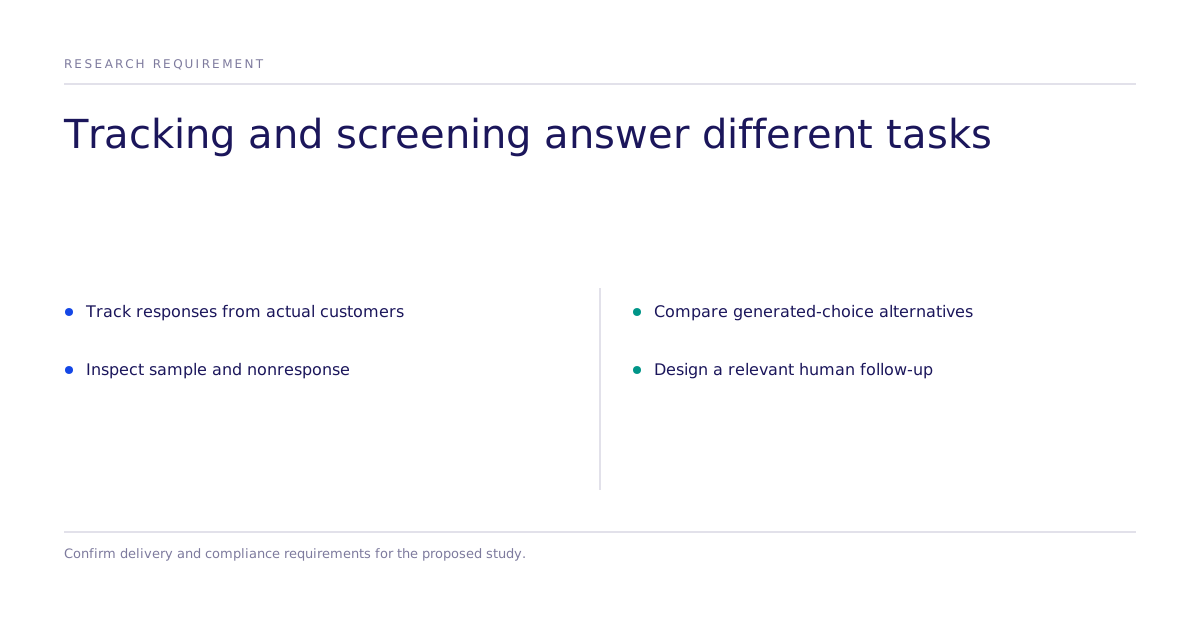
Survio's feature tour describes questionnaire building, distribution by link, email and website embedding, and tabulated reporting with data exports. Review the current plans for access and response limits. The workflow fits requirements such as:
- A customer or member list already exists and needs to be tracked for satisfaction or NPS at a fixed cadence.
- Results need to tabulate cleanly across hundreds or thousands of respondents.
- The research requires responses from the defined human audience, with documented sampling and methods.
A customer survey measures what responding customers report under the instrument. Nonresponse and sample quality still affect whether that result represents the whole customer base.
Where does a causal experiment platform fit instead?
A synthetic choice comparison can screen messaging, pricing, or positioning alternatives before fieldwork. Specify the generated-choice endpoint and estimator. Design-conditional uncertainty does not cover population mismatch or generator bias.
When the question is which of several actions a real audience would respond to, and no fielding budget is committed yet, that's the upstream step. When the question is "how satisfied is our actual customer base right now," that's a tracking survey, full stop.
Comparing the two layers
| Structured survey tool (e.g. Survio) | Causal experiment platform (Subconscious) | |
|---|---|---|
| Audience | Your own list or recruited respondents | Simulated population, upstream of fielding |
| Best fit | Tracking, satisfaction, NPS, or defined human measurement | Screening defined alternatives before relevant human validation |
| Output | Tabulated responses from the participating sample | A generated-choice contrast with design-appropriate uncertainty |
| Delivery planning | Confirm design, distribution, fieldwork, and analysis | Confirm configuration, execution, and human follow-up |
| Governs the decision when | The audience and question are already fixed | The action to test against a real audience is still undecided |
Use the table to place a specific open question, not to rank platforms. A team with a fixed NPS cadence and a defined list has already answered the "which layer" question in Survio's favor for that program.
From a simulated read to real-human confirmation
A human follow-up should align population, alternatives, outcomes, and analysis with the synthetic comparison where feasible. Document any instrument changes. Its purpose is to assess transfer, rather than guarantee confirmation.
Limitations
Keep a real-customer survey for customer tracking. Generated choices should not be reported as observed customer metrics. Regulatory or audit use needs a separately specified standard, accepted protocol, consent, and documentation; a survey-builder feature list does not establish those requirements.
Next step
For a team weighing this decision, how Subconscious runs a causal experiment and published case studies show the exploration layer in practice; the research page covers the underlying causal method.