What Is a Research Panel? Panels vs. Controlled Experiments
A research panel is a group of people, recruited ahead of time, who agree to answer research questions over a defined period. Unlike a one-off survey, a panel lets a research team reach the same people repeatedly, track how their answers change, and build a demographic and behavioral profile before the first study starts.
Panels are usually managed by a research agency, panel company, or internal team that maintains membership and incentives.
The panel types buyers commission most often
- Consumer panels. General-population members recruited to represent a target market, used for brand tracking and product testing. Major providers such as Nielsen, Ipsos, and Kantar run panels numbering in the hundreds of thousands across markets.
- B2B panels. Professionals screened by industry, job function, company size, and seniority. Harder to maintain than consumer panels: qualifying professionals in a niche industry are scarcer and less willing to join.
- Expert panels. Domain specialists such as doctors, engineers, financial advisors, and other subject matter experts, recruited when the research question needs professional judgment to answer meaningfully. Usually small, hundreds of members rather than thousands, and expensive to maintain and access.
- Online access panels. Large, pre-recruited pools who complete surveys online for incentives. With millions of members under management, providers can put a study in front of a representative sample in short order. That speed can cost data quality: respondents who join repeatedly to collect incentives skew results over time, a risk documented in AAPOR's review of online panel methodology.
- Longitudinal panels. The same participants tracked over months or years, used to measure attitude change or the long-run effect of a campaign.
- Internal customer panels. A company's own customers, recruited from its user base for recurring product feedback and satisfaction tracking. These panelists are actual product users, which raises response quality for that specific use.
Why panel research costs what it costs
A number without its limits is marketing. Panels are valuable: real people with known, verified characteristics. That value comes with structural costs:
- Cost. Large-scale consumer studies can run into tens of thousands of dollars, and access to well-screened niche or expert populations adds cost quickly.
- Speed. Members are already recruited, but the study still has to run: fielding, waiting on responses, and analysis take days or weeks, slower than pricing, launch, and messaging decisions typically allow.
- Sample quality. Professional respondents who game incentive systems degrade data quality over time and require constant panel management to correct.
- Depth. Most panel research runs on surveys, which cap how much a single answer reveals about the reasoning behind it.
- Fixed population. A panel can only represent people who exist today and can be recruited. It cannot speak for a hypothetical customer segment or a market that has not formed yet.
Should I recruit a panel now or run a controlled experiment first?
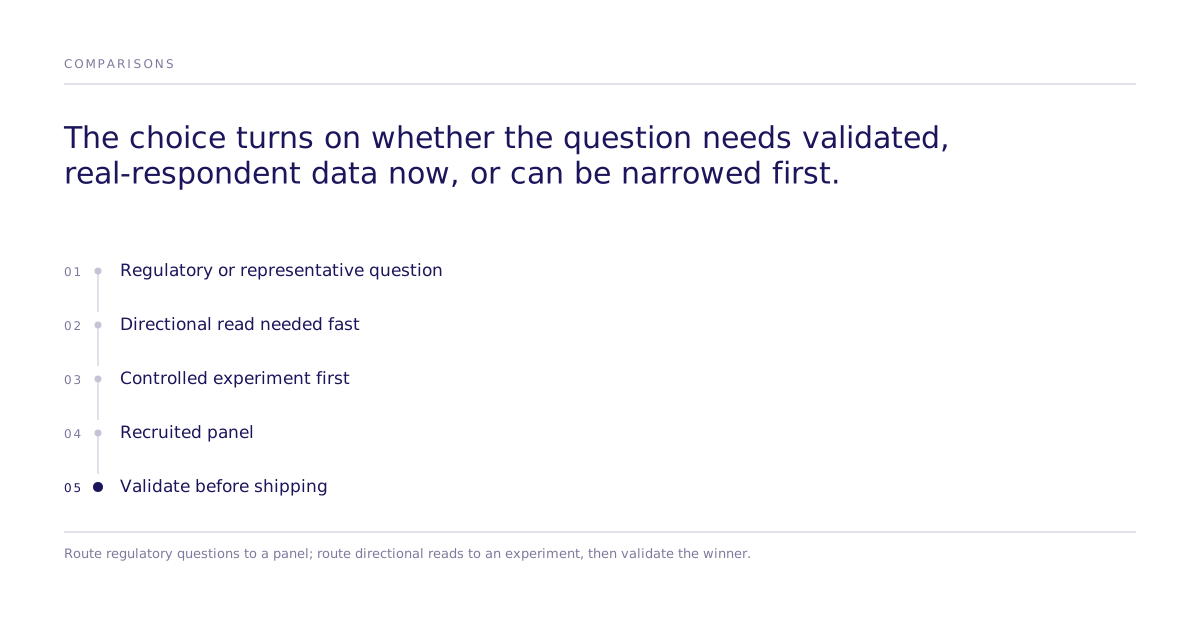
Not panel versus no panel. The choice is whether the next question needs statistically validated, real-respondent data immediately, or whether a controlled experiment can narrow the option set first, with panel-grade validation reserved for the decision that survives.
| Question in front of you | Better first step |
|---|---|
| Regulatory, compliance, or ongoing tracking research | Recruited panel |
| Early pricing, messaging, or feature-direction read across many options | Controlled experiment first |
| Directional signal needed quickly, statistical certainty not required yet | Controlled experiment first |
| A launch, pricing, or claims decision about to ship | Controlled experiment, then real-human validation of the same question |
| Statistically representative estimate of a defined population | Recruited panel |
Naming the failure mode here is what lets a buyer check for it before committing budget. Picking the wrong instrument has a real cost. Paying panel-level time and money for a question that only needed a directional read wastes weeks and budget. Shipping a launch or pricing decision on an unvalidated read, when the decision actually warranted real-human confirmation, risks a costlier mistake downstream.
Where does a controlled experiment fit before a panel?
Subconscious runs controlled discrete-choice experiments on a simulated market to estimate which action moves an outcome, before a team commissions a full panel study or in place of one for questions that do not need statistical validation. The misses sit on the same leaderboard as the hits, so a buyer can check both. Our best configuration reaches 87% of the measured human ceiling on one study: 0.832 rank correlation against the published human result, where two independent samples of real humans reach 0.959. Across all 43 studies that pass design filters the mean is 0.73, documented in the causal fidelity paper. It is a validation result, not a guarantee for a new market.
For decisions big enough to justify it, Subconscious can test or validate studies with real human participants, moving from simulation to real-human validation without changing the causal question under test. It is not a recruitable panel, not a synthetic-respondent replacement for regulatory or compliance-grade panel research, and not a claim that every population Subconscious can simulate is available to recruit.
How do I choose the right tool for my next study?
Use a recruited panel when the study needs statistical validation, tracks change over a defined population, or falls under a compliance requirement that mandates real participants. Use a controlled experiment first when speed matters, the population is hard or expensive to recruit, or the goal is narrowing options before a panel study confirms the winner. See how the two connect in a live experiment or review the leaderboard evidence behind the replication figure above.