Adding Causal Testing to an Existing Client Scope: A Decision Guide
An agency or in-house marketing team should add a research step to an existing client scope only when a specific decision carries real budget risk and the current process resolves it with opinion instead of evidence. The test is not whether a client would pay for another line item. It is whether the decision on the table needs a causal answer, not a directional one.
The revenue argument is real, but it points at the wrong question
Demand for outside marketing-research and analysis services keeps expanding as brands look for outside partners to answer audience questions they cannot resolve internally (Marketing Research and Analysis Services Global Market Report 2026, The Business Research Company). That growth is a reason agencies keep getting asked for research, not a reason to sell more research into every account.
The failure mode is not skipping research. It is adding a research line item that produces a directional read for a decision with real money behind it, so the client makes the same wrong call with a research cost attached. A one-page summary that "feels informative" is not evidence that a specific action changes the outcome, and confusing the two costs the agency credibility with the client paying for it every month.
What's the difference between a directional read and a causal answer?
A directional read tells a team what an audience says or seems to prefer. It is useful for early-stage ideation and for questions where the cost of being wrong is low. A causal answer tells a team which of two or more specific actions is more likely to change a defined outcome, with the alternatives and audience held explicit.
| Research approach | What it answers | Best fit | Where it fails |
|---|---|---|---|
| Stated-preference read (survey, quick panel, informal client Q&A) | What people say they prefer or believe | Early ideation, low-stakes gut-checks, narrowing a long list of options | Budget-committing decisions, where what people say and what they do can diverge |
| Traditional human research (interviews, focus groups, fielded studies) | Deep qualitative context, lived experience, discovery of unknown concerns | Decisions that need real human nuance, regulated claims, or discovery-stage work | Speed and cost when the team needs to compare several alternatives quickly before committing |
| Controlled experiment on a simulated market, validated against human behavior | Which of the defined alternatives is more likely to change the target outcome | Decisions with real budget risk and concrete alternatives already on the table | Decisions that still need human judgment about strategy, brand voice, or client-specific context |
Selling a budget-committing decision with stated-preference research is the core risk here. The client still makes the expensive call on incomplete evidence, and the agency now owns the research recommendation as well as the creative one.
Audit the account before pitching anything
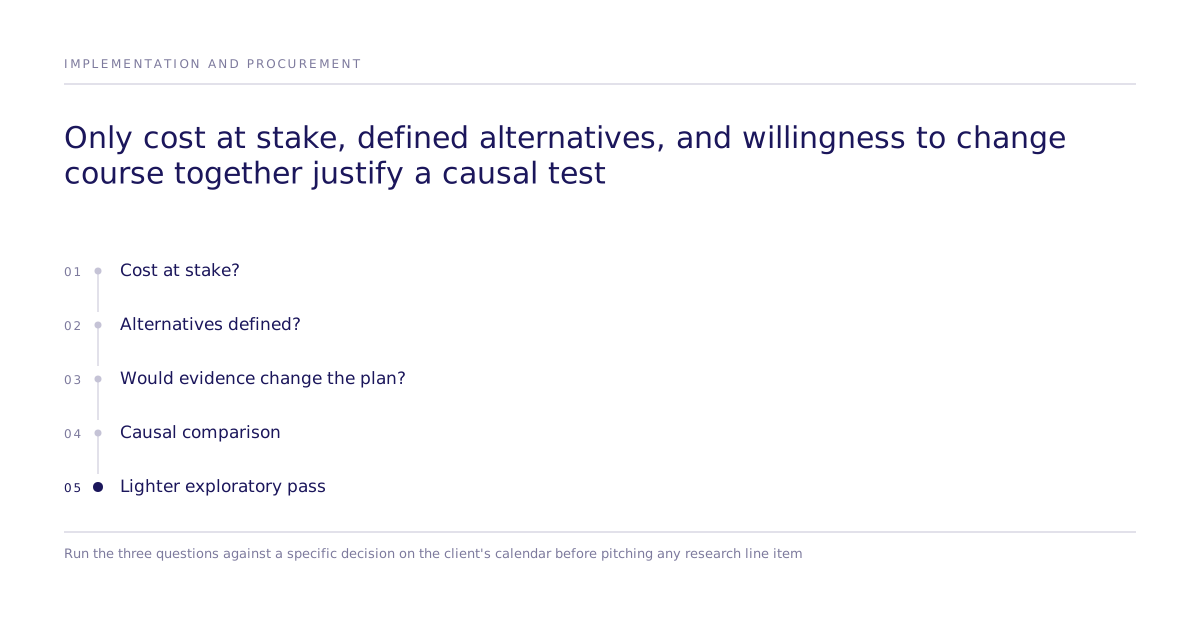
Skip the general pitch. Look at each client's near-term calendar and ask, for every candidate decision:
- Is there real budget or reputational cost attached to the outcome (media spend, a launch date, a repositioning campaign)?
- Are there two or more concrete alternatives already defined, rather than an open-ended "what do you think"?
- Would the client change what they do if the evidence pointed a different direction than their current plan?
A "yes" to all three means the decision needs a causal comparison between the specific alternatives on the table. A "no" to any of them usually means a lighter, exploratory pass is enough, or the client has no decision yet, only a question. This audit is the entire pitch: it replaces "let us sell you research" with "let us test the two options you are already choosing between."
Building the case with one client first
Do not pitch a new service in the abstract. Pick the strongest client relationship, name one budget-committing decision on their calendar, and run a controlled comparison against the alternatives they are choosing between. Share the result in the next status meeting as a decision input, not as a new line of business. A team that has seen a causal answer change or confirm a real call is a better audience for a broader conversation than one hearing about a new capability cold.
Once the client has seen one comparison change how they acted, the second and third studies do not need the same introduction. That pattern, not a fixed package menu, is what folds a causal test into an existing scope: a campaign concept choice gets a comparison built into its pre-launch checklist, a repositioning effort gets one built into its brief.
Where does a causal experiment fit, and where does it not?
Subconscious is a causal behavioral platform: controlled experiments on a simulation of the market, validated against real human behavior, that estimate which action is more likely to change a defined outcome. For an agency or marketing team, that makes it a fit for the budget-committing decisions identified above, not a general-purpose replacement for every research task in a client relationship.
When a decision calls for extra confidence before the client commits, the same experimental question can move from a simulated study to a recruited human validation without changing the underlying comparison. See how Subconscious works for the mechanics, and the current case studies for examples of causal comparisons before a launch decision.
A causal answer is only useful to a buyer who knows exactly where it stops applying. It does not replace the agency's client relationship, strategic recommendation, or judgment about brand voice, politics, or client-specific context. It also does not replace recruited human validation for decisions where regulatory, safety, or reputational stakes require testing with real participants. A causal comparison is only as useful as the alternatives it is given: if the client has not yet defined concrete options, the immediate need is a strategy conversation, not a study.
Common objections, answered by scope rather than by discount
"We already do research." The relevant follow-up is what kind of question that research answers. Existing stated-preference or qualitative work can coexist with a causal test aimed at budget-committing decisions.
"Can't we do this ourselves?" Running a comparison is one step. Defining the right alternatives, framing the outcome that matters, and translating the result into a recommendation the client will act on is the work an agency is already being paid for.
"We don't have budget for another line item." That framing is the mistake to avoid. The pitch is not a new line item; it is a specific decision the client is already about to make with or without evidence behind it.
"Is this reliable enough to act on?" An honest answer to that question names the limit instead of hiding it. Treat a simulated comparison as a directional-but-causal screen appropriate to the decision's stakes, and route regulated or high-reputational-risk decisions to recruited human validation before the client commits.
To apply this to a live account, start with the research method or talk through a specific decision that still needs a clear evidence path before it ships.