How a Research Team Avoids Becoming an AI Ticket Desk
A head of research protects the team by publishing a routing rule before the request queue grows, not by defending headcount after it does. Low-stakes, reversible questions go to fast exploratory testing. Pricing, launch, and positioning decisions go through a controlled, validated causal experiment before they ship. Skip the routing rule and the team becomes either a slow bottleneck stakeholders route around, or a fast desk producing confident-sounding answers nobody validated.
Why is the routing question arriving now?
AI tools have made a plausible-sounding answer cheap to produce: a draft concept reaction, a first-pass read on a message, a quick comparison of options. That does not remove the need for a validated one. Per the U.S. Bureau of Labor Statistics market research analyst outlook, employment in market research and marketing specialist roles is still expected to keep expanding over the 2024-2034 window.
The pressure is specific: when any stakeholder can generate a draft answer in minutes, the research team's advantage stops being access to tools and becomes judgment about which answers are safe to act on for a given decision.
What stays scarce once production gets cheap
Research expertise used to include partial ownership of access: knowing how to field a study, clean the data, and package the finding. AI weakens that access advantage. It does not remove the need for the judgment that decides whether an answer deserves trust.
It means naming the business decision before any AI-assisted tool touches the question, and naming the caveat after the tool produces output. A useful research leader can say what the decision is, what evidence would change it, what confidence it requires, and where a fluent-sounding answer could still mislead the business.
Three tiers of evidence, routed by decision risk
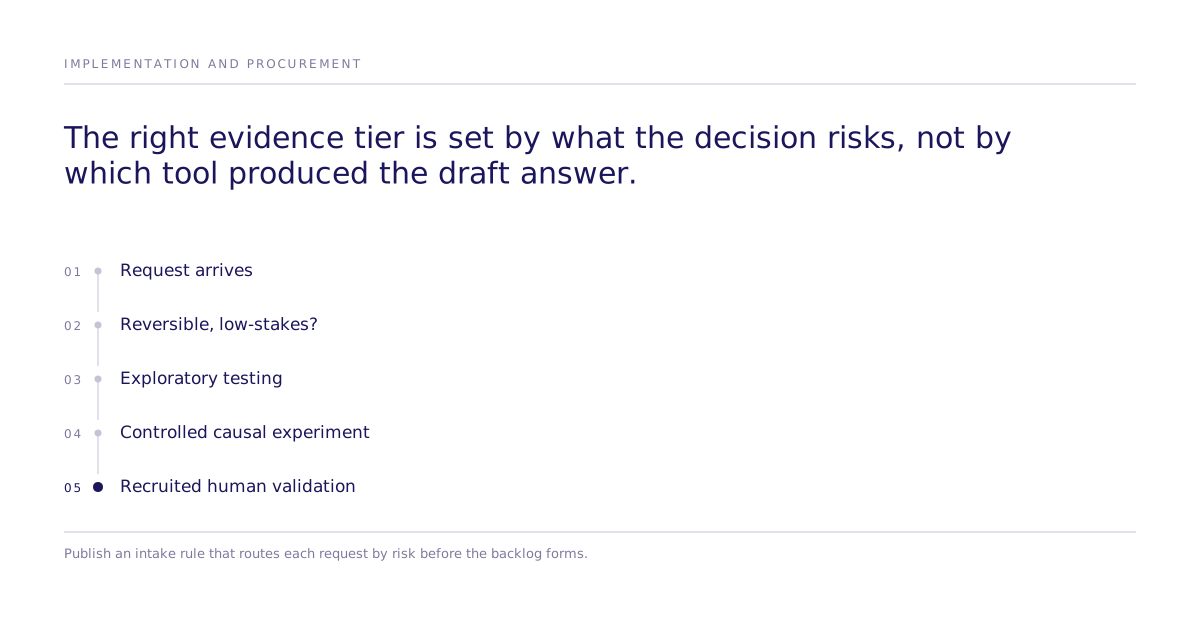
The core design choice is not which tool to use. It is which requests get fast exploratory testing and which require a controlled, validated causal experiment before a decision ships.
| Tier | Best question it answers | What it produces | Where it stops |
|---|---|---|---|
| Exploratory testing | Which of several early concepts, messages, or directions is worth developing further? | A fast, directional comparison that narrows a wide option set | A directional read, not a defensible estimate of market behavior |
| Controlled causal experiment | Which action is more likely to cause a specific behavioral outcome, at what confidence, before the decision ships? | A causal effect with a confidence interval, comparing defined alternatives under controlled conditions | Still a modeled comparison; a genuinely novel context may call for recruited human evidence |
| Recruited human validation | Does the same causal question hold when tested with real participants? | Direct human evidence on the same causal question, actions, and audience | Confirms or challenges the modeled finding; does not turn the study into a usability session or clinical trial |
Subconscious runs the middle tier as a controlled discrete choice experiment and reports a causal effect with a confidence interval. That is the evidence a pricing, launch, or positioning decision needs once it is expensive or public to defend: a measured effect, not another fluent draft answer.
Publish an intake rule before the backlog forms
A routing rule beats a routing habit because it survives the person who wrote it going on vacation. A useful rule asks four questions of every incoming request:
- What decision is being made, and what changes if the answer points one way or the other?
- Who is the audience, and what does being wrong about them cost?
- Is the question reversible and low-stakes, or does it precede a pricing, launch, or positioning commitment?
- What evidence tier does that risk level require?
A reversible message or concept choice can start and end in exploratory testing. A pricing decision, a launch commitment, or a public positioning claim should move to a controlled causal experiment, and escalate further when the question is genuinely novel or the result has to hold up outside the model.
Carry the same question from exploration to validation
When a finding needs to hold up under real human evidence, the useful move is continuity, not a restart. Subconscious can test or validate studies with real human participants, carrying the same causal question, actions, audience definition, and outcome from the modeled experiment into human validation. Only the evidence tier changes.
Where scale of the modeled population matters to the decision, keep it distinct from the tiers above it: a person-level audience graph covering 800 million real people describes how large a modeled population can be, a controlled causal experiment describes a comparison run against that population, and recruited human validation describes evidence gathered from real, fielded participants. Collapsing any two of these into one claim is the fastest way to lose the credibility a routing rule is built to protect.
Say which tier answered the question
The failure mode that turns a routing rule back into a ticket desk is letting every request get a bespoke, unlabeled answer. Label the tier every time: "directional exploratory read," "modeled causal effect with confidence interval," or "validated with real human participants." Naming the tier makes the finding more credible because it tells the stakeholder exactly what evidence they are holding and what would strengthen it.
A rejection or a redirect should name the tested action, the alternative, the target audience, the outcome, and the evidence limit, rather than a vague objection. That gives the stakeholder a defined next step instead of a stalled request.
Where does a routing rule still break?
A routing rule depends on the team enforcing it. It breaks when a stakeholder skips the intake questions and reports an exploratory read as though it were validated evidence, or when the team routes every request to full validation out of caution and becomes the bottleneck it was built to avoid.
It also breaks when the causal question changes between tiers. If the audience, the compared actions, or the outcome shifts between passes, the escalation does not confirm anything. It starts a new study instead.
Limitations
A method that hides its edges is marketing. This one publishes its edge here: none of these tiers replace a research team. A controlled causal experiment narrows and tests options; it does not decide organizational priorities, negotiate with stakeholders, or write the intake rule itself. It is one validation option among fielded research, behavioral data, and expert review, not a substitute for the operating model that decides when to use it.
To size a routing rule against a live backlog, see the research method behind the causal-effect tier, how causal experiments are run, review case evidence, or discuss a decision that needs a defined evidence path.