How to Test Messaging Before Launch
Test each message variant as a controlled comparison against a defined buyer audience before committing launch budget to one of them. The way to break an internal tie between competing headlines is evidence about which variant a target buyer responds to, not another round of opinions in a meeting.
The decision this solves
A launch team may have three message options and no evidence for choosing among them. Marketing prefers version A. Product prefers version B. A senior stakeholder wants version C. Without a comparison tied to buyer behavior, the loudest voice in the room wins by default.
The cost of getting this wrong is not abstract. A launch window, ad budget, and sales enablement all get committed to a positioning that may not cause the intended response. Observed market evidence can arrive after the campaign has already consumed the budget or launch window.
Why the traditional approach gets skipped
Traditional message testing follows a known sequence: write several variants, build a survey instrument, recruit participants who match the target population, field the survey, and analyze the results. A historical planning example used 3 to 5 message variants, 200 to 500 recruited respondents, and 1 to 2 weeks of fieldwork before results were ready to analyze. Those ranges are not current Subconscious commitments or universal requirements for a valid study.
Recruitment, instrument design, fieldwork, and analysis must fit the launch plan. When they do not, teams often substitute internal preference for buyer evidence. A controlled comparison can narrow the options before a consequential launch decision, while recruited research remains a separate validation step.
Why use a causal comparison before spend?
Subconscious tests message and go-to-market actions as causal experiments before capital commitment, estimating which message is more likely to cause better engagement or intent for each segment.
This is a discrete-choice-style comparison of alternatives rather than open-ended opinion gathering.
Step 1: Draft three candidate variants
One variant gives you nothing to measure against. Five variants introduce enough additional variables to blur the comparison. Three can represent genuinely different approaches, such as benefit-focused, problem-focused, and proof-focused framing, rather than three versions of the same sentence.
Step 2: Define the audience segments that matter
As a planning example, define four buying contexts: a hands-on buyer evaluating day-to-day fit, a skeptical buyer weighing the message against competing priorities, a budget-constrained buyer, and a rigorous evaluator at a larger organization. Four is a workflow choice, not a product limit. Each definition should reflect the roles, constraints, and current alternatives that shape how the segment reads a message.
Step 3: Run the comparison
Expose each audience segment to each variant separately, so an earlier variant does not color the reaction to the next one. Ask direct questions for each pairing: What is the immediate reaction? What does the buyer think the product does? Does the message address a problem they have? What questions remain? How likely are they to take the next step on a defined scale? A 1 to 5 response scale is one planning example, not a prediction of market performance.
How do you read the results by segment instead of just the average?
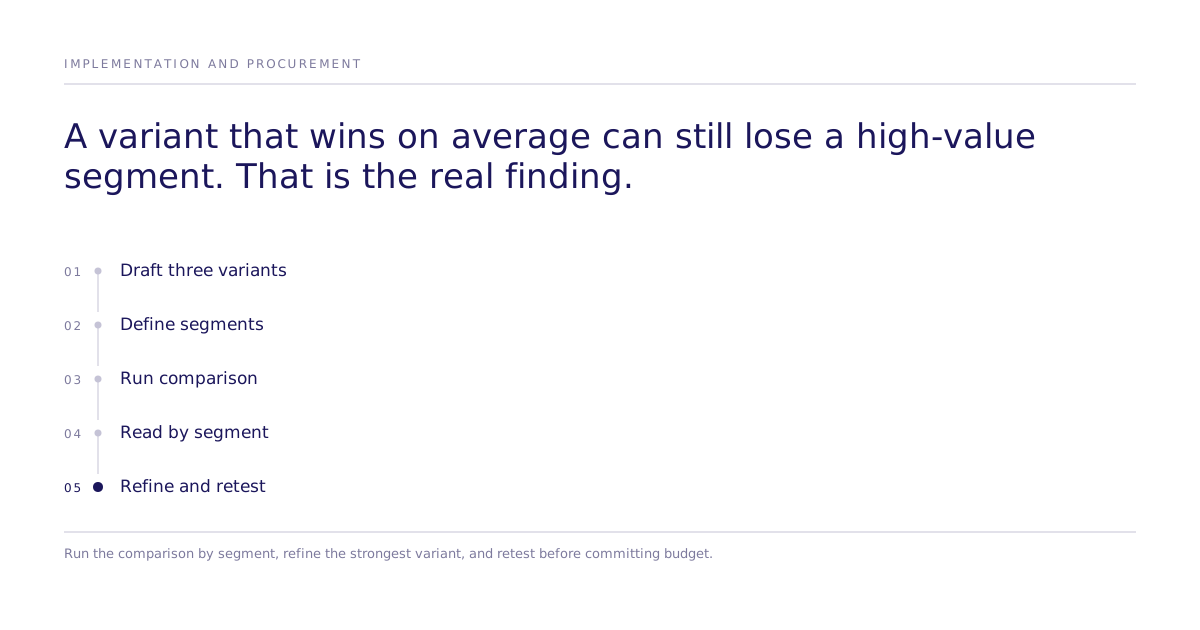
Organize the results in a matrix of variant by segment rather than a single average score. A variant that wins overall but loses one high-value segment is not a clean winner. That is the finding worth acting on, not a footnote.
| What to look for | What it tells you |
|---|---|
| The broadest winner | Which variant produces the intended response across the most segments and becomes the default candidate |
| Segment-specific splits | A variant that wins with two segments but alienates a third reveals a targeting problem, not just a copy problem |
| Specific objections | A concrete objection to a claim or number in a variant is evidence that the claim needs support or removal |
Step 5: Refine and retest
Take the strongest variant, address the objections that came up, and run it again against the same segments. Compare the revision with the prior winner rather than a fresh field of options. A planning example may budget 2 to 3 comparison cycles. That is a workflow choice, not a delivery commitment or proof that the result is ready to launch.
Step 6: Move to real-human validation for the launch decision
A comparison at this stage is directional. It narrows the field and surfaces objections before a team commits budget, but stated reactions to a message can diverge from what a buyer actually does when it counts, a pattern researchers call the say-do gap (Quirk's Marketing Research Review). That gap is why a launch decision with real consequences needs to close the loop with people. Subconscious can test or validate studies with real human participants. The team can move from the initial comparison to real-human validation without changing the underlying causal question: what causes the buyer to respond, not just which variant sounds better internally.
| Method | What it answers | When to use it |
|---|---|---|
| Internal review | Which version the team prefers | Never sufficient alone for a launch decision |
| Controlled comparison against a defined audience | Which variant is more likely to cause the intended response, and for which segment | Narrow the variants and surface objections before spend |
| Real-human validation | Whether the result holds with recruited participants | Validate the causal question with people before committing campaign budget |
Where else does this method apply beyond a headline?
The same sequence works for email subject lines, ad copy hooks, product description clarity, pricing-page language, and the key slides in a sales deck. It also applies across markets: a message that works in one market may not resonate in another, so market-specific audience segments matter as much as the message itself when a launch spans regions.
Combining approaches can answer both a directional and an observed-behavior question. As a planning example, use a controlled comparison to narrow 5 variants to 2, then run a quantitative test on the finalists with real traffic. The first step identifies the stronger causal hypothesis. The second tests behavior in the live channel.
Where teams go wrong
Comparing minor wording tweaks rather than genuinely different concepts. Swapping a verb is rarely worth a full comparison cycle. Testing two genuinely different value propositions is.
Not defining "winning" before the test. Decide in advance whether the goal is comprehension, appeal, click-intent, or reducing objections. Each of those metrics can point to a different winning variant, so choosing the metric after seeing the results is not a real decision rule.
Reading only the average. A variant that wins overall but alienates the highest-value segment is not a winner.
Skipping the second round. A first comparison gives direction. A second comparison tests whether the response survives the revision. Launching on the first pass alone leaves objections unaddressed.
Limitations
A controlled comparison is directional evidence for narrowing options and surfacing objections. It is not a substitute for validation with real people before a launch decision that carries real budget or brand risk. Automated recommendation output, confidence intervals, and segment-level statistical validation are not standard claims here. Treat any specific number from a comparison as a result to investigate, not a final statistic. It should not be described as recruiting or fielding a study with real respondents; that is a separate validation step.
Where to go next
Start with how Subconscious tests decisions before launch, review the method behind the comparisons, or see case studies of decisions tested this way. To scope a message test for an upcoming launch, book time with the team.