What are Omnibus Surveys?
A VP of pricing weighing a price increase on a flagship SKU wants a fast read on how customers will react. Omnibus surveys deliver that read cheaply and quickly. A number without its limits is marketing. They do not prove what a price change, a new feature, or a new claim does to demand, because nothing on the shared instrument is manipulated and there is no control group to compare against.
- An omnibus survey is a shared questionnaire where multiple clients each buy a few questions on one fielded instrument, run on a fixed cadence by the provider.
- Pricing runs from roughly $1.50 per completed response self-serve (YouGov) to $1,000 for each of the first three questions and $750 after that (SSRS).
- The standard switch point to a custom survey is roughly five to six questions, per Versta Research; below that, omnibus is usually cheaper.
- Omnibus and custom survey both measure stated opinion, the say-do gap between what someone reports and what they would actually do; neither manipulates price, feature, or claim, so neither can prove a causal effect on demand.
- Proving what a specific change does to demand requires a randomized experiment with a control condition, not another question on a shared instrument.
What is an omnibus survey, and how does it work?
An omnibus survey is a single fielded questionnaire that a provider builds from many clients' questions stitched together, then runs against one panel or sample on a set schedule. SSRS's Opinion Panel Omnibus, for example, fields twice a month in a fixed Friday-through-Monday window, and clients buy in by the question rather than commissioning their own fielding (SSRS). Ipsos runs Online, Face-to-Face, and Online Overnight versions of the same model and has moved its Omnibus product onto a self-serve digital platform, live in Australia, France, Germany, Italy, the UK, and the US, with the full product available in 100+ markets (Ipsos). You get a general-population read fast, on someone else's schedule, sharing the questionnaire with clients whose topics you don't control.
How much do omnibus surveys cost, and how fast do they run?
YouGov fields omnibus across 70+ markets with self-service pricing from roughly $1.50 per completed response and results available in as little as 24 hours (YouGov). SSRS prices its omnibus at $1,000 for each of the first three questions and $750 per question after that, with a predictable twice-monthly fielding window (SSRS). Cheap per question, fast to field: that combination is why omnibus remains the default first call for a directional read. It says nothing yet about whether the question being asked is one a survey, shared or custom, can actually answer.
When does a custom survey beat omnibus?
Once a buyer needs more than a handful of questions, or a narrow or low-incidence audience, the math flips. Versta Research's guidance puts the tipping point at roughly five to six questions, the level where a short custom survey becomes price-competitive with omnibus while adding targeting and design control that a shared instrument can't offer (Versta Research). Providers like TGM Research and Kadence lean into this and position omnibus explicitly as a triage step: run a cheap question first to see whether a topic justifies the budget for a full custom instrument. That framing is useful, but it only resolves cost and scope. It doesn't resolve whether either format, omnibus or custom, can tell you what will happen if you actually change the price, the feature, or the claim.
| Omnibus | Custom Survey | Randomized Experiment | |
|---|---|---|---|
| Cost | ~$1.50/response self-serve (YouGov); $1,000 for each of the first three questions, $750 after (SSRS) | Competitive with omnibus once you need roughly five to six questions or more (Versta) | Scoped to the decision, not priced per question; a randomized experiment is a study, not a shared instrument slot |
| Speed | Results in as little as 24 hours (YouGov); SSRS fields twice monthly on a fixed window | Days to weeks, depending on targeting and incidence | Set by the study design, not a shared instrument's fixed cadence |
| What it measures | A stated opinion on a shared, unrandomized instrument, the say-do gap between report and action left unresolved | A stated opinion with full design and targeting control, still unrandomized | A causal effect with a confidence interval covering the effect within the simulated population: what a randomized intervention (price, feature, claim) does to choice, against a control condition |
| Best for | A quick directional read on a handful of questions, no causal claim needed | Niche or low-incidence audiences needing more depth than omnibus allows, still no causal claim | A buyer who needs to close the say-do gap and know which action actually drives the outcome, not just what people say they'd do |
Can an omnibus survey tell you what people will actually do?
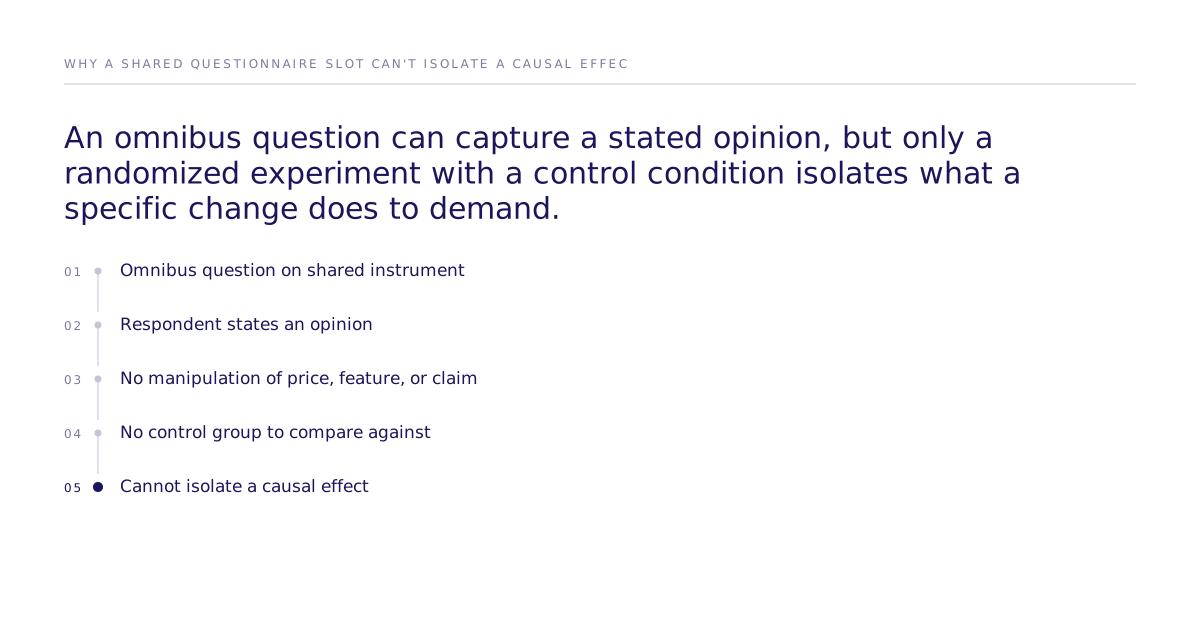
Naming this failure mode is what lets a buyer check it. No. An omnibus question captures a stated opinion at a point in time. That's the say-do gap: what someone reports and what they would actually do are not guaranteed to match, and omnibus has no way to close it, because nothing in the design manipulates price, feature, or claim and there's no control group to compare against. That gap is easy to miss because the survey report looks the same either way, a table of percentages, so it's worth making the missing step explicit.
Does sitting next to unrelated questions affect your data?
This kind of miss belongs on the record next to the hits. It can, structurally, even before any effect on data quality is measured. Omnibus stacks each client's items into one instrument, and even when topic order is randomized, a respondent answers your question in the context of whatever unrelated, sometimes burdensome, topic came right before it. That ordering is outside your control on a shared instrument, and it's one more variable that neither omnibus nor custom, unrandomized survey design accounts for. It doesn't change the causal gap above, but it's a reason to treat even the stated-opinion number with some caution when it comes off a shared instrument.
What proves a causal effect instead of a stated opinion?
A randomized experiment with a control condition, not a bigger or better-worded survey question. The design applies an intervention, a specific price, feature, or claim, to a treatment condition and withholds it from a holdout, then compares choices between the two using discrete choice models: McFadden discrete choice, Mixed Logit, and ICLV. Those are estimators, not causal methods on their own; the causal identification comes from randomizing the intervention across conditions, not from the estimator doing the counting. Where a flat multinomial logit is used for preference-share or substitution questions, that estimate carries the IIA assumption (independence of irrelevant alternatives); Mixed Logit relaxes it, which is why it's the standard choice when substitution across options matters.
Validated against human baseline studies, this kind of simulated, randomized design reaches 87% of the measured human ceiling on one study (0.832 rank correlation against the published human result, where two independent samples of real humans reach 0.959), with a mean of 0.73 across the 43 studies that pass design filters. Publishing where the method falls short is what makes the number usable. That is a validation result, not a guarantee for a market that hasn't been run yet, per the causal fidelity paper. Because some of those published studies could sit in a model's training data, that risk is worth naming directly rather than assuming it away; it's also why replication results, and the studies they're checked against, are published openly on a running leaderboard rather than asserted. The broader case for treating discrete choice modeling as an estimator layered on a randomized design, not a causal method by itself, is laid out in more depth in methods and validation, alongside worked examples in case studies.
What should a buyer do next?
Pull your last few omnibus briefs and check the verb in each question. If it asks what people think, prefer, or intend, an omnibus or custom survey both work, and Versta's five-to-six-question threshold still tells you which one to buy. If it asks what happens when you change the price, the feature, or the claim, that's a causal question, and no shared questionnaire slot, omnibus or custom, answers it; you need a control condition and a randomized intervention instead. For a second read on a specific decision, talk to us.