Social Listening for Market Research: Closing the Gap Between Signal and Decision
A social listening dashboard can tell a CMO that sentiment around a competitor's pricing move spiked. It cannot tell that CMO whether the counter-message their team drafted this morning would land with the audience driving that spike. That gap, between what a signal shows and what a decision requires, is where insights teams either move fast and guess, or move slow and miss the moment.
Why isn't a sentiment spike an answer?
A dashboard number means little without a plain account of what it cannot see. Social listening platforms are observational. They track volume, sentiment, share of voice, and emerging topics across public conversation. But the people generating those conversations never agreed to be surveyed, so a listening tool cannot put a new message, a pricing change, or a product concept in front of them and record a reaction. It can only report what already happened.
Independent research on social media analytics in market research documents this same structural boundary: social data reflects who chooses to speak publicly, not a defined research sample. ESOMAR's guidance for buyers of social media research makes the same point from the buyer's side: Naming what a method was never built to measure is what lets a buyer check it before they rely on it. Before treating a listening output as a market-research answer, a buyer needs to know what population it represents and what it was never designed to measure.
That leaves a real decision on the table. When a sentiment spike, a competitor misstep, or an emerging complaint surfaces, the team has to choose a response, a message, a feature framing, a pricing move, and commit budget to it. Three paths follow from there.
The cost of each path
Naming the cost of each path is what lets a team choose one instead of guessing. Acting on sentiment alone means shipping a response that was never tested against how the audience reacts to it. Commissioning a full human study for every candidate response is the opposite failure: rigorous, but slow enough that the market signal has often passed by the time results land. Waiting is its own decision, with a cost too.
The middle path is a fast, structured test of the candidate response before committing budget, not a replacement for sentiment tracking or human research, but the step that sits between them.
What does a decision-specific causal test add?
Subconscious is a causal behavioral platform: it runs randomized experiments against a simulation of the market to estimate which candidate response moves a defined outcome for a defined segment. That means testing the counter-message, the feature framing, or the pricing move itself: a specific comparison tied to the decision at hand, not a general-purpose panel or an open-ended chat with a simulated persona.
This is the step listening tools cannot provide: a controlled test of what happens if the team acts on the signal.
| Layer | What it answers | What it cannot answer |
|---|---|---|
| Social listening | What audiences are already saying, and how sentiment is trending | How they would react to a message, price, or concept that doesn't exist yet |
| Causal experiment on a simulation | Which candidate response moves the outcome for a defined segment, fast enough to inform this week's decision | Final pricing, regulatory-grade evidence, or exact market-share sizing |
| Recruited human study | Regulated, high-stakes, or exact-measurement decisions requiring real respondents | Same-day turnaround on a fast-moving signal |
When a decision depends on tighter validation than a simulated test can support, Subconscious can also test or validate studies with real human participants. A team can move from the simulated experiment to human validation without changing the causal question it is answering. That move matters when getting the call wrong would cost enough to warrant the extra time; it is not a step every response needs.
Where the method stops
A stopping point stated plainly is what keeps a fast method honest about what it does not cover. A causal experiment run against a simulated market is a fast first pass for narrowing options and iterating on messaging. It is not a substitute for recruited human participants on decisions that are regulated, high-stakes, or require exact measurement. Moving to real-human validation does not turn the test into a usability session or a clinical trial; it answers the same causal question with a different, more rigorous population.
None of this replaces the listening layer. Detecting the signal still depends on the monitoring tools already in place. What changes is what happens the moment a signal demands a response.
Putting the sequence to use
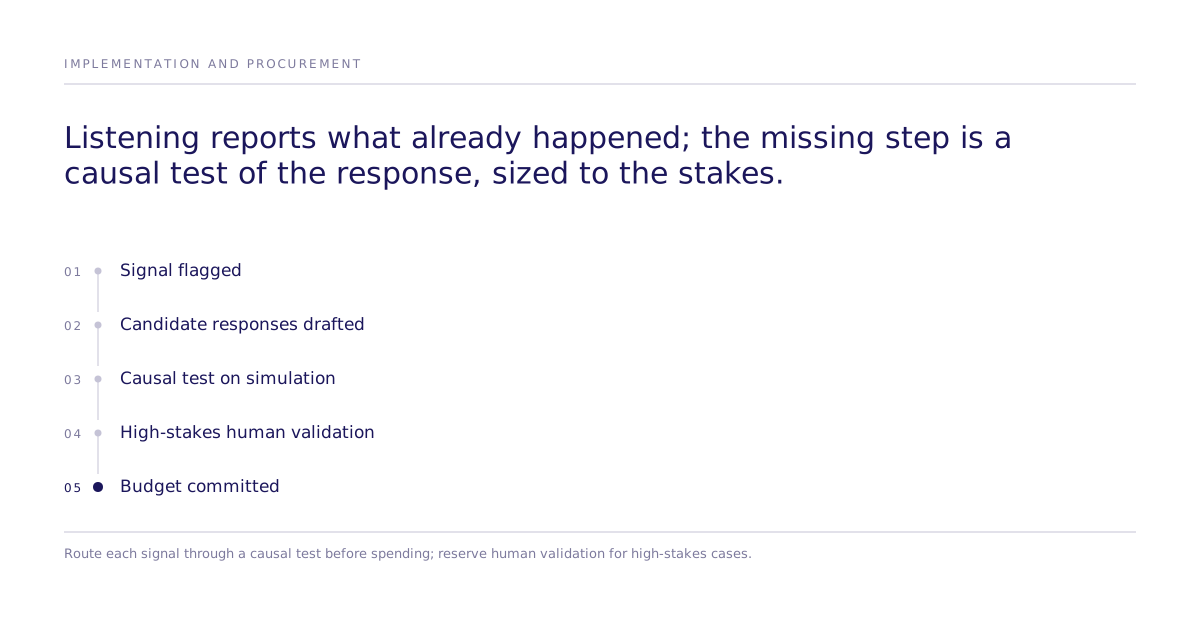
The practical sequence: let listening tools flag the signal, draft two or three candidate responses, test them against a defined segment before committing budget, and reserve recruited human validation for the decisions where getting the exact number right matters more than getting an answer quickly. Teams can see the underlying causal method, review how the testing process works, or look at applied examples before scoping a test against a live signal.